

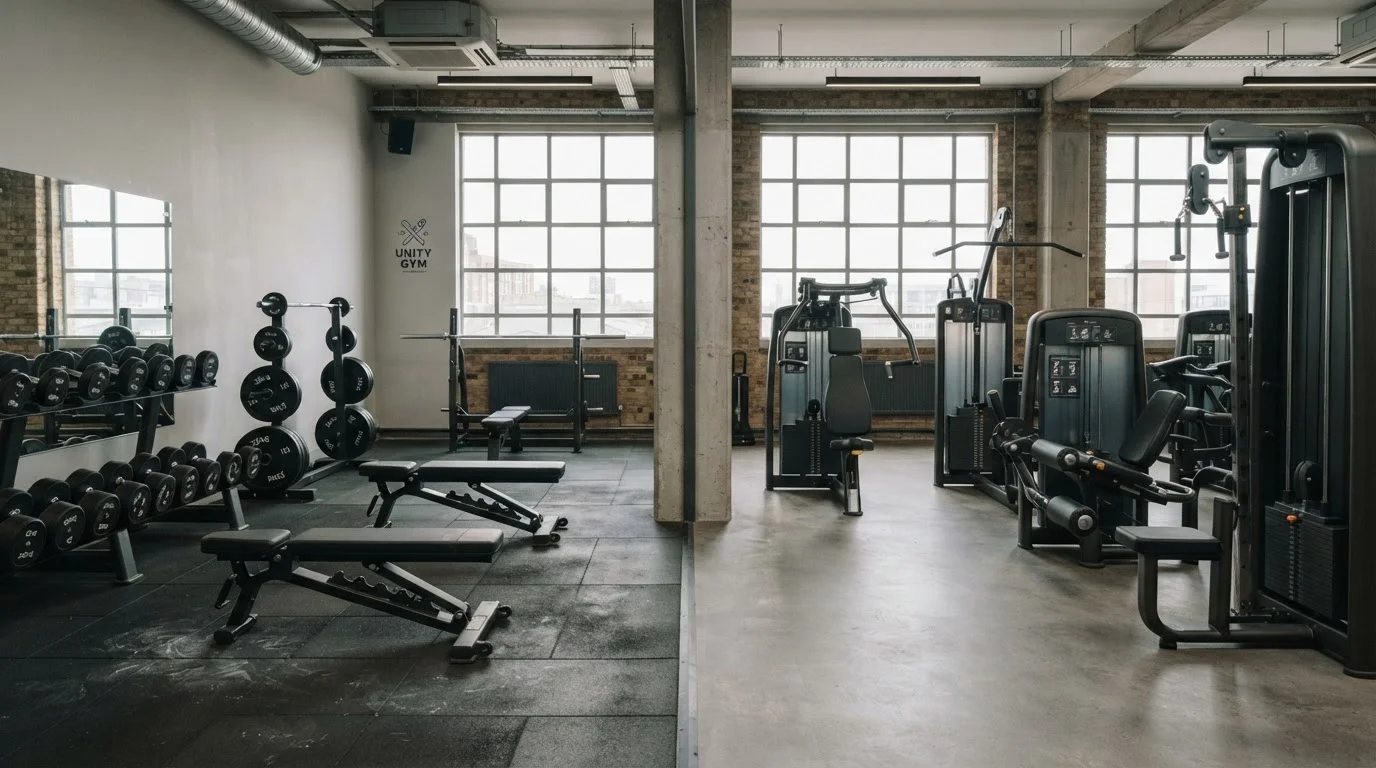
Option A
Free Weights
The versatile, functional strength-building classic.
Best for: Lifters seeking functional strength, multi-muscle coordination, and versatile programming across all experience levels.
Option B
Resistance Machines
The structured, accessible option for targeted training.
Best for: Beginners, those returning from injury, or anyone wanting to isolate specific muscles with guided movement paths.
How Each Approach Works
Free weights - including dumbbells, barbells, and kettlebells - require the user to control movement through all three planes of motion. This demands constant engagement from stabiliser muscles alongside the primary movers. Resistance machines, by contrast, guide motion along a fixed axis or cable track, reducing the stabilisation demand and allowing the target muscle to be loaded more directly.
This mechanical difference is the root of most practical distinctions between the two. It's not that one is inherently harder or more effective; they simply train the body in different ways. As noted in exercise science research, both modalities produce significant strength and hypertrophy gains when programmed with adequate volume and progressive overload - but the quality and type of adaptation can differ. To understand how strength training compares with other exercise forms at a physiological level, see our overview of cardio versus strength training.
| Criterion | Free Weights | Resistance Machines |
|---|---|---|
| Stabiliser muscle demand | High - requires active balance and control | Low - movement path is guided |
| Technique learning curve | Steeper - instruction recommended | Gentler - easier to start independently |
| Injury risk (beginner) | Moderate if form is poor | Lower due to fixed movement path |
| Muscle isolation | Less targeted; involves multiple muscles | High - isolates specific muscles effectively |
| Functional strength carry-over | Strong - mimics real-world movement | More limited in daily-life transfer |
| Versatility per piece of equipment | High - many exercises per item | Lower - typically one movement per machine |
| Suitability for home use | Good - compact options available | Poor - large, expensive, fixed |
| Rehabilitation context | Requires careful programming | Often preferred for controlled loading |
Muscle Activation and Functional Carry-Over
Studies using electromyography (EMG) - a technique that measures electrical activity in muscles - generally show that free-weight exercises recruit a broader network of muscles compared to their machine counterparts. A barbell squat, for instance, activates the core, hip stabilisers, and lower back in addition to the quads and glutes. A leg press machine loads similar primary muscles but largely removes that stabilisation requirement.
This difference matters for functional strength - the ability to apply force during everyday tasks like carrying groceries, climbing stairs, or recovering your balance. Free weights tend to develop this carry-over more efficiently because the motor patterns are less constrained. That said, functional benefit is not the goal of every training session, and machine isolation work has a legitimate role in building muscle volume in specific areas, particularly when a lifter's stabilisers are fatigued or recovering.
~Equal
Hypertrophy gains over matched training periods
A 2020 meta-analysis in the Journal of Strength and Conditioning Research found no statistically significant difference in muscle growth between free-weight and machine exercises when volume and effort were equated.
Up to 30%
Greater core activation with free weights
EMG studies comparing free-weight squats to leg-press machines have documented meaningfully higher core and stabiliser muscle activity during free-weight movements, though results vary by exercise and individual.
It's also worth separating fact from fitness folklore. Many people assume machines are ineffective or that free weights are always superior - neither is accurate. For a broader look at common training misconceptions, our article on fitness myths and what the research actually shows offers useful grounding.
Safety, Accessibility, and Special Considerations
Resistance machines are often recommended for beginners precisely because they reduce the risk of technique breakdown under load. A guided movement path makes it harder to place joints in vulnerable positions, which lowers the learning curve and the likelihood of acute strain. For older adults or individuals managing joint conditions, machines can also allow continued strength training with more controlled stress on the body - though any exercise programme change should be discussed with a qualified healthcare or fitness professional first.
Free weights carry a higher technique demand, especially in compound lifts like deadlifts or overhead presses. Poor form under heavy load is a genuine injury risk. However, this is largely addressable through proper instruction, appropriate starting weights, and gradual progression. Those interested in joint-friendly movement generally may also find value in our rundown of low-impact exercise options.
Special Populations: Get Professional Guidance First
Older adults, people managing chronic conditions, those post-surgery, and anyone new to exercise after a long break should consult a healthcare provider or certified exercise professional before choosing a modality or programme. General guidance in this article is not a substitute for personalised assessment. What is appropriate varies significantly based on individual health status and medical history.
One practical consideration: free weights require either a home investment or gym access, but are generally more space- and cost-efficient per exercise than machines. Machines offer consistency and convenience in a gym setting but are rarely feasible for home use. Recovery and training frequency are also worth considering - the trade-offs of working out every day are relevant regardless of which modality you choose.
This article is for general informational purposes only and does not constitute medical or fitness advice. Consult a qualified healthcare provider or certified fitness professional before beginning or modifying any exercise programme.
The content on this site is for informational purposes only and is not a substitute for professional advice. Always consult a qualified professional for guidance specific to your situation.