

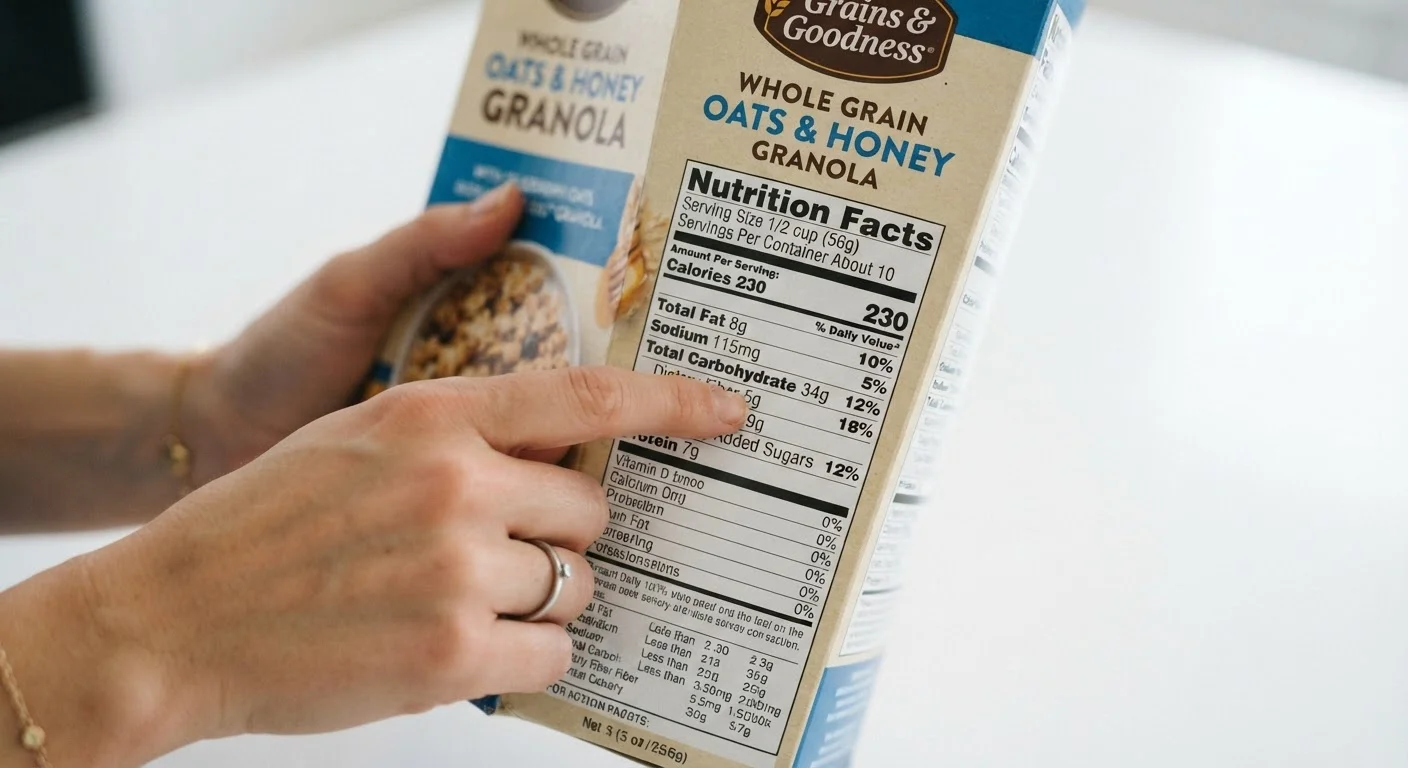
Start Here: Serving Size and Servings Per Container
The first thing to read on any Nutrition Facts panel is the serving size - not the calories. Every single number that follows is calculated based on that stated serving amount. If a bag of chips lists a serving size of 1 oz (about 28 grams) but you regularly eat 3 oz in one sitting, every nutrient figure needs to be tripled to reflect what you actually consumed.
Servings per container tells you how many of those reference servings are in the entire package. A bottle labeled with two servings contains twice the calories and nutrients listed on the panel. The FDA updated its rules so serving sizes now reflect amounts people realistically eat rather than idealized small portions, making the numbers more practical than they once were.
Always Scale Up for Realistic Portions
Before reading any other number, divide the total package size by the stated serving size. If you routinely eat the whole package, multiply every nutrient figure by the number of servings. This single habit gives you accurate data rather than a misleading undercount.
Calories: A Measure of Energy, Not Quality
Calories measure the energy a food provides. They matter for overall energy balance, but the calorie count alone says nothing about nutrient density - a 200-calorie handful of almonds delivers very different nutrition than a 200-calorie serving of a sugar-sweetened snack cake.
Use the calorie figure as one data point among many rather than the sole criterion for judging a food. Context - the full nutrient profile, the ingredients, and your overall dietary pattern - gives a far clearer picture. For a deeper look at why single-nutrient thinking has limits, see our piece on why dietary advice seems to keep changing.
90%
Americans who exceed daily sodium recommendations
According to CDC data, roughly 9 in 10 Americans consume more sodium than the 2,300 mg per day guideline - making the sodium line on the Nutrition Facts panel especially relevant.
~7%
Of adults who correctly interpret % Daily Value
Research published in nutrition education literature has found that a small minority of consumers accurately understand what % Daily Value represents without instruction, underscoring the need for clearer label literacy.
2,000
Calorie baseline for all % Daily Value calculations
The FDA uses a 2,000-calorie reference diet as the standard benchmark for computing % DV figures, though individual calorie needs vary widely by age, sex, activity level, and health status.
Nutrients to Limit and Nutrients to Prioritize
The label separates nutrients into two informal groups. Nutrients most Americans consume in excess - saturated fat, trans fat, sodium, and added sugars - are listed prominently because over-consumption is linked to increased risk of heart disease, hypertension, and other chronic conditions. Trans fat has no safe level of intake; most manufacturers have removed it, but checking is still worthwhile.
Nutrients many Americans under-consume - dietary fiber, vitamin D, calcium, iron, and potassium - appear lower on the panel. Adequate intake of these is associated with reduced risk of osteoporosis, anemia, and cardiovascular disease. The % Daily Value column is your quick reference: aim to keep the first group low and nudge the second group higher across your day.
For the full story behind ingredient listings that accompany these nutrients, our guide to reading ingredient lists explains how order and naming conventions work on packaged foods.
Trans Fat: A Note on Zero-Gram Claims
FDA regulations allow manufacturers to list trans fat as 0g if a product contains less than 0.5g per serving. If you eat multiple servings, small amounts can accumulate. Scanning the ingredient list for "partially hydrogenated oil" is the most reliable way to detect whether trace trans fat is present.
Understanding % Daily Value - and Its Limits
The % Daily Value column is the label's most underused tool. It answers the question: Is this food high or low in this nutrient? The FDA's rule of thumb is simple - 5% DV or less is low, and 20% DV or more is high. That applies whether you are trying to get more of something (like fiber) or less of something (like sodium).
One important caveat: % DV is calculated against a 2,000-calorie reference diet. If your actual calorie needs differ substantially - which they do for children, older adults, pregnant individuals, and those with certain health conditions - the percentages will not map perfectly to your situation. The label is a directional guide, not a personalized prescription. Always consult a qualified healthcare professional or registered dietitian for guidance tailored to your specific health needs.
“The Nutrition Facts label is one of the most democratic tools in public health - it puts the same information in front of every shopper, regardless of background, if they know how to use it.”
— Walter Willett, Professor of Epidemiology and Nutrition, Harvard T.H. Chan School of Public Health
This article is for general informational purposes only and does not constitute medical or dietary advice. Consult a qualified healthcare professional or registered dietitian for guidance specific to your health situation.
Frequently Asked Questions
% Daily Value tells you how much of a nutrient one serving provides relative to the recommended daily intake for a 2,000-calorie diet. It helps you gauge whether a food is high or low in a given nutrient without doing math. A % DV of 5% or less is considered low; 20% or more is considered high.
Not necessarily. The serving size reflects the amount people typically consume in one sitting, based on FDA reference data - it is not a dietary recommendation. All nutrient values on the label correspond to that stated serving size, so if you eat more or less, you should adjust accordingly.
Total Sugars includes all sugars naturally present in the food (such as lactose in dairy or fructose in fruit) plus any sugars added during processing. Added Sugars is the sub-category that shows only sugars introduced during manufacturing. Health guidelines generally focus on limiting added sugars rather than naturally occurring ones.
Rounding rules allowed by the FDA can cause small discrepancies when you manually multiply macronutrients by their calorie-per-gram values. Fat provides roughly 9 calories per gram, while carbohydrates and protein each provide roughly 4 - but manufacturers apply specific rounding thresholds, so the totals may differ slightly.
Most packaged foods regulated by the FDA are required to carry a Nutrition Facts label. Notable exceptions include raw produce, raw meat and poultry (regulated by the USDA), foods produced by very small businesses meeting certain sales thresholds, and restaurant menu items, though some local regulations require calorie disclosure for chain restaurants.
The content on this site is for informational purposes only and is not a substitute for professional advice. Always consult a qualified professional for guidance specific to your situation.