

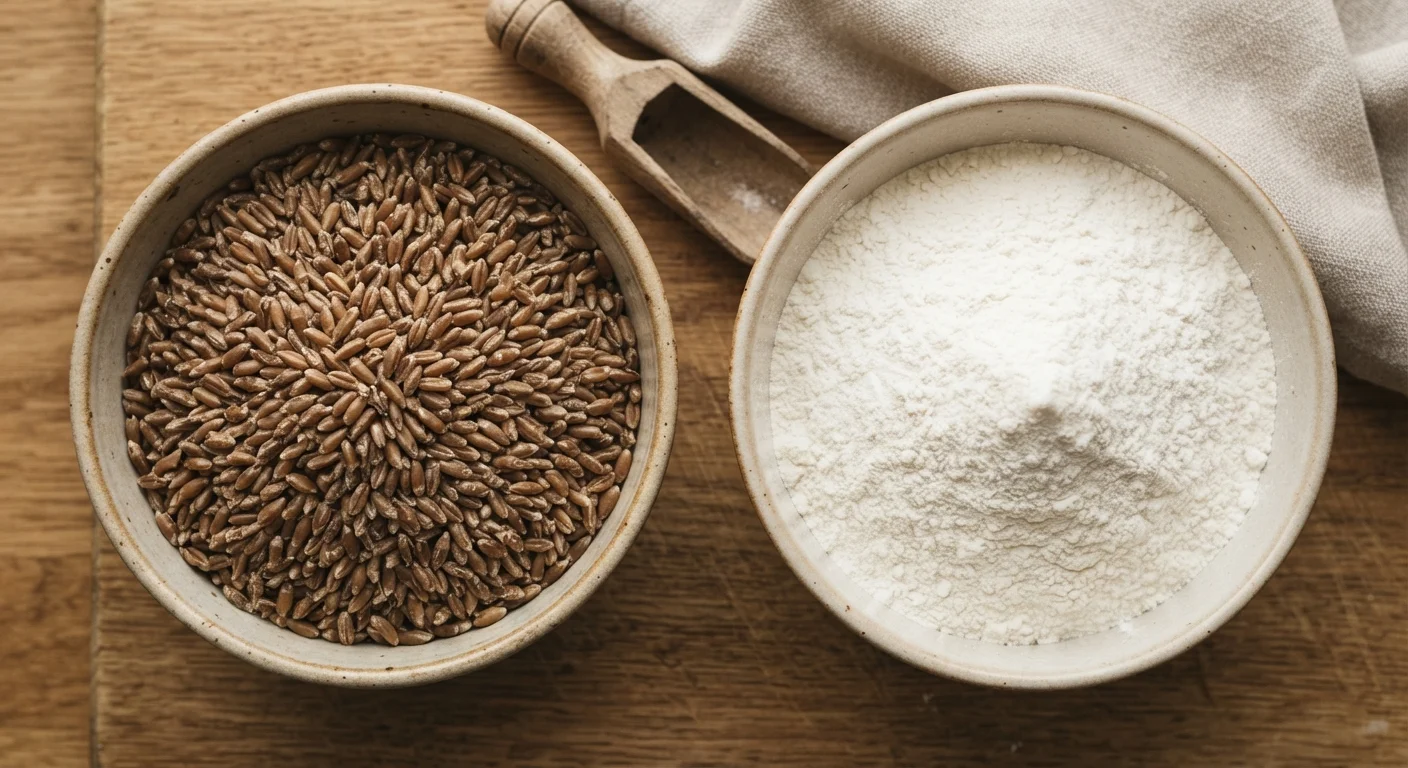
Option A
Whole Grains
The nutritionally complete, minimally processed option.
Best for: People seeking more fiber, sustained energy, and a broader nutrient profile from everyday staple foods.
Option B
Refined Grains
The convenient, longer-shelf-life alternative with partial nutrient restoration.
Best for: Situations where texture, palatability, or shelf life is a priority and nutrient gaps are addressed elsewhere in the diet.
What Happens Inside the Mill
A grain kernel is composed of three distinct parts: the bran (the fibrous outer layer), the germ (the nutrient-dense embryo), and the endosperm (the starchy interior). Whole grains, by definition, retain all three parts in their original proportions - whether the grain is ground into flour, rolled into flakes, or left intact.
Refining strips away the bran and germ, leaving primarily the starchy endosperm. This dramatically changes the nutritional profile. The bran supplies the majority of the kernel's dietary fiber and houses much of its B vitamins - particularly thiamine, niacin, riboflavin, and folate - along with minerals like magnesium and zinc. The germ contributes vitamin E, healthy unsaturated fats, additional B vitamins, and a range of antioxidants and phytochemicals. When both layers are removed, most of those compounds go with them.
The process is efficient and intentional: removing the oil-rich germ extends shelf life by preventing rancidity, while the lighter endosperm produces the soft, fine-textured flour that many baking applications require.
| Criterion | Whole Grains | Refined Grains |
|---|---|---|
| Kernel parts retained | Bran, germ, endosperm | Endosperm only |
| Dietary fiber | High (bran intact) | Very low (bran removed) |
| B vitamins | Naturally present | Partially added via enrichment |
| Vitamin E | Present (from germ) | Largely absent |
| Phytochemicals | Broad spectrum retained | Mostly removed, not restored |
| Glycemic response | Generally lower and slower | Generally higher and faster |
| Shelf life | Shorter (germ oils present) | Longer (germ removed) |
| Texture | Denser, heartier | Lighter, finer |
What Enrichment Does - and Doesn't - Restore
Since the mid-twentieth century, U.S. regulations have required that refined grain products labeled as "enriched" add back specific nutrients lost during milling. Enriched flour and products made from it typically contain added thiamine, riboflavin, niacin, folic acid, and iron.
This policy has had meaningful public health impact - mandatory folic acid fortification of enriched grain products, introduced in the late 1990s, is associated with a significant reduction in neural tube birth defects. However, enrichment is not equivalent to restoration. Fiber is not added back. Neither are vitamin E, magnesium, zinc, potassium, or the dozens of phytochemicals - including lignans and phenolic acids - that are naturally concentrated in the bran and germ. Enrichment replenishes a narrow slice of what refining removes.
25%
Share of Americans meeting whole grain recommendations
Data from the Dietary Guidelines Advisory Committee reports that only about one in four Americans consumes the recommended amount of whole grains daily.
~3g vs. ~0.5g
Fiber per slice: whole wheat vs. white bread
A typical slice of 100% whole wheat bread contains roughly 2-3 grams of fiber, while an equivalent slice of enriched white bread averages around 0.5 grams.
20-30%
Reduction in neural tube defect risk linked to folic acid fortification
The CDC has associated mandatory folic acid enrichment of grain products in the U.S., introduced in 1998, with significant declines in neural tube birth defects.
Understanding this distinction matters when evaluating food labels. An enriched white bread and a whole wheat bread may show similar B-vitamin counts on the label, but their fiber and phytochemical profiles remain substantially different. This is also why nutrition science draws a parallel distinction between intrinsic and added nutrients - similar in concept to how natural versus added sugars differ beyond their basic chemical makeup.
Blood Sugar, Satiety, and the Role of Fiber
One of the most practical differences between whole and refined grains is how the body processes them. The glycemic index (GI) - a measure of how quickly a carbohydrate-containing food raises blood glucose - tends to be higher for refined grain products. Without the fiber matrix of the bran, starch in refined grains is digested and absorbed more rapidly, producing a faster and often larger spike in blood glucose followed by a quicker decline.
Whole grains slow this process in two ways. First, soluble fiber forms a gel-like substance in the gut that slows starch digestion. Second, intact or coarsely ground grain particles require more digestive work than finely milled flour, regardless of fiber content. Research published in journals including the American Journal of Clinical Nutrition has consistently linked higher whole-grain intake with lower glycemic response, improved satiety, and reduced long-term risk of type 2 diabetes - though individual responses vary and this is population-level evidence, not a guarantee for any individual.
The fiber difference also affects satiety. Fiber adds bulk, delays gastric emptying, and interacts with gut hormones that signal fullness. Gram for gram, whole grain products tend to be more filling than their refined counterparts, which can influence how much a person eats overall.
This article is intended for general informational and educational purposes only. It is not a substitute for personalized medical or dietary advice. Consult a qualified healthcare provider or registered dietitian for guidance specific to your health needs and circumstances.
The content on this site is for informational purposes only and is not a substitute for professional advice. Always consult a qualified professional for guidance specific to your situation.