

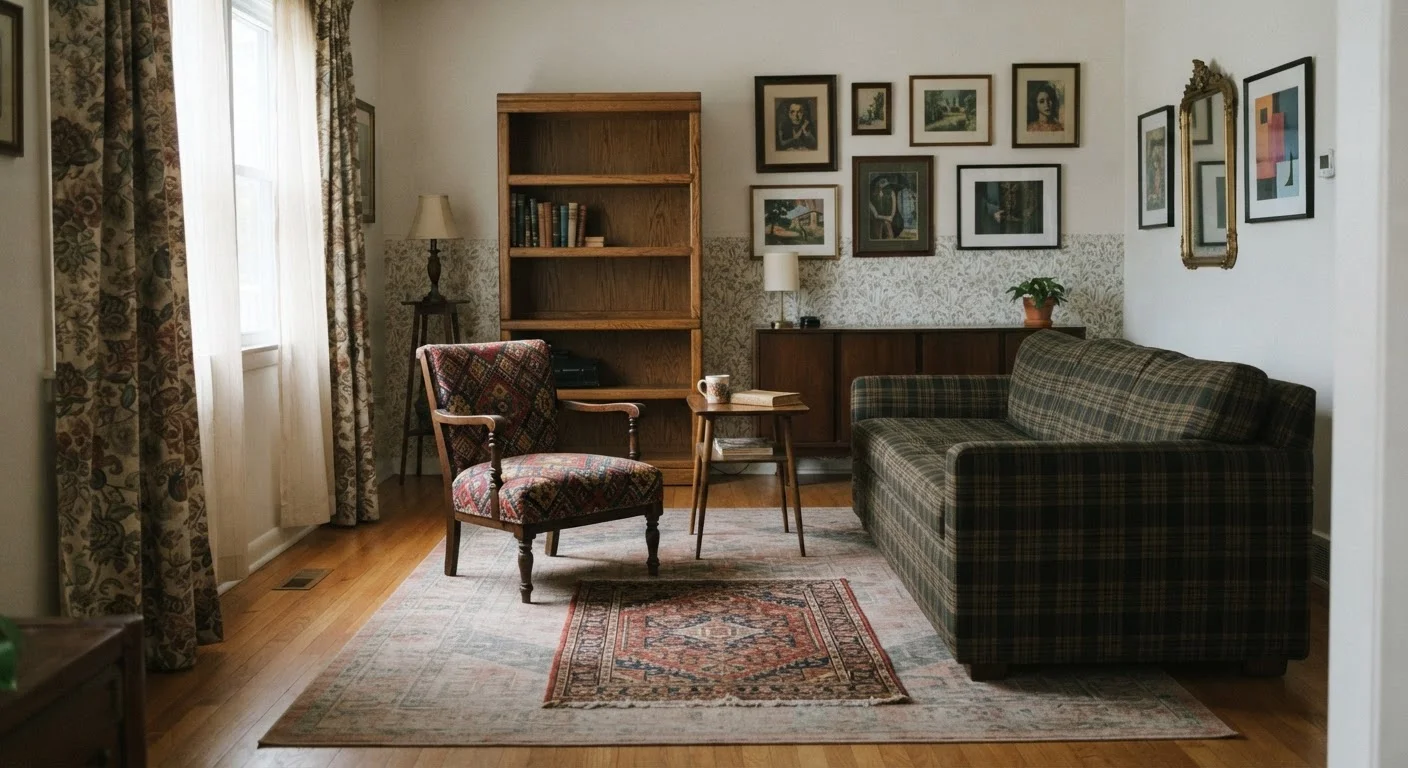
The Gap Between 'Clean' and 'Calm'
You've picked everything up off the floor, wiped the counters, and returned every item to its shelf. By any practical measure, the room is clean. Yet you walk in, look around, and feel a familiar low-grade tension - like there's still something wrong that you can't name.
This experience is extremely common, and it has a straightforward explanation: physical cleanliness and perceptual calm are not the same thing. A room's tidiness is measured by the absence of misplaced objects. A room's calmness is measured by how much cognitive effort your brain expends just by looking at it. Those two metrics can diverge significantly.
The distinction matters because most home organization advice focuses entirely on the first - where things go and how to put them away. Far less attention is paid to what remains visible once everything is stored, and how that visual field affects your mood and mental energy throughout the day. For more on how your environment connects to everyday stress, the Mental Wellbeing hub covers strategies for managing stress in home and daily contexts.
How Your Brain Reads a Room
Every time you enter a space, your brain performs a rapid, largely unconscious scan of the environment. It catalogs objects, assesses contrasts, tracks patterns, and registers anything that seems unresolved or incomplete. This process is automatic and continuous - you cannot turn it off.
The practical consequence is that every visible object costs a small amount of mental processing power, regardless of whether it's in its correct place. A bookshelf lined with 60 books of varying heights, colors, and orientations demands more cognitive effort than one with 30 books organized by color or spine height - even if both shelves are equally tidy.
~900ms
Time for the brain to process a complex visual scene
Research in cognitive psychology indicates that visual scene processing - including object recognition and spatial mapping - occurs within the first second of viewing an environment, happening largely below conscious awareness.
62%
Adults reporting home environment affects stress levels
A survey by a national home organization association found that a majority of American adults said the state of their home environment directly influenced how stressed or calm they felt on a daily basis.
This is why interior designers often talk about 'visual stopping points' - the number of places where your eye lands and has to make a decision before moving on. A room with 40 stopping points feels busy. A room with 12 feels restful. The objects don't need to be misplaced to create the difference; they simply need to be numerous, competing, or inconsistent enough to keep your brain working.
The Four Main Causes of Visual Chaos in Tidy Rooms
Understanding what creates visual clutter makes it possible to address it deliberately. Four factors account for most cases:
- Object density: The sheer number of items visible in a room, regardless of their arrangement. Even organized objects, when numerous enough, create visual noise. This is especially common on open shelving, windowsills, and mantels.
- Scale inconsistency: When objects of dramatically different sizes share the same surface or wall without intentional grouping, the eye struggles to find a hierarchy. A tiny picture frame next to a large lamp next to a medium plant sends three competing signals at once.
- Color and pattern competition: Multiple strong colors or clashing patterns - in throw pillows, rugs, curtains, and decor - create high contrast that the visual system registers as stimulating. This is particularly pronounced when patterns differ in scale (a large floral next to a small geometric, for example).
- Unresolved visual anchors: Cords left visible, a piece of art hung slightly off-center, mismatched hardware on cabinets - individually minor, but cumulatively they create a background sense that things are slightly 'off.'
Try the 'Photo Test' on Each Room
Take a photo of your room on your phone and look at the image rather than the room itself. Photos flatten depth and remove familiarity bias, making visual clutter far easier to spot. You'll often notice immediately where there are too many stopping points, competing patterns, or unresolved elements that you'd stopped seeing in person.
The Room-by-Room Organization Checklist is a useful companion for auditing each space in your home with fresh eyes for exactly these factors.
Practical Steps Toward a Calmer Space
Addressing visual clutter is a process of editing rather than cleaning. Here's where to start:
- Take everything off one surface at a time and replace only what genuinely needs to be there. Most surfaces benefit from holding no more than two to three intentional objects.
- Limit your visible color palette. Aim for two dominant tones and one or two accents in any single room. This doesn't require repainting - swapping or removing textiles often has a significant effect.
- Group by scale and material. When arranging objects on a shelf or table, group similar-height items together and mix textures (smooth, matte, natural) rather than colors. This creates cohesion without monotony.
- Conceal cords and cables. Even in an otherwise calm room, visible cable runs register as visual disorder. Cable management solutions - clips, raceways, or simple cord ties - cost very little and have a disproportionately large perceptual impact.
- Audit lighting. Walk through your room at the time of day you use it most and note any harsh shadows or unlit corners that make the space feel fragmented.
To make sure these improvements last, habits like the one-in-one-out rule help prevent new objects from gradually rebuilding the visual noise you've worked to reduce.
Frequently Asked Questions
A clean room can feel messy because of visual clutter - the number of objects, patterns, and colors competing for your attention. Your brain processes each visible item as information, and too much visual input creates a sense of disorder even when nothing is technically out of place.
Physical clutter refers to items that are misplaced, piled up, or without a designated home. Visual clutter refers to the perceptual experience of a busy, overwhelming space - which can exist even in a well-organized room with many decorative items, competing patterns, or inconsistent scale.
There is no universal number, but design practitioners often suggest limiting visible decor groupings to odd numbers of three to five items and leaving intentional empty space on surfaces. If your eye has nowhere to rest when you scan the room, you likely have too many stopping points.
Yes. High-contrast color combinations and many competing hues increase visual stimulation, which the brain registers as busyness. A limited palette of two to three coordinating tones - even in a furnished room - generally produces a calmer perception.
Absolutely. Uneven lighting creates pockets of shadow and highlight that draw the eye unpredictably, amplifying visual busyness. Layered, consistent lighting helps unify a space and reduces the brain's effort to make sense of what it sees.
Research in environmental psychology suggests that chronically overstimulating home environments can contribute to elevated stress and difficulty concentrating. While a busy room is not a clinical diagnosis, reducing visual load in your living space can support a greater sense of calm and focus. If feelings of overwhelm persist, consulting a mental health professional is worthwhile.
The content on this site is for informational purposes only and is not a substitute for professional advice. Always consult a qualified professional for guidance specific to your situation.