

What Network Tiers Are and Why They Exist
Health insurance networks exist because insurers negotiate contracts with providers - hospitals, physicians, labs, and other facilities - agreeing on set rates for covered services. These rates, called allowed amounts or contracted rates, are typically lower than the provider's standard "list price." In exchange for the discount, the provider gains access to the insurer's pool of members.
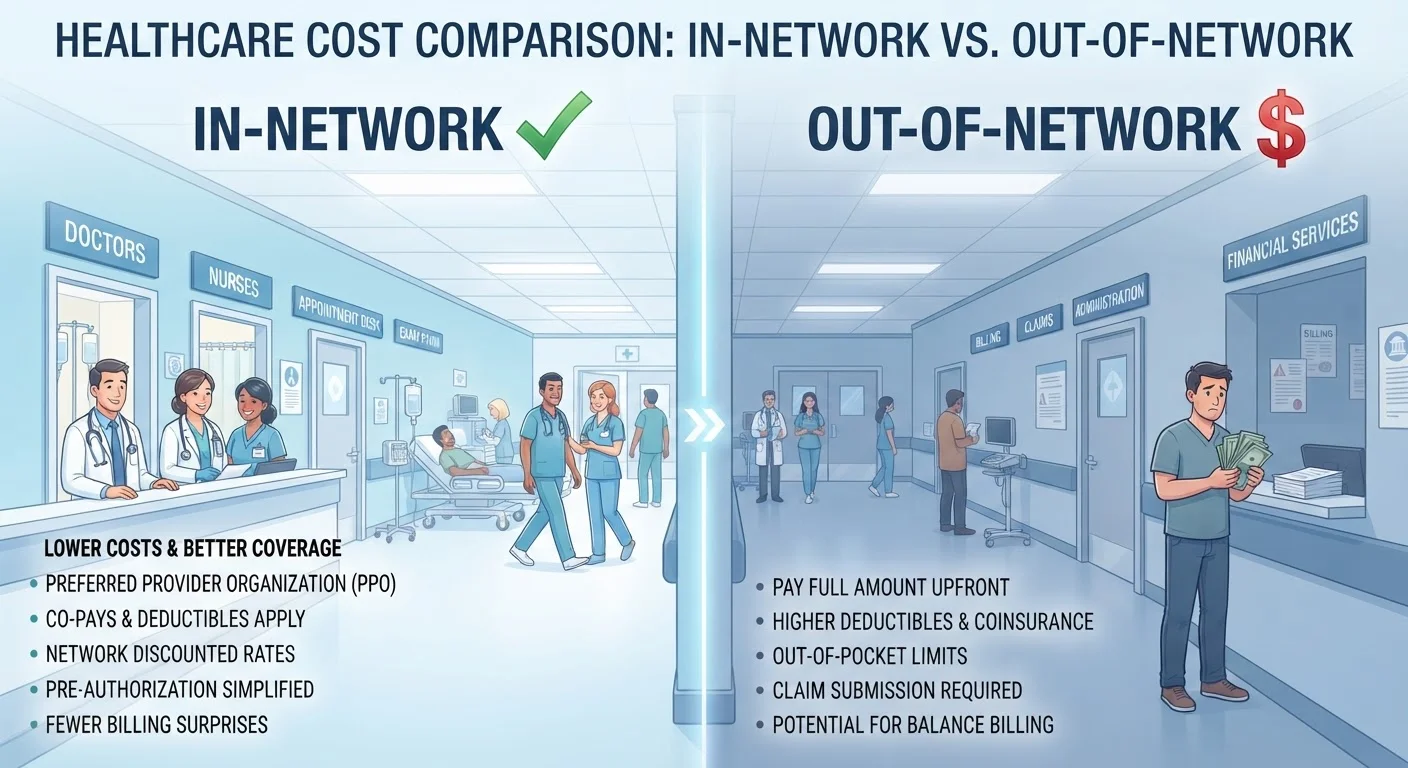
When you use an in-network provider, your insurer applies this negotiated rate. Your cost-sharing - deductible, copay, or coinsurance - is calculated based on that lower figure. When you use an out-of-network provider, no contracted rate exists, and the financial math changes dramatically.
The structure of your plan determines how much exposure you have. HMO and PPO plans handle networks very differently - HMOs generally restrict coverage to in-network providers, while PPOs allow out-of-network use at a higher cost.
How Out-of-Network Billing Actually Works
When you visit an out-of-network provider, the billing process involves several layers that can create confusion and unexpected costs:
- The provider bills a "chargemaster" rate - typically the provider's standard, undiscounted price.
- Your insurer calculates an allowed amount - often based on a "usual, customary, and reasonable" (UCR) standard for your region, which may be well below the billed amount.
- Your plan pays its share of the allowed amount - typically a smaller percentage than it would for in-network care, or nothing at all on some plan types.
- You pay your share of the allowed amount - plus potentially the gap between the allowed amount and what the provider actually charged. This gap is called a balance bill.
Balance billing is one of the most significant risks in out-of-network care. The provider is not obligated to accept your insurer's allowed amount and can legally pursue you for the difference - unless federal or state protections apply.
1 in 5
Emergency visits include an out-of-network charge
According to research published in JAMA, approximately one in five emergency room visits resulted in at least one out-of-network charge, even when the facility itself was in-network.
~$750
Median surprise out-of-network bill amount
A study by the Peterson-Kaiser Health System Tracker estimated the median surprise out-of-network bill sent to patients was approximately $750, though amounts varied widely by specialty and region.
Your Explanation of Benefits (EOB) statement will show the billed amount, the allowed amount, what your plan paid, and what you owe. Reviewing it carefully can help you spot errors and understand exactly where each charge originated.
The No Surprises Act: Federal Protections to Know
A common source of unexpected out-of-network bills is receiving care at an in-network facility but from a provider who is not in your network - for example, an out-of-network radiologist reading a scan done at your in-network hospital. The No Surprises Act, which took effect January 1, 2022, provides federal protections against this specific scenario.
Under the law, for emergency services and for certain non-emergency services at in-network facilities, patients cannot be billed more than their in-network cost-sharing amount. The provider and insurer must resolve any payment dispute between themselves. This protection applies to most private health plans, though there are some exceptions - particularly for ground ambulance services.
No Surprises Act Has Limits
The No Surprises Act covers most private plans for emergency services and certain non-emergency services at in-network facilities, but it does not apply to all situations. Ground ambulance services, for example, are not currently covered by the federal law. Some states have stronger protections - check your state insurance department's website or speak with a licensed insurance professional to understand what applies to your plan.
It's worth noting that state laws may offer additional protections beyond the federal baseline. Checking with your state insurance commissioner's office can clarify what applies in your situation.
Practical Steps to Protect Yourself
Understanding the billing system is useful; taking action before you receive care is even more valuable.
- Verify network status before every visit. Provider directories can lag behind reality - always call the provider's office and ask them to confirm they participate with your specific plan.
- Ask about every provider at a facility. If you're having surgery, ask whether the surgeon, anesthesiologist, and assistants are all in-network. A single out-of-network clinician can generate a large bill.
- Request an estimate for planned procedures. Many providers are now required to provide good-faith cost estimates for scheduled services.
- Understand your plan's out-of-network benefits. Some PPO plans do have out-of-network coverage - but with a separate, higher deductible and a lower reimbursement percentage. Review your Summary of Benefits and Coverage (SBC) document.
- Appeal unexpected bills. If you receive an out-of-network bill you believe should be covered, you have the right to appeal with your insurer and, in some cases, pursue an external review.
Always Ask About Every Provider on Your Care Team
Before any scheduled procedure, ask the facility to identify every clinician who will be involved - surgeons, anesthesiologists, assistants, and radiologists - and verify that each one is in your network. A single out-of-network provider in an otherwise in-network setting can generate a separate, unexpected bill. Get this information in writing when possible.
Avoiding billing surprises is also part of broader financial planning. See how network costs connect to your overall healthcare spending in our guide to deductibles, premiums, copays, and out-of-pocket maximums.
This article provides general information about health insurance billing concepts and is not personalized financial, insurance, or legal advice. Coverage terms, costs, and protections vary by plan, provider, and state. Consult a licensed insurance professional or your plan documents for guidance specific to your situation.
Frequently Asked Questions
An out-of-network provider has no contracted agreement with your insurance plan. This means your insurer hasn't pre-negotiated rates with them, so you may pay significantly more - or your plan may not cover the visit at all, depending on your policy type.
Yes, this is called balance billing. If an out-of-network provider charges $500 but your insurer's allowed amount is $300, the provider can bill you for the remaining $200 in addition to your normal cost-sharing. The federal No Surprises Act limits this practice in emergency and certain other situations.
Many plans have separate - and higher - out-of-pocket maximums for out-of-network care, or they may not count out-of-network spending toward your in-network maximum at all. Review your Summary of Benefits and Coverage (SBC) to understand how your plan handles this.
Check your insurer's online provider directory and call your doctor's office to confirm. Network participation can change, so verifying before each plan year or before a new procedure is advisable.
The No Surprises Act is a federal law that took effect in 2022. It protects patients from unexpected out-of-network bills in emergencies and for certain non-emergency services at in-network facilities - such as when an out-of-network anesthesiologist assists during an in-network surgery.
Generally, HMO plans do not cover out-of-network care except in emergencies. If you see an out-of-network provider without prior authorization in an HMO plan, you will likely be responsible for the full cost.
The content on this site is for informational purposes only and is not a substitute for professional advice. Always consult a qualified professional for guidance specific to your situation.