

Our Verdict
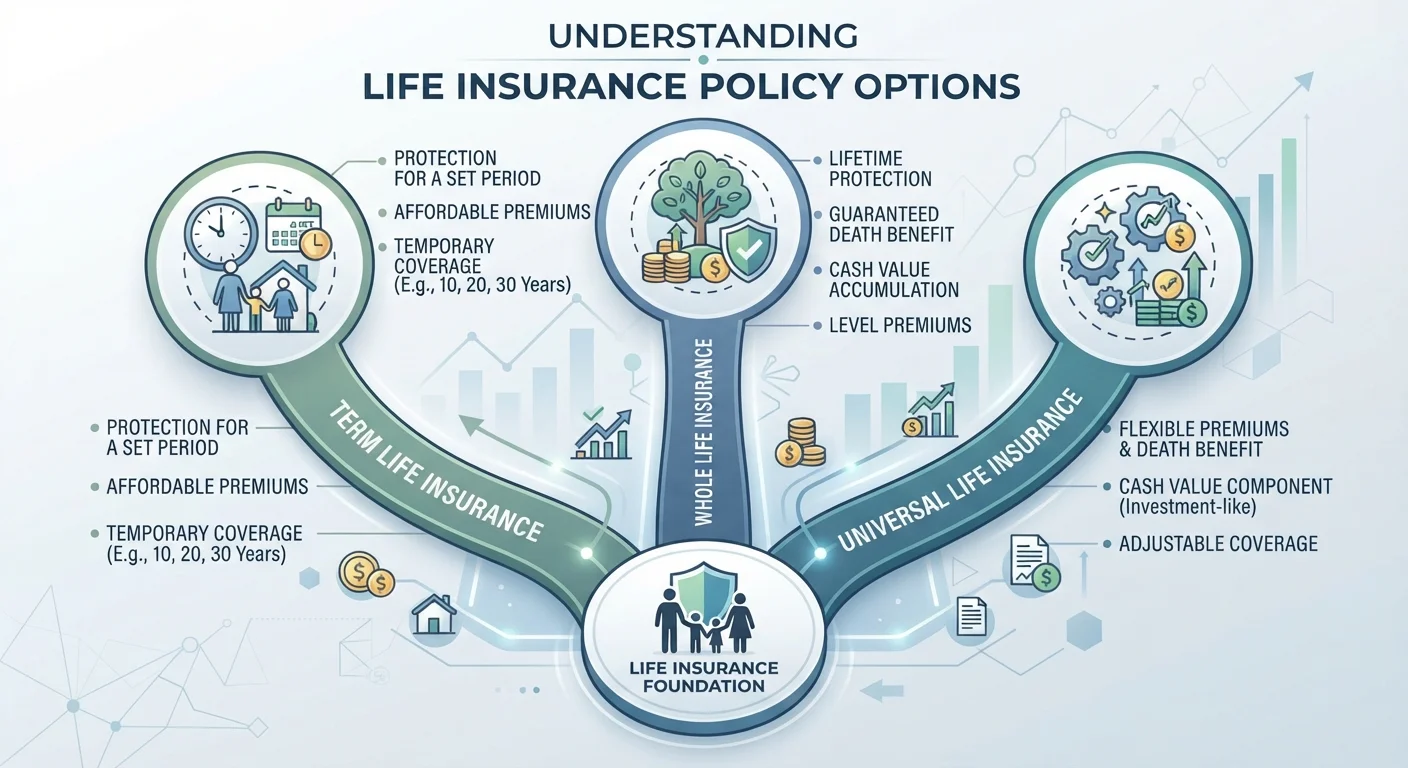
Whole, universal, and variable life insurance all deliver lifelong coverage, but they serve meaningfully different planning needs. Whole life prioritizes predictability; universal life adds premium flexibility; variable life introduces investment-linked growth with commensurate risk. No single type is universally superior - the right fit depends on individual circumstances.
| Best for | Recommended |
|---|---|
| Those who value guaranteed, predictable costs and growth | Whole Life |
| Those who want lifelong coverage with payment scheduling flexibility | Universal Life |
| Those comfortable with market risk in exchange for higher growth potential | Variable Life |
| Those new to permanent insurance who want to understand the basics first | Whole Life as a starting reference point |
What Permanent Life Insurance Means
Unlike term coverage, which expires after a set period, permanent life insurance is designed to remain in force for the policyholder's entire life - provided premiums are paid. If you're new to these concepts, the complete overview for first-time buyers covers the foundational landscape before diving into policy types.
All permanent policies share two core features: a death benefit paid to beneficiaries upon the insured's death, and a cash value component that accumulates over the life of the policy. However, the mechanics of how premiums are structured, how cash value grows, and how much control the policyholder has differ substantially across the three main types: whole life, universal life, and variable life.
For a plain-language explanation of the terms used throughout this article, see the life insurance glossary.
Whole Life: Stability and Guarantees
Whole life is the most straightforward permanent policy. Premiums are fixed at the time of issue and do not change over the life of the policy. The death benefit is also guaranteed, and the cash value grows at a rate specified in the contract - typically a modest, insurer-guaranteed rate unaffected by market conditions.
This predictability is whole life's primary appeal. Policyholders know exactly what they owe each month and can count on a defined accumulation trajectory. Some whole life policies issued by mutual insurers may also pay dividends - non-guaranteed distributions that can be taken as cash, used to reduce premiums, or applied to purchase additional coverage. Dividends are not guaranteed and should not be treated as a reliable return.
The trade-off is cost. Whole life premiums are generally higher than those of comparable term policies, and the guaranteed cash value growth tends to be conservative relative to market-based alternatives.
Whole Life as a Baseline for Comparison
When evaluating permanent policies, many financial educators suggest understanding whole life first, since its mechanics are the most straightforward. Once you understand how fixed premiums, guaranteed cash value, and a set death benefit work together, the trade-offs introduced by universal and variable structures become easier to assess. Use whole life as your conceptual starting point, not necessarily your final answer.
Universal Life: Flexibility in Exchange for Complexity
Universal life (UL) was designed to offer permanent coverage with more adaptability than whole life. Its defining feature is adjustable premiums: within limits set by the insurer, policyholders can vary how much they pay from month to month. Payments above the minimum cost of insurance go into the cash value account; skipping or reducing payments draws down that account instead.
Cash value in a standard universal life policy earns interest at a rate that typically has both a guaranteed floor and a current credited rate that adjusts over time. This means growth is tied partly to prevailing interest rate environments rather than being fully locked in at issue.
Variants of universal life add further layers. Indexed universal life (IUL) links credited interest to the performance of a market index (such as the S&P 500), subject to caps and floors. Guaranteed universal life (GUL) strips out most cash value accumulation in favor of a lower-cost guarantee that the death benefit stays in force to a specified age. Each variant involves its own set of trade-offs.
The flexibility UL offers is also a source of risk. Underfunding a policy - especially during periods of rising insurance costs - can cause it to lapse. Policyholders need to monitor their policies actively. You can also explore how life insurance riders can modify how any of these policies behave.
Universal Life Policies Require Active Monitoring
The premium flexibility of universal life is a genuine benefit, but it creates a real lapse risk if the policy is chronically underfunded. Rising cost-of-insurance charges - which increase as the insured ages - can erode the cash value faster than policyholders expect, particularly if minimum payments were made for years. Request annual in-force illustrations from your insurer to verify your policy remains on track.
Variable Life: Investment Exposure Within a Policy
Variable life insurance introduces a fundamentally different cash value model. Rather than earning a fixed or index-linked rate, the cash value is allocated among investment sub-accounts - similar in structure to mutual funds - that the policyholder selects. The value of those accounts rises and falls with market performance.
This structure means variable life offers the greatest growth potential of the three types, but it also carries genuine downside risk. In a sustained market downturn, cash value can decline significantly, and in some cases the death benefit may also be affected if the policy's investment performance falls below a threshold. Variable life policies are regulated as securities in addition to insurance products, meaning the agents who sell them must hold appropriate securities licenses.
Variable universal life (VUL) combines the sub-account investment structure of variable life with the premium flexibility of universal life. It represents the most complex - and potentially most volatile - permanent policy type available.
For a deeper look at how cash value works across all permanent policies, see the cash value component explained.
| Whole Life | Universal Life | Variable Life | |
|---|---|---|---|
| Coverage duration | Lifetime | Lifetime | Lifetime |
| Premium structure | Fixed | Flexible (within limits) | Fixed or flexible (VUL) |
| Cash value growth basis | Guaranteed rate | Interest rate (current/guaranteed) | Investment sub-accounts |
| Market risk to cash value | None | Low to moderate (IUL) | High (market-linked) |
| Death benefit guarantee | Yes | Conditional on funding | May vary with performance |
| Complexity | Low | Moderate to high | High |
| Regulatory classification | Insurance only | Insurance only | Insurance + securities |
How to Think About the Choice
Selecting a permanent policy type is not simply a matter of picking the one with the most features. Each type suits a different planning profile.
- Risk tolerance: If market fluctuations are a concern, whole life's guarantees may be more appropriate than variable life's investment exposure.
- Cash flow variability: If income is irregular, the premium flexibility of universal life may be valuable - provided the policy is monitored carefully.
- Growth objectives: If accumulating cash value aggressively is a priority and the policyholder accepts market risk, a variable or indexed product may align better.
- Cost sensitivity: All permanent policies cost more than comparable term coverage. If cost is the primary constraint, term life insurance may be worth considering first.
This article provides general educational information only and is not personalized financial or insurance advice. Policy terms, costs, and features vary significantly by insurer and individual circumstances. Always read the full policy illustration and contract before purchasing, and consult a licensed insurance professional to assess what suits your situation.
This article is for informational purposes only and does not constitute personalized insurance, financial, or legal advice. Coverage terms, premiums, and eligibility vary by insurer and individual. Consult a licensed insurance agent or financial adviser for guidance specific to your needs.
The content on this site is for informational purposes only and is not a substitute for professional advice. Always consult a qualified professional for guidance specific to your situation.