

How Credit Scores Are Calculated
Credit scores are not arbitrary — they are built from specific categories of financial behavior reported by your lenders to the three major credit bureaus: Equifax, Experian, and TransUnion. Under the FICO model, five factors drive your score:
- Payment history (≈35%): Whether you pay bills on time is the most influential factor. Even a single late payment can cause a noticeable drop.
- Amounts owed (≈30%): Also called credit utilization, this measures how much of your available credit you are using. Keeping utilization below 30% is widely considered healthy.
- Length of credit history (≈15%): Older accounts generally help your score by demonstrating a longer track record.
- Credit mix (≈10%): Having a variety of account types — such as a credit card, an auto loan, and a mortgage — can be a positive signal.
- New credit (≈10%): Opening several new accounts in a short period can temporarily lower your score due to multiple hard inquiries.
Understanding these categories is the first step toward managing your score deliberately. For a deeper look at the underlying data driving these calculations, reading your credit report is an essential next step.
716
Average U.S. FICO Score
According to FICO's published data, the average American credit score has remained in the "good" range in recent years.
35%
Weight of Payment History in FICO Score
FICO's publicly documented scoring breakdown identifies payment history as the single largest factor affecting your score.
7 Years
How Long Most Negative Items Stay on Your Report
Under the Fair Credit Reporting Act (FCRA), most negative marks — such as late payments or collections — must be removed after seven years.
What Each Score Range Signals to Lenders
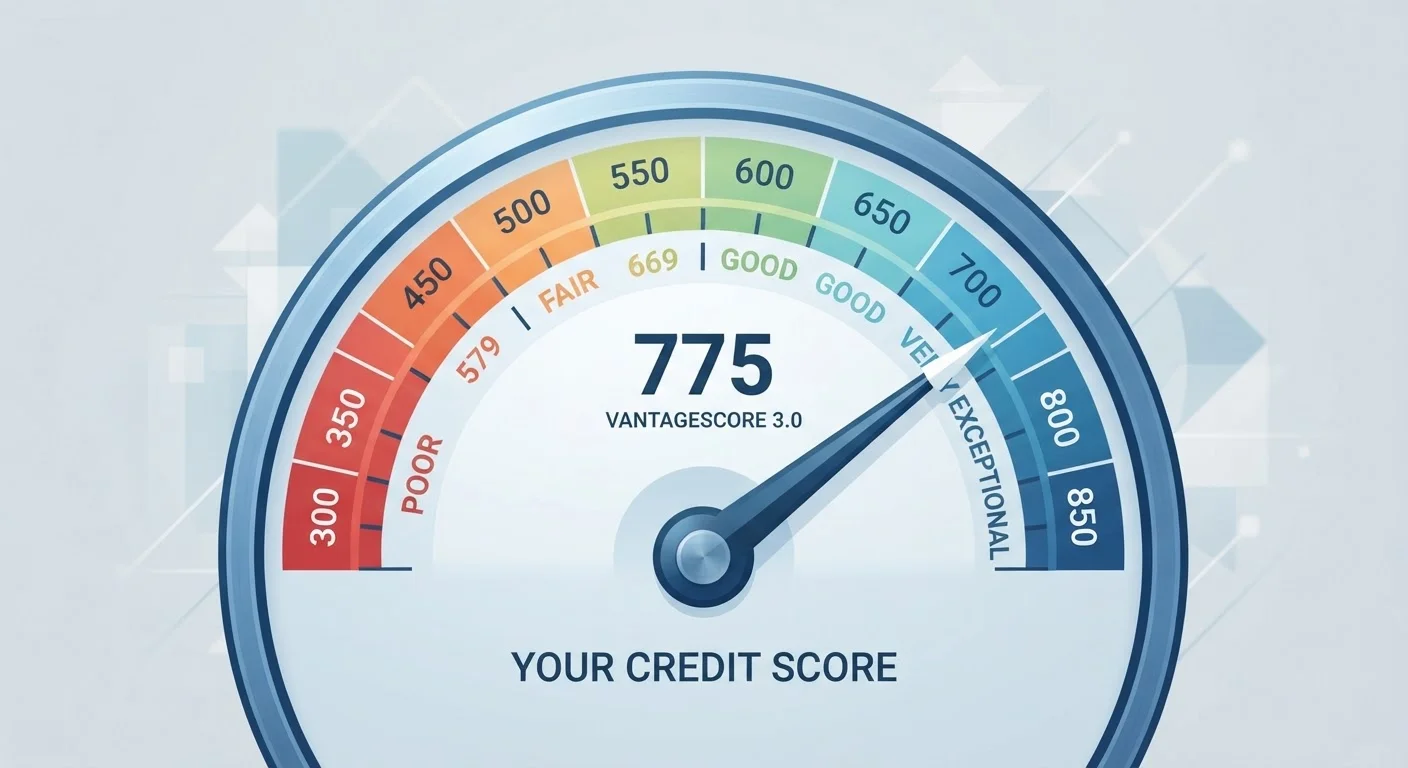
Lenders use score ranges as a quick risk filter. While each lender sets its own thresholds, the FICO model provides a broadly recognized framework:
| Score Range | Category | What It Typically Means |
|---|---|---|
| 800–850 | Exceptional | Qualifies for the most competitive rates and terms |
| 740–799 | Very Good | Usually eligible for above-average terms |
| 670–739 | Good | Near or above the average U.S. consumer score |
| 580–669 | Fair | Some lenders will approve, often at higher rates |
| 300–579 | Poor | Approval is difficult; secured products may be an option |
A score difference of even 50 points can meaningfully change the interest rate offered on a mortgage or auto loan, which translates to real dollars over the life of the loan. This is why understanding — and actively managing — your score matters well before you need to borrow.
Keep Utilization Low Before Applying for Credit
If you are planning to apply for a loan or a new credit account, try to pay down existing balances first. Reducing your overall credit utilization — ideally below 30% on each card — can give your score a meaningful boost in the weeks before a lender checks it. This is one of the fastest legitimate ways to improve your score in the short term.
Why Your Score Changes Over Time
Your credit score is not a fixed number. It is recalculated each time a lender or bureau receives updated account information, which means it can fluctuate month to month. Common reasons scores rise or fall include:
- A late or missed payment being reported
- Paying down a significant portion of a credit card balance
- Opening or closing an account, which affects utilization and average account age
- A hard inquiry from a new credit application
- A derogatory mark such as a collection account or bankruptcy aging off your report (negative items generally fall off after seven years)
Because scores respond to real changes in your financial behavior, improving a poor score is genuinely achievable — though it takes time and consistent habits. Building a stable budget is foundational to making those payments consistently; budgeting basics offers a practical framework for managing your cash flow. For readers who are newer to borrowing, credit and debt from the ground up provides a comprehensive starting point.
Your Score May Vary by Bureau and Model
It is normal to see slightly different scores depending on where you check. Each credit bureau (Equifax, Experian, TransUnion) may hold slightly different account data, and lenders may use different scoring models. Focus on the trend across all sources rather than obsessing over a single number from one provider.
This article is for general informational and educational purposes only and does not constitute personalized financial or legal advice. For guidance tailored to your situation, consult a qualified financial professional or licensed credit counselor.
Frequently Asked Questions
Generally, a score of 670 or above is considered "good" under the FICO model. Scores of 740 and above are typically viewed as "very good" or "exceptional" and often qualify for the most favorable loan terms. Scores below 580 are usually categorized as poor and may limit borrowing options.
Your credit score can change whenever new information is reported to the credit bureaus, which typically happens monthly when lenders submit account updates. Significant changes — such as a missed payment or paying off a large balance — can shift your score within one to two billing cycles.
No. Checking your own score is considered a "soft inquiry" and has no impact on your score. Only "hard inquiries," triggered when a lender reviews your credit for a lending decision, can temporarily lower your score by a small amount.
Different lenders and services use different scoring models (FICO, VantageScore) and may pull data from different credit bureaus (Equifax, Experian, TransUnion). Each bureau may hold slightly different information, producing small variations in your score across sources.
Yes. Common strategies include becoming an authorized user on someone else's account, opening a secured credit account, or using a credit-builder loan through a credit union. Consistent, on-time payments are the foundation of a positive credit history. Consulting a nonprofit credit counselor can also provide personalized guidance.
The content on this site is for informational purposes only and is not a substitute for professional advice. Always consult a qualified professional for guidance specific to your situation.