

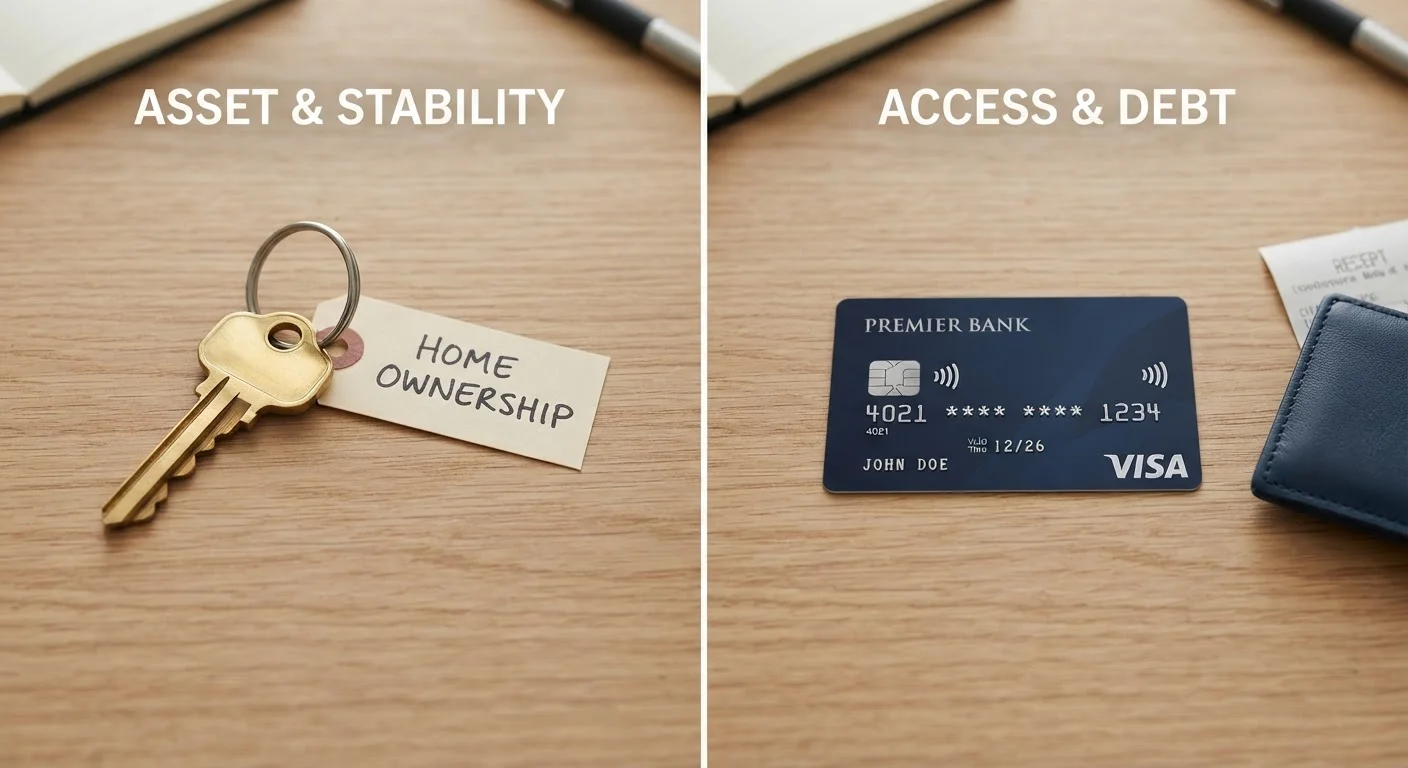
Option A
Secured Debt
Collateral-backed borrowing with lower rates and higher stakes.
Best for: Borrowers financing large purchases who can offer an asset as collateral and want lower interest costs.
Option B
Unsecured Debt
Collateral-free credit based on your creditworthiness alone.
Best for: Borrowers needing flexible credit without pledging assets, typically for smaller or shorter-term needs.
What Makes Debt Secured or Unsecured?
At its core, the distinction between secured and unsecured debt comes down to one word: collateral. Collateral is an asset — such as a home, vehicle, or savings account — that a borrower pledges to a lender as security for the loan. If the borrower fails to repay, the lender has a legal right to seize that collateral to recover what's owed.
Secured debt is any loan backed by collateral. Common examples include mortgages (where the home is the collateral), auto loans (where the vehicle is pledged), and home equity loans. Because the lender's risk is reduced by having that safety net, secured loans typically come with lower interest rates and higher borrowing limits.
Unsecured debt, by contrast, requires no collateral. Lenders approve these loans based entirely on the borrower's creditworthiness — including credit score, income, and debt-to-income ratio. Credit cards, personal loans, medical bills, and student loans are all common forms of unsecured debt. Without an asset to claim, lenders charge higher interest rates to offset the additional risk they're absorbing.
If you're new to borrowing concepts, our foundational credit and debt guide covers how credit scores and interest work in plain language.
| Criterion | Secured Debt | Unsecured Debt |
|---|---|---|
| Collateral Required | Yes — asset pledged | No — creditworthiness only |
| Typical Interest Rate | Generally lower | Generally higher |
| Common Examples | Mortgage, auto loan, HELOC | Credit card, personal loan, student loan |
| Borrowing Limits | Often higher | Typically lower |
| Default Consequence | Asset repossession or foreclosure | Collections, wage garnishment, credit damage |
| Qualification Basis | Credit profile + collateral value | Credit score and income |
What Happens When You Can't Repay?
The consequences of default differ meaningfully depending on which type of debt you hold — and understanding this distinction matters before you borrow.
With secured debt, default gives the lender the right to repossess or foreclose on the collateral. Miss enough mortgage payments and the lender can begin foreclosure proceedings on your home. Stop paying your auto loan and the vehicle can be repossessed, sometimes with very little warning. The asset loss is direct and often swift, making it critical to understand the terms before pledging anything valuable.
With unsecured debt, no single asset can be immediately seized. However, that doesn't mean consequences are minor. Lenders can report missed payments to credit bureaus, significantly damaging your credit score. They can also send the account to collections or pursue a court judgment against you. If a court rules in the creditor's favor, they may be able to garnish your wages or levy a bank account, depending on your state's laws.
In both cases, defaulting on debt carries serious financial and legal consequences. Neither type of debt is consequence-free — the nature of the consequences simply differs. For guidance on responsible borrowing habits that can help you avoid default situations, see our principles for borrowing responsibly.
~70%
Share of US consumer debt that is secured
Mortgage debt alone accounts for the vast majority of total US household debt, according to Federal Reserve consumer credit data.
200+ points
Potential credit score drop from serious delinquency
Major delinquencies — on either secured or unsecured accounts — can cause substantial credit score declines, per general guidance from credit bureaus.
Interest Rates, Limits, and Qualification Factors
Because collateral reduces a lender's exposure, secured loans almost always carry lower annual percentage rates (APRs) than comparable unsecured products. A mortgage, for example, typically carries a far lower rate than a personal loan for the same borrower. That rate difference can translate into thousands of dollars in interest savings over the life of a large loan.
Unsecured debt, by contrast, is priced to reflect the lender's greater risk. Credit card APRs in the United States have historically ranged well above those of secured products, and personal loan rates vary widely based on credit score. Borrowers with excellent credit may qualify for competitive unsecured rates, while those with limited or damaged credit histories often face higher costs — or may not qualify at all without collateral.
Borrowing limits also tend to differ. Secured loans can extend to very large amounts because the lender has an asset backing the obligation. Unsecured loans and credit cards are generally capped at lower limits, though high-credit borrowers may access substantial unsecured lines.
If you're weighing two popular unsecured options for managing existing debt, our comparison of credit cards vs. personal loans breaks down how interest structures and timelines differ between them.
A Note on Secured Credit Cards
Secured credit cards are a hybrid product worth understanding. Unlike most credit cards, they require a cash deposit that typically serves as the credit limit. They are classified as secured but behave operationally like unsecured cards for everyday use. They are often used by consumers building or rebuilding credit history. The deposit is returned if the account is closed in good standing, depending on the issuer's terms.
Choosing the Right Type for Your Situation
Neither secured nor unsecured debt is inherently better — the right choice depends on your financial situation, goals, and risk tolerance. A few practical considerations can help clarify which type makes sense for a given need.
Consider secured debt when:
- You're making a large, long-term purchase such as a home or vehicle.
- A lower interest rate would meaningfully reduce your total cost of borrowing.
- You have sufficient equity or assets to pledge and are confident in your repayment ability.
Consider unsecured debt when:
- You need flexible credit without risking a specific asset.
- The amount needed is relatively modest and a higher rate is manageable.
- You don't own assets that qualify as collateral.
Whatever type of debt you take on, understanding the full terms — including the interest rate, repayment schedule, fees, and default consequences — is essential before signing. If you're exploring how debt consolidation might simplify multiple obligations, our balanced look at debt consolidation explains what it does and doesn't solve.
This article is for general informational and educational purposes only and does not constitute personalized financial, legal, or investment advice. Consult a licensed financial professional before making borrowing decisions specific to your circumstances.
The content on this site is for informational purposes only and is not a substitute for professional advice. Always consult a qualified professional for guidance specific to your situation.