

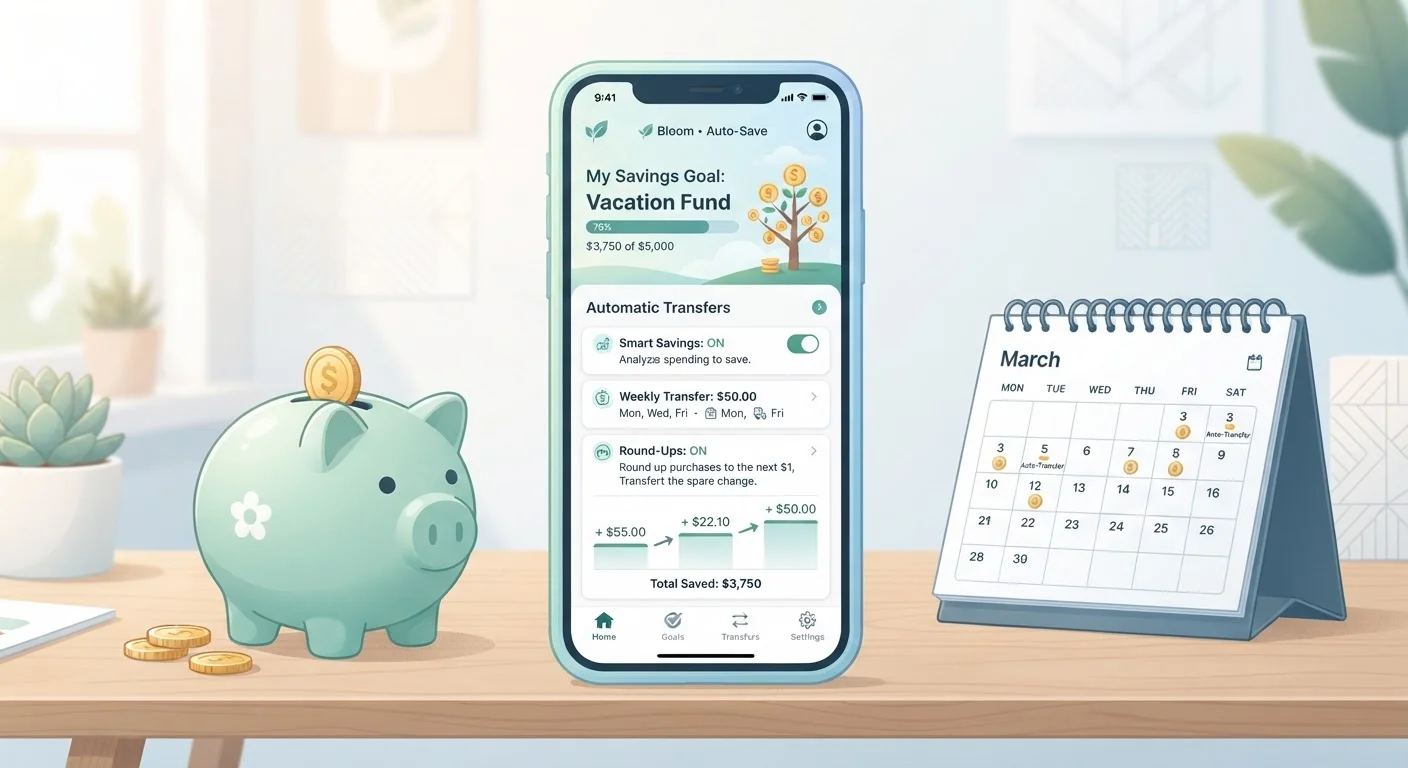
What Automated Savings Actually Means
Automated savings means setting up a system where money moves from your checking account to a savings or investment account on a fixed schedule — without requiring a manual action each time. The core idea is straightforward: when saving happens automatically, you spend what remains rather than saving what's left over after spending. That reversal of order is the primary behavioral advantage.
Research in behavioral economics has consistently shown that defaults matter. When saving requires an active decision each month, it competes with immediate expenses and gets skipped. When it's the default — triggered by a calendar date or a paycheck deposit — it happens consistently regardless of motivation on any given day.
Automated savings can serve different goals simultaneously. A transfer to an emergency fund builds a financial buffer. A contribution to a 401(k) or IRA grows retirement savings, potentially with tax advantages. A dedicated sub-account can handle irregular but predictable costs. For context on how this fits into broader financial planning, see our budgeting basics hub.
Align Transfers With Your Pay Date
Schedule your automatic transfer for the day after your paycheck typically clears. This timing ensures funds are available and reinforces the habit of treating savings as a non-negotiable expense rather than an afterthought at month's end.
Before You Set It Up: Key Considerations
Automation is a tool, not a fix for an unexamined budget. Before configuring any automatic transfers, it's worth taking stock of where your money currently goes. If your spending already exceeds your income, automating a savings transfer could trigger overdrafts and fees that set you back further. The guide to building a budget on a tight income is a practical starting point if you're not yet tracking expenses.
You should also consider the tax structure of where the automated money is going. Contributions to a traditional 401(k) reduce your taxable income now; Roth contributions are made with after-tax dollars but can grow tax-free. These distinctions matter for long-term planning, and a licensed financial adviser can help you think through what's appropriate for your circumstances. This article provides general information and is not personalized financial advice.
Avoid Overdraft Fees Before Automating
Automatic transfers pull funds on a scheduled date regardless of your checking account balance. Before activating any automation, ensure you maintain a reliable cushion — typically one to two weeks of essential expenses — to prevent overdraft charges. Review your bank's overdraft policy and consider setting a low-balance alert as a safeguard.
Finally, think about your goals timeline. Short-term goals (under three years) generally belong in liquid, low-risk accounts. Longer-term goals, such as retirement, may involve different account types with different rules around access and penalties.
Online or Mobile Banking Portal
Used to set up recurring transfers between your checking and savings accounts.
Employer Payroll System
Allows you to split your direct deposit so a portion goes straight to a savings account.
Retirement Account (401(k) or IRA)
Receives automatic pre-tax or post-tax contributions on a scheduled basis.
Low-Balance Alert
Sends a notification when your checking account drops below a set threshold, helping you avoid overdrafts.
Getting Started: Steps to Automate Your Savings
What you will need
Determine how much to automate
Before touching any settings, calculate a sustainable transfer amount. Review your last two to three months of take-home pay and essential expenses — rent, utilities, groceries, and debt payments. The gap between income and fixed costs is your starting point. A common framework is saving 10–20% of take-home pay, but if that is out of reach today, even $25–$50 per pay period builds a meaningful habit. If you're working through a tight income situation, the guide on building a monthly savings habit offers practical ideas for identifying small amounts to set aside.
Choose where the money will go
Decide on a destination before setting up the transfer. Common options include:
- High-yield savings account: Well-suited for emergency funds and short-term goals. Interest rates vary; compare account types to understand the differences between options like high-yield savings accounts and money market accounts.
- Dedicated goal account: Many banks allow you to label sub-accounts (e.g., "Car Repair" or "Holiday Gifts"). This pairs well with sinking funds for irregular expenses.
- Retirement account: If your employer offers a 401(k) match, contributing enough to capture the full match is generally considered a financial priority before building other automated savings.
Set up the transfer through your bank or payroll
You have two primary methods for automating transfers:
- Bank-initiated recurring transfer: Log in to your bank's online or mobile portal, navigate to the transfers section, and schedule a recurring transfer from checking to your savings account. Select the frequency (weekly, biweekly, or monthly) and the start date.
- Payroll direct deposit split: Log in to your employer's payroll portal or ask HR to split your direct deposit. Specify a fixed dollar amount or percentage to route directly to your savings account before it ever reaches checking. This is generally the most effective method because the money never touches your spending account.
Confirm the first transfer completes successfully
After scheduling, watch for the first transfer to execute and verify both accounts reflect the correct amounts. Check that no overdraft fee was triggered. If the timing caused a shortfall, adjust the transfer date or reduce the amount temporarily. Most banks also allow you to pause or cancel a scheduled transfer if an unexpected expense arises in a given cycle.
Increase the amount gradually
Once the initial transfer feels routine — typically after two or three pay cycles — consider increasing it. A common approach is to route a portion of any raise or bonus directly into savings before adjusting your lifestyle spending. This makes growing your savings rate feel less like a sacrifice. If you're also thinking about longer-term growth, the dollar-cost averaging approach applies the same principle of consistent, scheduled contributions to investing.
This article is for general informational purposes only and does not constitute personalized financial, tax, or investment advice. Consult a qualified financial professional before making decisions based on your individual circumstances.
The content on this site is for informational purposes only and is not a substitute for professional advice. Always consult a qualified professional for guidance specific to your situation.