

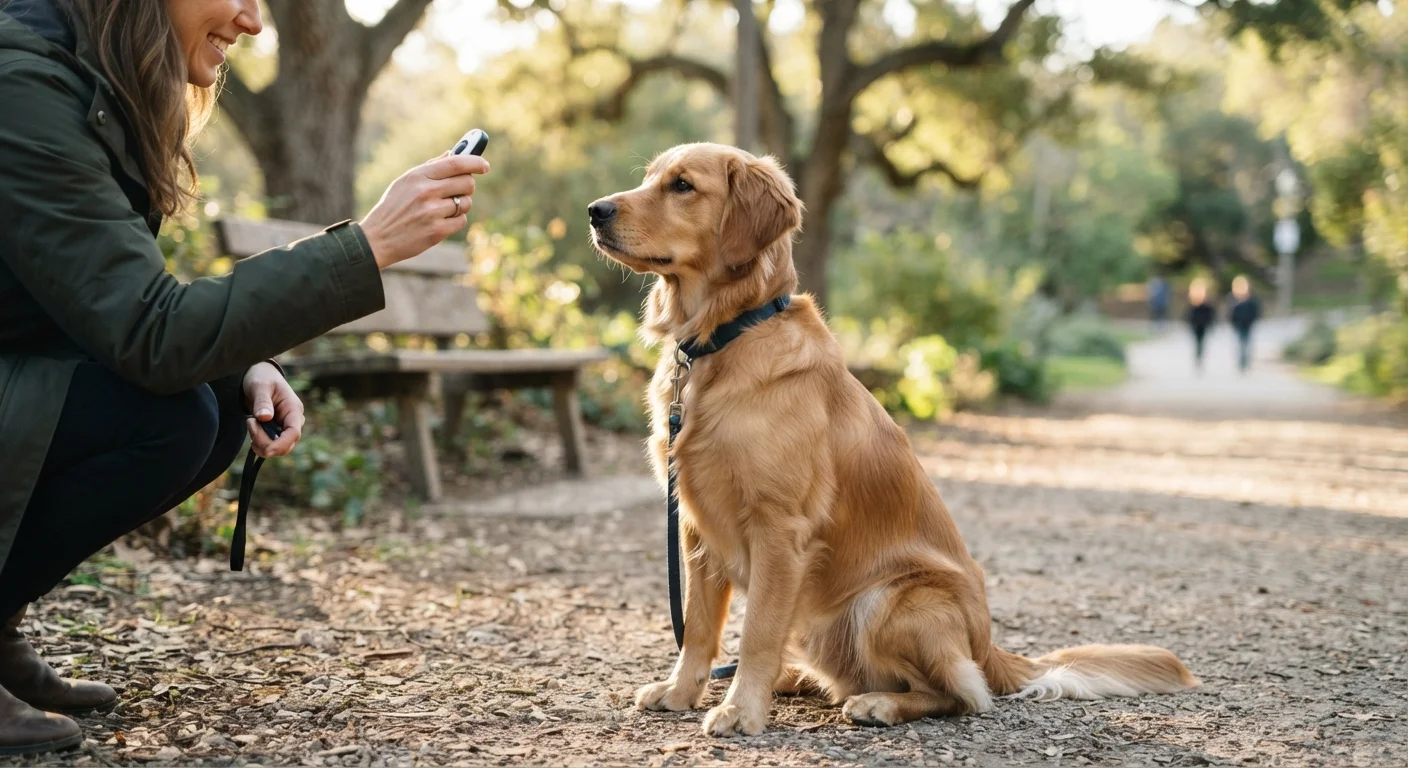
Option A
Clicker Training
The precision-first, event-marker method.
Best for: Owners learning a new behavior chain or working with dogs who struggle to connect vague praise to specific actions.
Option B
Verbal Cue Training
The hands-free, always-available alternative.
Best for: Owners who want a flexible, tool-free approach that integrates naturally into everyday life.
How Each Method Actually Works
Understanding the mechanics of both approaches helps owners make a genuinely informed choice — not just follow whatever trend is popular.
Clicker training is a form of operant conditioning that uses a small handheld device producing a consistent clicking sound. The click functions as a conditioned reinforcer or event marker: it signals to the dog, with split-second accuracy, that the behavior they just performed earned a reward. Before clicker training can begin, the owner must charge the clicker — pairing the click with treats repeatedly until the dog responds to the sound itself as meaningful. This process typically takes only a few short sessions.
Verbal cue training relies on spoken words — such as "sit," "stay," or "come" — paired with a reward (treat, praise, or play) to build an association between a word and a behavior. Because humans speak constantly, dogs must learn to distinguish a training cue from ambient conversation. That distinction comes from consistent tone, timing, and context. To understand why both methods produce results, see our article on the science behind positive reinforcement in pet training.
| Criterion | Clicker Training | Verbal Cue Training |
|---|---|---|
| Signal consistency | Identical every time | Varies with tone and mood |
| Timing precision | Split-second accuracy | Slight cognitive delay possible |
| Equipment needed | Small handheld clicker | None |
| Best learning phase | Early behavior shaping | Fluent, real-world application |
| Long-term use | Usually faded over time | Continues indefinitely |
| Ease for beginners | Moderate (requires coordination) | High (feels natural) |
| Effectiveness for complex tricks | Very high | Moderate without added marker |
What the Research and Behavioral Science Suggest
Animal behaviorists generally agree that the timing of a reward signal is one of the most critical variables in dog training. A dog's working memory for linking a behavior to an outcome is very short — typically within one to two seconds. This is where the clicker holds a measurable advantage in early learning: a click can be delivered in the precise moment a dog's rear touches the floor, while a verbal "yes" may arrive a fraction of a second later due to the cognitive load of speaking.
1–2 sec
Dog's behavioral association window
Behavioral science research consistently shows dogs can only reliably link a reward to an action within approximately one to two seconds of that action occurring.
2 brain regions
Canine vocal processing areas
A 2016 study in the journal Science found dogs process word meaning and vocal intonation in separate brain hemispheres, similar to humans.
~5 sessions
Average clicker charging time
Most professional trainers report that dogs reliably associate the click sound with reward after approximately three to five short conditioning sessions.
That said, research also shows that dogs are highly attuned to human vocal patterns and can discriminate between words reliably when training is consistent. A 2016 study published in Science confirmed that dogs process vocabulary and intonation in separate brain hemispheres — suggesting verbal cues carry genuine linguistic weight, not just conditioned response to sound patterns.
Neither approach has been shown to produce fundamentally superior long-term outcomes when applied with equal consistency. The trainer's skill and the dog's individual history matter as much as the tool itself. If you are weighing broader methodology questions, it is also worth reading about what the evidence shows on reward-based vs. dominance-based training.
Practical Strengths, Limitations, and When to Use Each
Choosing between these methods is less about which is "correct" and more about what fits your dog's learning stage and your daily life.
Clicker Training: Strengths and Limitations
- High precision: The neutral, consistent click removes ambiguity — every click means the same thing every time.
- Excellent for shaping: Complex behaviors built in small steps (called shaping) benefit enormously from the clicker's exact timing.
- Requires a free hand: Managing a leash, treats, and a clicker simultaneously can be awkward for some owners.
- Clicker must eventually be faded: Most trainers transition dogs to verbal cues once a behavior is learned, making the clicker a teaching aid rather than a permanent fixture.
Verbal Cue Training: Strengths and Limitations
- Always available: You never need to locate a device — your voice is with you in every situation.
- Natural integration: Verbal cues fit seamlessly into daily life, reinforcing behaviors in real-world contexts.
- Tonal inconsistency is a risk: Frustration, excitement, or illness can alter your tone, potentially confusing a dog who has learned to respond to pitch as much as the word.
- May be slower initially: Without the precision of a marker, dogs may take longer to isolate exactly which behavior earned the reward.
Many experienced trainers use both: the clicker accelerates early learning, and verbal cues take over as the dog gains fluency. Whatever method you use, a stable foundation of trust matters enormously — especially with a new dog. Our guide on your new dog's first 30 days covers what to prioritize before jumping into formal training.
A Note on Dogs With Hearing Loss
Neither clicker nor verbal cue training is suitable as the primary method for dogs with significant hearing impairment. In these cases, a visual marker — such as a hand signal or a small flashlight — can serve the same function as a click or spoken word. Consult a certified trainer experienced with deaf dogs for tailored guidance.
This article provides general educational information about dog training methods and is not a substitute for guidance from a certified professional trainer or veterinary behaviorist. If your dog shows persistent behavioral challenges, consult a qualified expert. See our guide on when to call a certified animal behaviorist vs. a dog trainer for help deciding who to contact.
The content on this site is for informational purposes only and is not a substitute for professional advice. Always consult a qualified professional for guidance specific to your situation.