

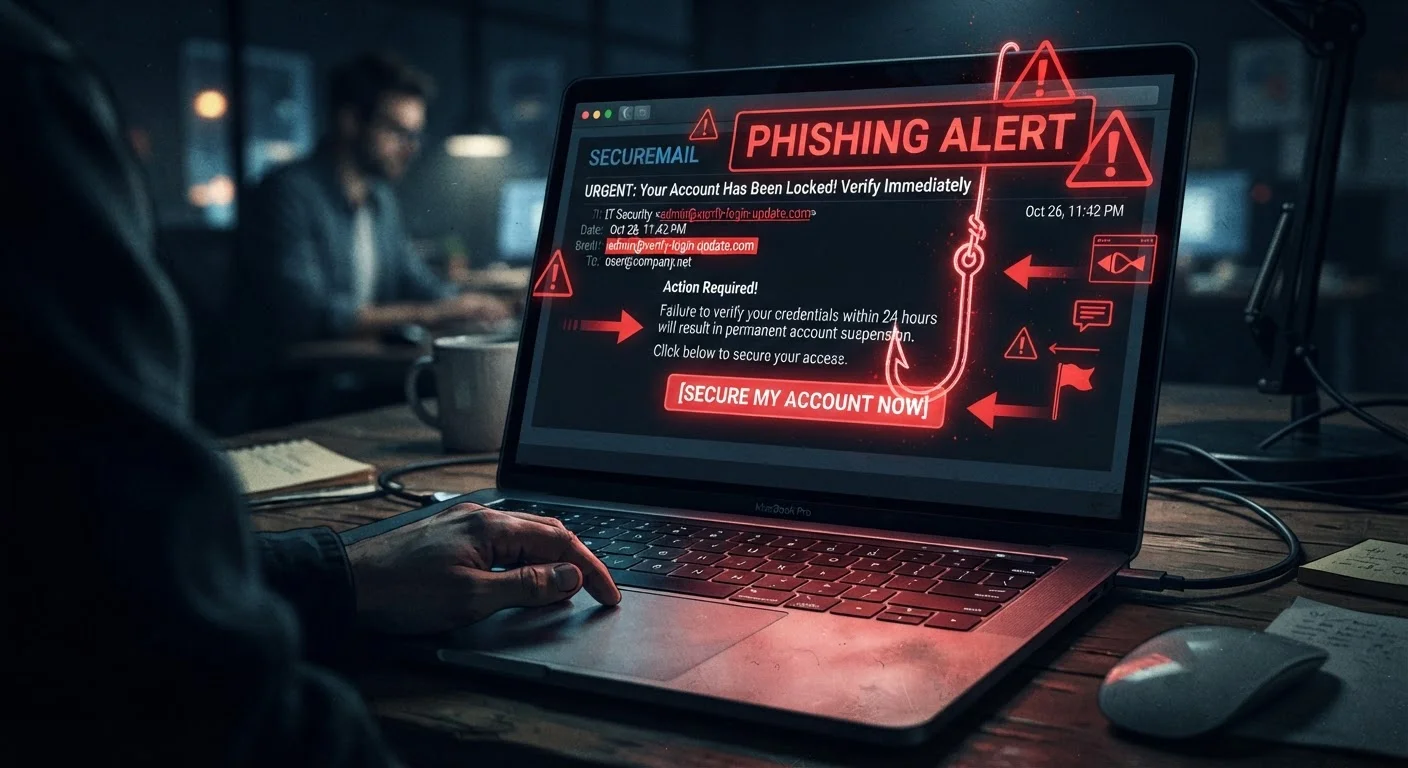
The Core Mechanism: Engineering Emotion, Not Exploiting Ignorance
A common misconception is that phishing victims are simply careless or unsophisticated. The truth is more unsettling: phishing works because it targets the way all human brains process urgency and authority, regardless of technical experience. Scammers don't need to break encryption — they just need to make you act before you think.
The fundamental formula is consistent across attack types. A message creates a high-stakes scenario, attributes it to a trusted authority, and provides an immediate action to resolve it. Your bank account has been compromised. Your package couldn't be delivered. Your Netflix subscription will lapse. Each scenario is plausible enough to feel real, urgent enough to demand immediate attention, and just specific enough to seem targeted at you personally.
“Phishing is fundamentally a human problem, not a technology problem. Attackers exploit the way people are wired to respond to authority and urgency — and no firewall patches human psychology.”
— Cybersecurity and Infrastructure Security Agency (CISA), U.S. federal agency responsible for national cybersecurity guidance
For a broader grounding in how online threats work, see our introduction to digital safety which covers the foundational concepts every user should understand.
The Language Patterns Scammers Rely On
Phishing messages are not randomly worded. They follow identifiable linguistic patterns that, once recognized, become much easier to spot.
- False urgency: Phrases like "Your account will be suspended in 24 hours" or "Immediate action required" are designed to trigger panic and compress your decision-making window.
- Authority signaling: Messages impersonate institutions with social power — the IRS, Medicare, your bank, Amazon, or your employer — because we're conditioned to respond quickly to authority figures.
- Vague but alarming threats: "Unusual activity has been detected" is deliberately non-specific. It's threatening enough to motivate action but vague enough to apply to almost anyone.
- A single prescribed action: Legitimate institutions rarely demand you resolve a problem through a single link or phone number provided in an unsolicited message. Scammers do, because they control that channel.
- Flattery or reward framing: "You've been selected" or "Claim your refund" targets the same psychology but through positive motivation rather than fear.
Train Yourself to Pause Before Acting
When a message creates urgency — especially one asking you to click a link, call a number, or provide a code — treat that urgency itself as a warning signal. Scammers engineer time pressure deliberately. Taking 60 seconds to independently verify the sender through official channels costs nothing; acting immediately on a fraudulent message can cost a great deal.
Understanding these patterns also connects to key cybersecurity terminology — knowing what "spoofing" and "social engineering" mean helps you recognize them in action.
How Smishing and Vishing Raise the Stakes
Email phishing has a well-established reputation — many people have learned to scrutinize their inbox. Scammers adapted. Smishing (SMS phishing) and vishing (voice phishing) exploit channels where people are less guarded.
Text messages feel intimate. They arrive in the same thread as messages from your family. Mobile screens truncate URLs, making it harder to spot a suspicious domain. A text claiming to be from USPS about a missed delivery is easy to click without scrutiny.
Vishing adds a human voice. A caller claiming to be from your bank's fraud department, speaking calmly and using your first name, can be remarkably convincing. Some sophisticated operations even use audio spoofing tools to make calls appear to come from real institution phone numbers. The pressure of a live conversation leaves less time to evaluate the request critically.
3.4 billion
Phishing emails sent daily worldwide
According to estimates widely cited in cybersecurity industry reports, phishing remains the most common form of cybercrime by volume.
96%
Of phishing attacks arrive via email
The Anti-Phishing Working Group (APWG) consistently identifies email as the dominant delivery channel in its quarterly threat reports.
74%
Of organizations experienced a phishing attack
Proofpoint's State of the Phish report has found that a large majority of organizations surveyed across industries reported at least one successful or attempted phishing incident in a given year.
Red Flags Across All Phishing Channels
Despite varying delivery methods, the warning signs share a common thread. Watch for these across any unsolicited message or call:
One of the most reliable defenses is also the simplest: pause and verify independently. Hang up and call the institution back using a number from their official website. Navigate to your account directly rather than clicking a link. The few extra seconds this takes is far less costly than a compromised account.
If your personal or financial data has already been exposed, a related concern is monitoring your credit report for signs of misuse. And because phishing often targets account credentials, pairing phishing awareness with strong authentication habits matters — see what security research actually says about passwords for evidence-based guidance.
For a comprehensive look at protecting yourself across every digital surface, our full online safety resource covers privacy, security, and scam awareness together.
Frequently Asked Questions
Phishing emails often use real brand logos, professional formatting, and sender addresses that closely mimic genuine domains (e.g., 'support@paypa1.com'). They may reference real details about you obtained from data breaches. The closer the imitation, the harder it is to spot on first glance.
Smishing is phishing conducted via SMS text message. The psychological tactics are identical, but texts feel more personal and immediate, which can lower a person's guard. Malicious links in texts are also harder to preview before clicking on a mobile device.
Disconnect from the internet immediately if you believe malware may have been installed. Change any passwords for accounts you entered credentials on, enable multi-factor authentication, and report the incident to your bank or employer if sensitive information was involved. Contact your device manufacturer's support line if you're unsure about malware.
Yes. In the United States, you can report phone scams to the Federal Trade Commission at ReportFraud.ftc.gov and to the FCC. Many phone carriers also allow you to forward suspicious SMS messages to 7726 (SPAM) for investigation.
Not necessarily. HTTPS indicates the connection between your browser and the site is encrypted, but it says nothing about whether the site itself is legitimate. Phishing sites routinely use HTTPS certificates. Always verify the full domain name, not just the protocol.
Do not use any contact information provided in the message itself. Instead, navigate directly to your bank's official website by typing the address into your browser, or call the number printed on the back of your card. Never call a number provided in an unexpected email or text.
The content on this site is for informational purposes only and is not a substitute for professional advice. Always consult a qualified professional for guidance specific to your situation.