

Our Verdict
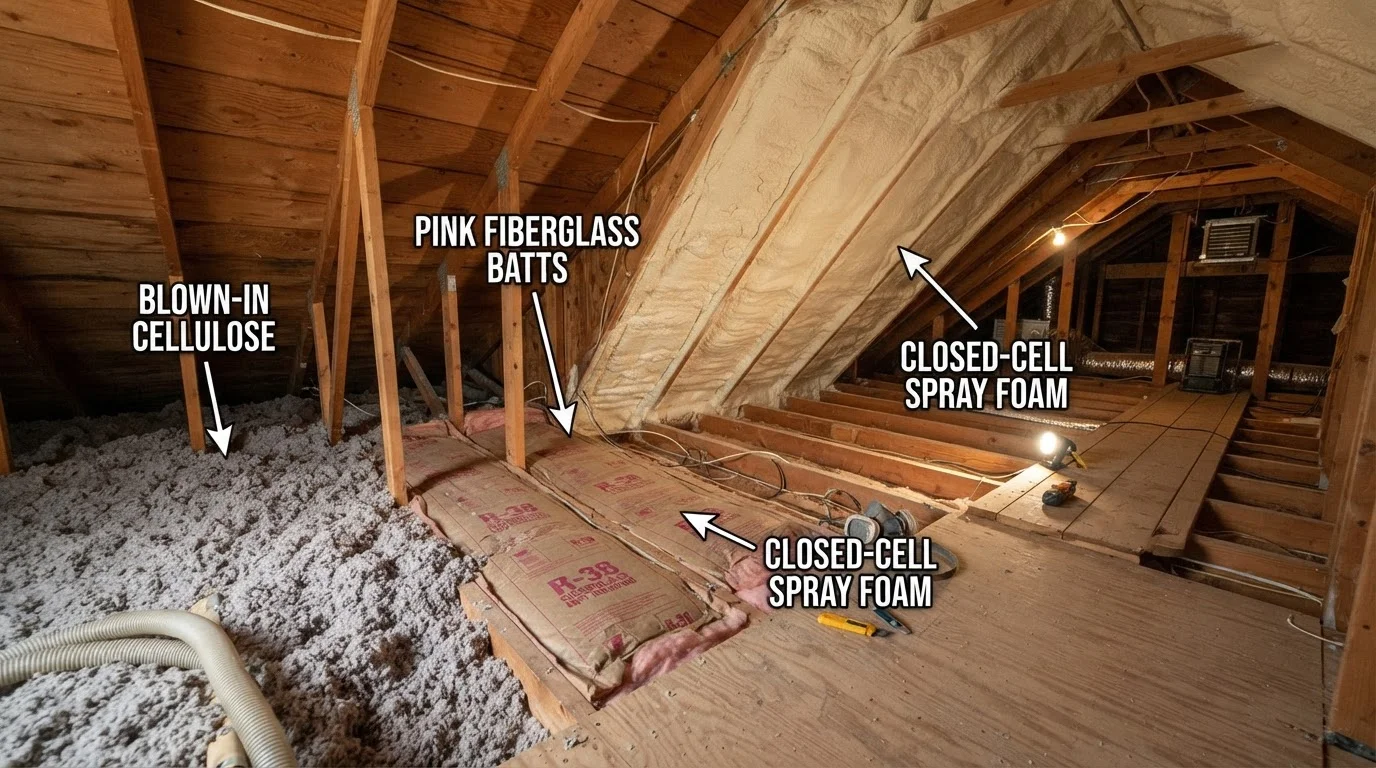
No single insulation type is universally superior - each excels in a specific situation. Blown-in suits most finished attic floors and retrofit projects, batts work well in open, regularly framed spaces, and spray foam is the go-to solution when air sealing and maximum thermal performance are both priorities. Matching the insulation type to your attic's geometry, moisture profile, and budget will deliver the most durable results.
| Best for | Recommended |
|---|---|
| Homeowners retrofitting an existing attic floor on a moderate budget | Blown-In Insulation |
| New construction or open framing with standard joist spacing | Batt Insulation |
| Unvented roof assemblies or spaces needing maximum air sealing | Spray Foam Insulation |
Why Attic Insulation Type Matters
The attic is responsible for a significant share of a home's heat loss in winter and heat gain in summer. Choosing the wrong insulation type - or installing the right one incorrectly - can leave you with cold floors above, high energy bills, and moisture problems that damage framing over time.
Three materials dominate residential attic insulation: blown-in (loose-fill), batt (blanket), and spray foam. Each handles thermal resistance, air movement, and moisture differently. Before comparing them, it helps to understand two key concepts:
- R-value - a measure of thermal resistance. Higher R-values resist heat flow more effectively. The U.S. Department of Energy recommends R-38 to R-60 for most attic floors depending on climate zone.
- Air sealing - insulation slows heat conduction, but gaps around plumbing penetrations, recessed lights, and top plates allow air to bypass insulation entirely. Sealing those bypasses before or during insulation installation is critical. See our guide to weatherproofing gaps and drafts for a practical starting point.
Blown-In Insulation: Flexible and Retrofit-Friendly
Blown-in insulation - available in fiberglass or cellulose - is installed using a blowing machine that distributes loose material evenly across attic floors. Cellulose (made largely from recycled paper treated with borate fire retardant) achieves roughly R-3.2 to R-3.8 per inch; fiberglass loose-fill reaches approximately R-2.2 to R-2.7 per inch.
R-38 to R-60
Recommended attic R-value range
The U.S. Department of Energy recommends this range for attic floors in most U.S. climate zones, with higher values for colder northern regions.
~25%
Share of home heat loss through attic
The U.S. Department of Energy estimates that heating and cooling account for roughly half of home energy use, with the attic and roof among the largest contributors to thermal loss.
Strengths
- Fills around obstructions like pipes, wiring, and irregular framing without cutting or fitting pieces.
- Well-suited to adding insulation on top of existing material in retrofit projects.
- Cellulose has a relatively low embodied energy compared to foam products.
- Blowing machines are available at many home improvement centers for short-term rental, making DIY installation feasible on flat attic floors.
Limitations
- Loose-fill can shift or settle slightly over years, modestly reducing effective R-value.
- Provides little inherent air-sealing benefit - gaps and bypasses should be caulked or foam-sealed first.
- Cellulose can absorb moisture if attic ventilation is inadequate, leading to clumping.
Batt Insulation: Familiar and Straightforward
Fiberglass or mineral wool batts come in pre-cut widths sized for standard 16-inch and 24-inch on-center joist spacing. Fiberglass batts typically deliver R-2.9 to R-3.8 per inch; mineral wool (rock wool) batts reach R-3.0 to R-3.3 per inch with better fire and moisture resistance.
Check for Compression Before Installing Batts
A compressed batt delivers far less R-value than its label indicates. When filling joist bays, the batt should fit snugly without being squeezed - if it's compressed more than about 10%, performance drops measurably. Cut batts cleanly around obstructions rather than folding or stuffing them into place.
Strengths
- Widely stocked at hardware stores; no specialized equipment needed for installation.
- Mineral wool batts resist moisture, mold, and fire better than standard fiberglass.
- Straightforward to install in open, evenly framed attic floors accessible for work.
Limitations
- Must be cut carefully to fit around obstructions; gaps, compression, or voids significantly reduce effective R-value.
- Not ideal for retrofit layering - batts on top of existing insulation can be difficult to seat without compression.
- Like blown-in, batts do not air-seal; penetrations must be addressed separately.
Spray Foam: Maximum Performance, Professional Installation
Spray polyurethane foam (SPF) comes in two forms. Open-cell foam expands dramatically, costs less, and achieves roughly R-3.5 per inch but is vapor-permeable. Closed-cell foam is denser, achieves R-6 to R-7 per inch, and acts as both a thermal barrier and a vapor retarder - making it the choice for unvented roof assemblies where insulation is applied directly to the underside of roof sheathing rather than the attic floor.
| Blown-In | Batt | Spray Foam (Closed-Cell) | |
|---|---|---|---|
| Typical R-value per inch | R-2.2 to R-3.8 | R-2.9 to R-3.8 | R-6 to R-7 |
| Air sealing capability | None (seal separately) | None (seal separately) | Excellent (integral) |
| DIY-friendly | Yes (flat floors) | Yes (open framing) | No - professional required |
| Moisture resistance | Moderate (cellulose absorbs) | Good (mineral wool) | Excellent |
| Relative installed cost | Low to moderate | Low to moderate | High |
| Best application | Retrofit attic floors | New open framing | Unvented roof assemblies |
Strengths
- Adheres to framing and sheathing, creating a continuous air barrier with no separate sealing step.
- Closed-cell foam adds structural rigidity to roof sheathing.
- Suitable for cathedral ceilings and conditioned attic spaces where floor-level insulation is impractical.
Limitations
- Significantly higher cost than blown-in or batts - typically two to three times the installed price per square foot.
- Requires professional installation; improper mixing or application causes off-ratio foam that underperforms or off-gases.
- Removal is difficult if future roof repairs expose the sheathing.
- Some jurisdictions require thermal or ignition barriers over exposed foam - verify local building codes before installation.
Choosing the Right Insulation for Your Attic
Start by assessing three factors: attic geometry, existing insulation, and moisture conditions.
- Flat accessible attic floor with existing insulation: Blown-in cellulose or fiberglass is the most practical choice. Seal bypasses first, then blow to the depth needed for your climate zone's target R-value.
- New construction or open framing, no existing insulation: Batts are efficient to install when joists are evenly spaced and accessible. Mineral wool is worth the modest cost premium in humid climates.
- Cathedral ceiling, unvented roof assembly, or conditioned attic space: Closed-cell spray foam applied to the underside of roof sheathing is the appropriate solution. Work with a licensed insulation contractor and confirm required code compliance for your region.
- High moisture or coastal climate: Closed-cell spray foam or mineral wool batts handle moisture better than cellulose or standard fiberglass.
Regardless of which material you select, sealing air bypasses before or during installation is the single step most likely to improve your results. Insulation without air control leaves substantial performance on the table.
This article provides general home improvement information only. Local building codes, required R-values, and permit requirements vary by region. Consult a licensed insulation contractor or your local building department before beginning any attic insulation project, particularly work involving spray foam or unvented roof assemblies.
The content on this site is for informational purposes only and is not a substitute for professional advice. Always consult a qualified professional for guidance specific to your situation.