

How R-Value Works
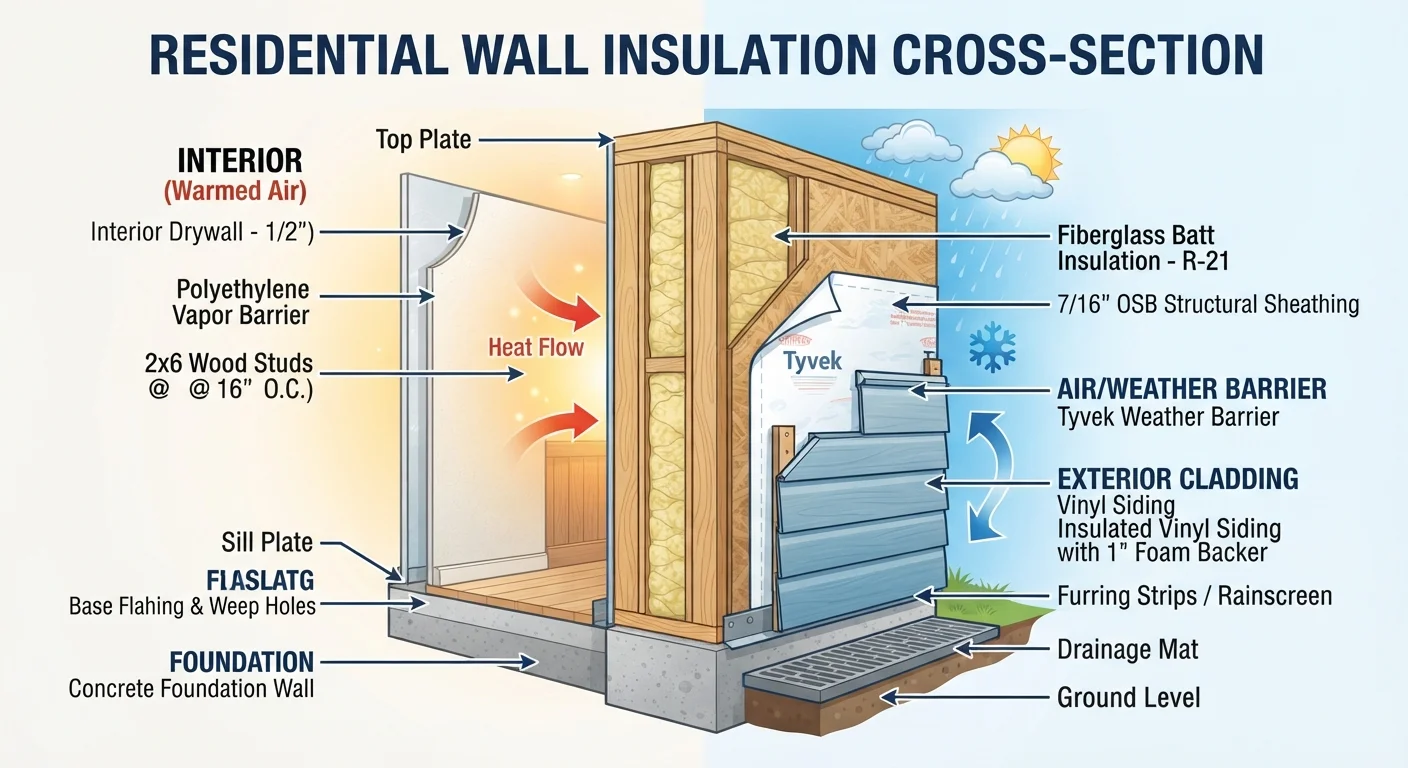
Think of R-value as a resistance score. Heat naturally moves from warm areas to cool ones - out of your home in winter and into it in summer. Insulation slows that movement, and R-value quantifies exactly how much resistance a material provides.
The math is additive: if you stack two layers of insulation rated R-19 each, your total assembly provides R-38. This is why attics - which lose the most heat in winter - are built up with thick layers of insulation stacked or blown in to reach high combined values.
R-value is measured per material, not per installation. A 3.5-inch fiberglass batt rated R-13 will only deliver R-13 if it is installed correctly, at full thickness, without gaps or compression. Any voids, gaps around wires, or packed-down sections reduce real-world performance below the label rating.
R-Value and Air Sealing Are Different Things
R-value measures resistance to conductive heat flow through a material, but it does not address air infiltration - drafts that carry conditioned air out and unconditioned air in. Air sealing (using caulk, foam, and weatherstripping) is a separate but complementary step. Doing both together yields better real-world performance than insulation alone.
Why Climate Zone Determines Your Target R-Value
The U.S. Department of Energy divides the country into eight climate zones, ranging from hot-humid Gulf Coast regions to frigid northern and mountain areas. Your zone determines the minimum R-values recommended for different parts of your home.
R-38 to R-60
Recommended attic R-value for most U.S. homes
According to the U.S. Department of Energy's climate-zone-based insulation recommendations.
~15%
Of home heating and cooling lost through the attic
The DOE estimates that air sealing and proper attic insulation can significantly reduce energy loss in poorly insulated homes.
8
U.S. climate zones with unique R-value targets
The DOE and International Energy Conservation Code map the country into eight zones, each with distinct insulation minimums.
In a mild Zone 3 climate (much of the Southeast), exterior walls may call for R-13 to R-15, while a Zone 6 home in the Upper Midwest might need R-20 or more in walls and R-49 to R-60 in the attic. Following these recommendations - or your local building code's requirements, whichever is stricter - helps ensure your insulation investment pays off in comfort and energy performance.
You can look up your climate zone using the DOE's online map or by checking your local building department. Many municipalities adopt the International Energy Conservation Code (IECC), which ties minimum R-value requirements directly to climate zone classifications.
R-Value by Location in Your Home
Not every part of your home needs the same level of insulation. Heat rises, so attics lose more heat than floors, and the recommended values reflect that physics.
- Attics: The highest priority area. The DOE recommends R-38 to R-60 for most U.S. attics. See our guide to attic insulation types to compare blown-in, batt, and spray foam options by R-value and cost.
- Walls: Exterior walls typically target R-13 to R-21 depending on climate zone and whether the wall cavity is 2×4 or 2×6 framing.
- Floors over unconditioned spaces: Crawl spaces and garages call for R-13 to R-30 beneath floors, depending on your zone.
- Basement walls: Generally R-10 to R-15 in colder climates, often applied as rigid foam board on interior or exterior surfaces.
Check Your Local Building Code First
Before purchasing insulation, contact your local building department or check the IECC table for your climate zone. Local codes sometimes require higher R-values than federal minimums, and certain projects - such as adding insulation to a finished wall - may require a permit and inspection.
Reading an Insulation Label and Avoiding Common Mistakes
Every insulation product sold in the U.S. is required by the Federal Trade Commission (FTC) to display its R-value prominently on packaging. When shopping, confirm the R-value matches your target for the specific location - a product labeled R-15 for a wall cavity is not the same as one labeled R-15 for attic use, since coverage area and installation method differ.
Common installation mistakes that reduce effective R-value include leaving gaps around electrical boxes, allowing faced batts to sag between joists, and blocking soffit vents with insulation (which causes moisture problems and reduces attic ventilation). Proper air sealing - caulking gaps and using foam sealant around penetrations - should be done before insulation is installed, as it addresses a separate but equally important pathway for heat loss.
This article is for general informational purposes only. Insulation requirements vary by local building codes and individual home conditions. Consult a licensed insulation contractor or your local building department before starting a project, especially for work requiring permits or inspections.
Frequently Asked Questions
The U.S. Department of Energy recommends R-38 to R-60 for attics in most climate zones, with colder northern regions requiring the higher end. Your local building code is the definitive guide for your area.
Yes. Adding new insulation on top of existing material increases the total R-value by combining the two. Ensure the existing insulation is dry, undamaged, and free of mold before layering.
A higher R-value reduces heat transfer, which generally lowers heating and cooling costs, but it does not guarantee specific savings. Air leaks, window quality, HVAC efficiency, and your habits all play significant roles.
No. Different materials achieve different R-values per inch of thickness. Spray foam typically offers around R-6 to R-7 per inch, while standard fiberglass batts provide roughly R-3 to R-4 per inch.
Compressing batt insulation reduces its effective R-value because the air pockets that resist heat flow are squeezed out. Always install batts at their intended thickness for rated performance.
The content on this site is for informational purposes only and is not a substitute for professional advice. Always consult a qualified professional for guidance specific to your situation.