

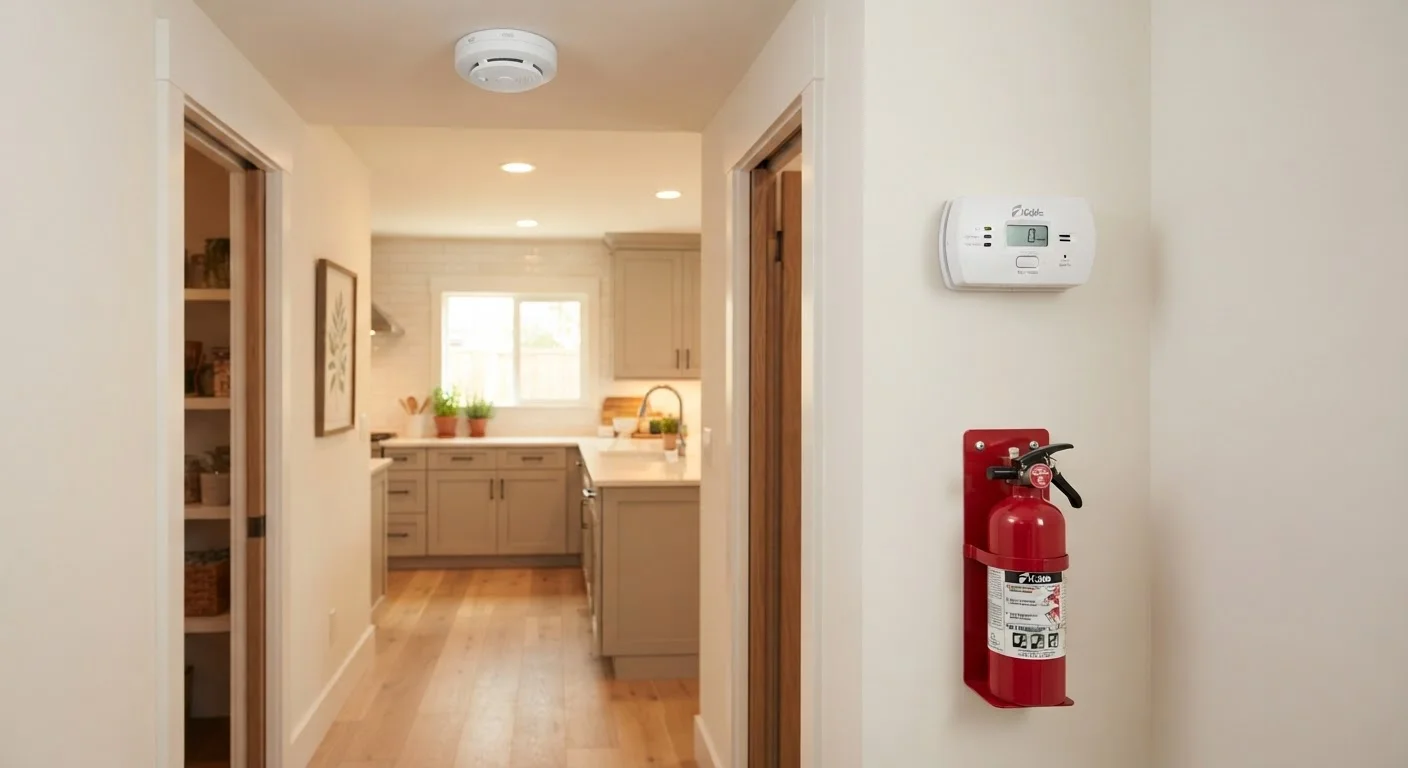
The Three Core Safety Devices and Where to Place Them
Smoke detectors, carbon monoxide (CO) alarms, and fire extinguishers serve distinct but overlapping purposes. Understanding what each detects - and where it belongs - is the starting point for a properly protected home.
| Smoke detector lifespan | 10 years from manufacture date (U.S. Fire Administration guidance) |
| CO alarm lifespan | 5-7 years (some models up to 10) (Manufacturer specifications vary; check label) |
| Testing frequency | Monthly for both smoke and CO alarms (NFPA 72 general guidance) |
| Fire extinguisher class for homes | ABC-rated multipurpose dry-chemical |
| Minimum smoke detectors required | One per level, plus inside and outside each sleeping area (NFPA 72 general guidance) |
| CO alarm placement height | Mid-wall (~5 ft) or ceiling; varies by model (Always consult manufacturer instructions) |
Smoke Detectors
Install a smoke detector on every level of the home, inside each sleeping area, and outside every sleeping area. Kitchens are a common false-alarm zone; keep detectors at least 10 feet from cooking appliances when possible, or use a heat alarm in that space instead. Mount on ceilings or high on walls, since smoke rises. Avoid corners where air circulates poorly.
Carbon Monoxide Alarms
CO alarms are required on every level that has a sleeping area, and near - but not directly adjacent to - fuel-burning appliances such as furnaces, water heaters, and attached garages. CO is roughly the same density as air, so mid-wall placement (about five feet up) is often recommended, though ceiling placement is also acceptable per most codes. Check your local building code, as requirements vary by state and municipality.
Fire Extinguishers
Keep at least one fire extinguisher in the kitchen - the most common location for home fires - and consider additional units in the garage and near any workshop or utility area. Mount extinguishers on a bracket within easy reach, no higher than five feet from the floor for the handle.
For a broader look at first-time home safety routines, see our guide for first-time homeowners.
Testing Schedules and Replacement Timelines
Installing these devices is only step one. A device with a dead battery or an expired sensor provides no protection at all.
Ionization detector
A smoke alarm type that uses a small amount of radioactive material to detect fast-flaming fires. It reacts quickly to open flames but may be slower to detect slow, smoldering fires.
Photoelectric detector
A smoke alarm that uses a light beam to detect smoke particles. It is generally faster to respond to slow, smoldering fires, which are common in residential nighttime fires.
Carbon monoxide (CO)
A colorless, odorless gas produced by incomplete combustion of fuel-burning appliances. Exposure can be dangerous or fatal, making a functioning CO alarm essential in any home with gas appliances, an attached garage, or a fireplace.
ABC-rated extinguisher
A multipurpose fire extinguisher rated to handle ordinary combustibles (Class A), flammable liquids (Class B), and electrical fires (Class C). It is the standard recommendation for most residential settings.
Hydrostatic testing
A pressure test performed on fire extinguisher cylinders to verify structural integrity. Most portable extinguishers require this test every 5 or 12 years depending on type, as marked on the label.
Smoke Detectors
Test: Press the test button monthly. A loud beep confirms the alarm and battery are functional. Battery replacement: For standard 9-volt battery units, replace batteries at least once a year - many households use daylight saving time changes as a reliable reminder. Sealed lithium-battery models are designed to last the life of the device without battery changes. Unit replacement: Replace the entire detector every 10 years from the manufacture date (printed on the back). Sensor technology degrades over time even when the alarm still sounds during testing.
CO Alarms
Test: Monthly, using the test button. Battery replacement: Same annual schedule as smoke detectors for battery-powered units. Unit replacement: Most CO alarms have a service life of 5-7 years, though some models last up to 10 years. Always check the manufacturer's label - CO sensors have a fixed chemical lifespan that the test button cannot evaluate.
Fire Extinguishers
Monthly check: Confirm the pressure gauge needle is in the green zone, the safety pin is intact, and the unit shows no visible damage or corrosion. Annual inspection: Many fire departments and professional services offer inspections; this is especially important for commercial-grade units. Replacement or recharging: Use a fire extinguisher even once and it must be recharged or replaced, regardless of how much agent remains. Dry-chemical extinguishers have a general service life of 5-12 years depending on type; check the label for hydrostatic testing requirements.
Interconnected Alarms Add an Extra Layer of Protection
Many modern smoke and CO alarms can be wired or wirelessly interconnected so that when one sounds, all alarms in the home activate simultaneously. This is especially valuable in larger homes or when sleeping areas are far from potential hazard zones. Check whether interconnected models are required by your local code - some jurisdictions mandate them in new construction.
Choosing the Right Type for Each Room
Not all devices are interchangeable. Selecting the right technology for each location improves reliability and reduces nuisance alarms.
Smoke Detector Types
- Ionization: Responds faster to fast-flaming fires. Common and inexpensive.
- Photoelectric: Responds faster to slow, smoldering fires - the type most often responsible for nighttime deaths. Generally recommended for bedrooms and hallways.
- Dual-sensor: Combines both technologies and is widely considered the most comprehensive option for general placement.
Combination Alarms
Combination smoke/CO alarms are available and acceptable in most jurisdictions. They simplify installation but should still follow the placement rules for both devices - meaning they may not cover every required location on their own.
Fire Extinguisher Classes
For most households, an ABC-rated multipurpose dry-chemical extinguisher is the appropriate choice. It handles ordinary combustibles (A), flammable liquids (B), and electrical fires (C). Avoid using water-based extinguishers on grease or electrical fires.
If your home uses a gas furnace or has an attached garage, your CO alarm placement ties directly into your HVAC setup. Our HVAC maintenance overview explains what fuel-burning appliances to be aware of.
3 of 5
Home fire deaths occur in homes without working smoke alarms
According to the National Fire Protection Association (NFPA) home fire death research.
~430
Annual U.S. deaths from unintentional CO poisoning
Based on CDC data on non-fire-related carbon monoxide fatalities in the United States.
10 years
Maximum recommended smoke detector service life
U.S. Fire Administration and NFPA guidance on sensor degradation over time.
This article provides general home safety information for educational purposes only. Building codes and device requirements vary by location - always verify current requirements with your local fire marshal or building department before making installation decisions.
The content on this site is for informational purposes only and is not a substitute for professional advice. Always consult a qualified professional for guidance specific to your situation.