

Our Verdict
Employer-sponsored insurance is generally the more cost-effective choice when available, because employers typically cover a significant share of the premium. The ACA Marketplace is the primary alternative for those without access to job-based coverage, and subsidies can make it genuinely affordable for many households. Neither pathway is universally superior - the right fit depends on your employment situation, income, and family coverage needs.
| Best for | Recommended |
|---|---|
| Workers with access to employer coverage | Employer-Sponsored Insurance |
| Self-employed, part-time workers, or those between jobs | ACA Marketplace |
| Households qualifying for premium tax credits | ACA Marketplace |
| Those needing to cover dependents affordably | Employer-Sponsored Insurance |
How Each Coverage Pathway Works
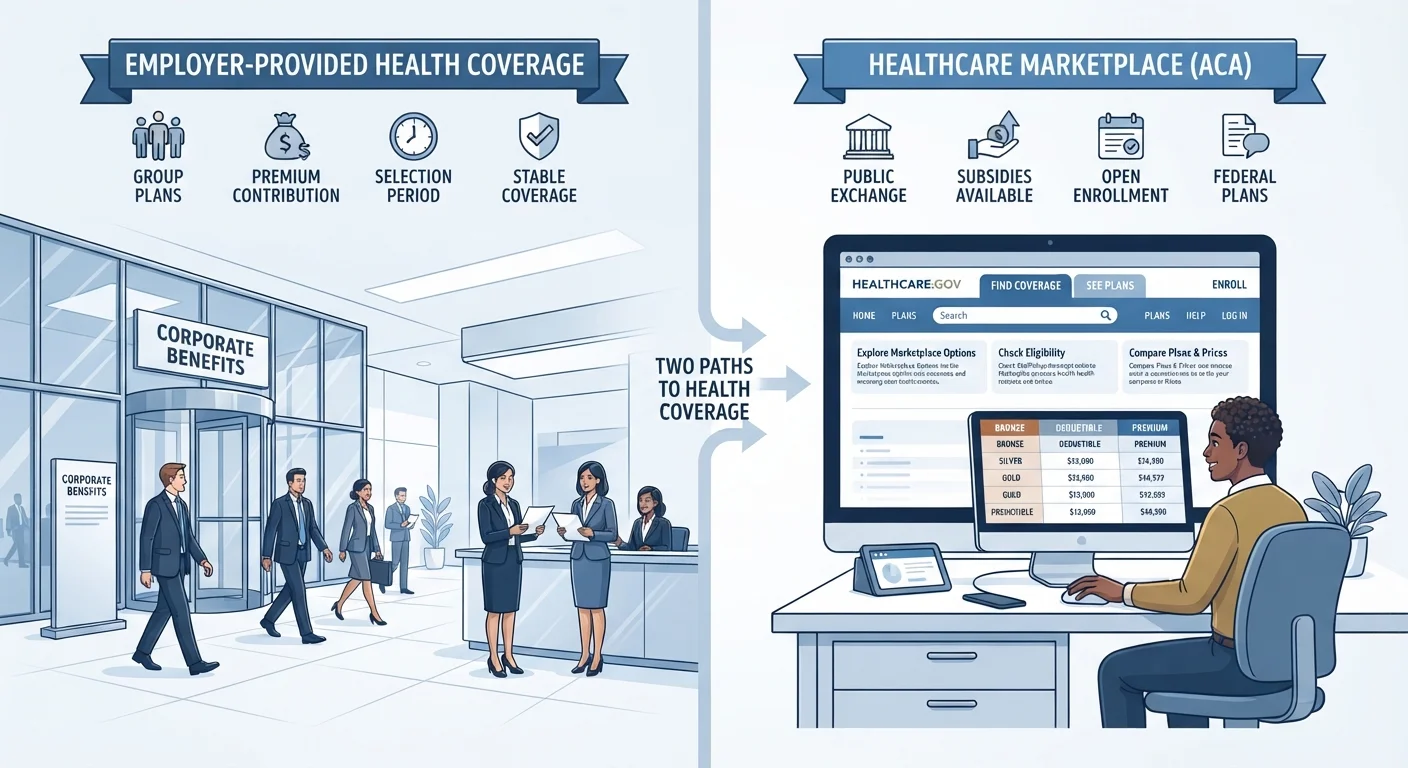
Most Americans get health insurance through one of two main channels: a plan sponsored by their employer, or a plan purchased through the Affordable Care Act (ACA) Marketplace. Understanding the structural differences between these pathways is essential before making enrollment decisions. For a broader introduction to how US health coverage works, see our plain-language health insurance overview.
Employer-Sponsored Insurance (ESI)
When a company offers health benefits, it typically selects one or more plans from an insurer and covers a portion of each enrolled employee's monthly premium. The employee pays the remainder - usually deducted pre-tax from their paycheck. Enrollment is limited to the plan's annual open enrollment window or after a qualifying life event (such as marriage, birth of a child, or loss of other coverage).
ACA Marketplace Plans
The Health Insurance Marketplace, established by the Affordable Care Act, allows individuals and families to shop for private health plans. Plans are categorized by metal tier - Bronze, Silver, Gold, and Platinum - reflecting cost-sharing levels. Enrollment occurs during the annual Open Enrollment Period (typically November through January) or during a Special Enrollment Period triggered by a qualifying event. Income-based premium tax credits are available to eligible households.
Cost Structure: Who Pays and How Much
Cost is one of the sharpest distinctions between these two pathways.
| Employer-Sponsored Insurance | ACA Marketplace | |
|---|---|---|
| Premium funding | Employer pays significant share | Individual pays full amount (minus any subsidy) |
| Subsidy availability | Employer contribution (pre-tax) | Income-based premium tax credits |
| Enrollment window | Employer's annual open enrollment | Federal Open Enrollment Period |
| Portability | Tied to employment | Continues regardless of job status |
| Plan selection | Employer chooses available options | Individual chooses from Marketplace tiers |
| Regulation | Federal (ERISA) + some state rules | Federal ACA + state-specific rules |
With employer-sponsored insurance, employers are required by the ACA to contribute at least 60% of the cost of a benchmark plan for employees at larger firms. In practice, many employers cover a much larger share. This employer contribution is not counted as taxable income, making ESI especially tax-efficient.
On the Marketplace, you pay the full premium unless you qualify for a premium tax credit (also called an advance premium tax credit, or APTC). Eligibility is based on your household income relative to the federal poverty level (FPL). Households earning between 100% and 400% of FPL have historically qualified; legislation expanded subsidy access for some households above that threshold. Silver-tier plans also unlock cost-sharing reductions (CSRs) that lower deductibles and copays for lower-income enrollees.
Check Affordability Before Declining Employer Coverage
If your employer offers coverage, the IRS uses an affordability test to determine whether you're eligible for Marketplace subsidies. If the employee-only premium for your employer's lowest-cost plan is considered affordable under IRS thresholds (a percentage of your household income that adjusts annually), you generally won't qualify for a premium tax credit - even if adding family members is expensive. This 'family glitch' has been addressed in recent regulatory updates, so it's worth verifying current rules with a licensed insurance adviser or through HealthCare.gov.
Enrollment Rules and Flexibility
Both pathways restrict when you can enroll, but the triggers and windows differ.
- Employer plans typically open enrollment once a year, aligned with the plan year (often calendar year or a company-specific date). New hires generally have a 30- to 60-day window to enroll after starting work.
- Marketplace plans follow the federally set Open Enrollment Period. Outside of that window, you must qualify for a Special Enrollment Period. Losing employer-sponsored coverage is itself a qualifying event - giving you 60 days to enroll in a Marketplace plan. Learn more about that transition in our guide to COBRA and post-job coverage options.
Portability is another key difference. Employer plans are tied to your job - if you leave, coverage ends (though COBRA can extend it temporarily at full cost). Marketplace plans remain in force as long as you pay premiums, regardless of your employment status, making them a common choice for self-employed and freelance workers.
Coverage Standards and Plan Types
Both employer-sponsored and Marketplace plans must cover the ACA's ten essential health benefits - including preventive care, emergency services, prescription drugs, and mental health treatment. Our article on what the ACA's essential health benefits actually guarantee explains what those protections include and where gaps can still exist.
Within each pathway, the plan type - HMO, PPO, EPO, or HDHP - governs network rules, referral requirements, and cost-sharing design. These structures exist in both employer plans and Marketplace plans. For a detailed breakdown, see our guide to HMO, PPO, EPO, and HDHP plan types.
Don't Assume Employer Coverage Is Always Cheaper for Families
Employer contributions typically apply only to the employee's premium, not to coverage for dependents. Adding a spouse or children to an employer plan can be significantly more expensive than it first appears. Before declining Marketplace coverage for your family, compare the full dependent premium costs side by side. Dependents may be eligible for Marketplace subsidies even if the employee is covered through work.
Large employer plans are often self-funded (also called self-insured), meaning the employer bears the financial risk directly and the plan may be exempt from certain state insurance mandates. This can affect benefits beyond the federal floor. Marketplace plans are always fully insured and must comply with both federal and applicable state standards.
This article is for general informational purposes only and does not constitute personalized insurance, financial, or legal advice. Coverage terms, costs, and eligibility vary by employer, insurer, and state. Consult a licensed insurance agent or benefits adviser for guidance specific to your situation.
The content on this site is for informational purposes only and is not a substitute for professional advice. Always consult a qualified professional for guidance specific to your situation.