

Why Plan Type Matters Before You Enroll
When you compare health plans during open enrollment, the monthly premium is usually the first number you see - but the plan type shapes every interaction you'll have with your coverage throughout the year. It determines which doctors are available to you, whether you need permission before seeing a specialist, and how much you'll pay if you receive care outside the plan's network.
For a broader foundation before diving into plan structures, see our plain-language overview of US health insurance. And if terms like deductible, copay, or coinsurance are still unfamiliar, the health insurance glossary every policyholder should know is a useful companion to this article.
The four structures below - HMO, PPO, EPO, and HDHP - cover the overwhelming majority of plans offered through employers and the ACA Marketplace. Understanding what each one actually does makes comparison far more meaningful than looking at premiums alone.
HMO: Coordinated Care With a Gatekeeper
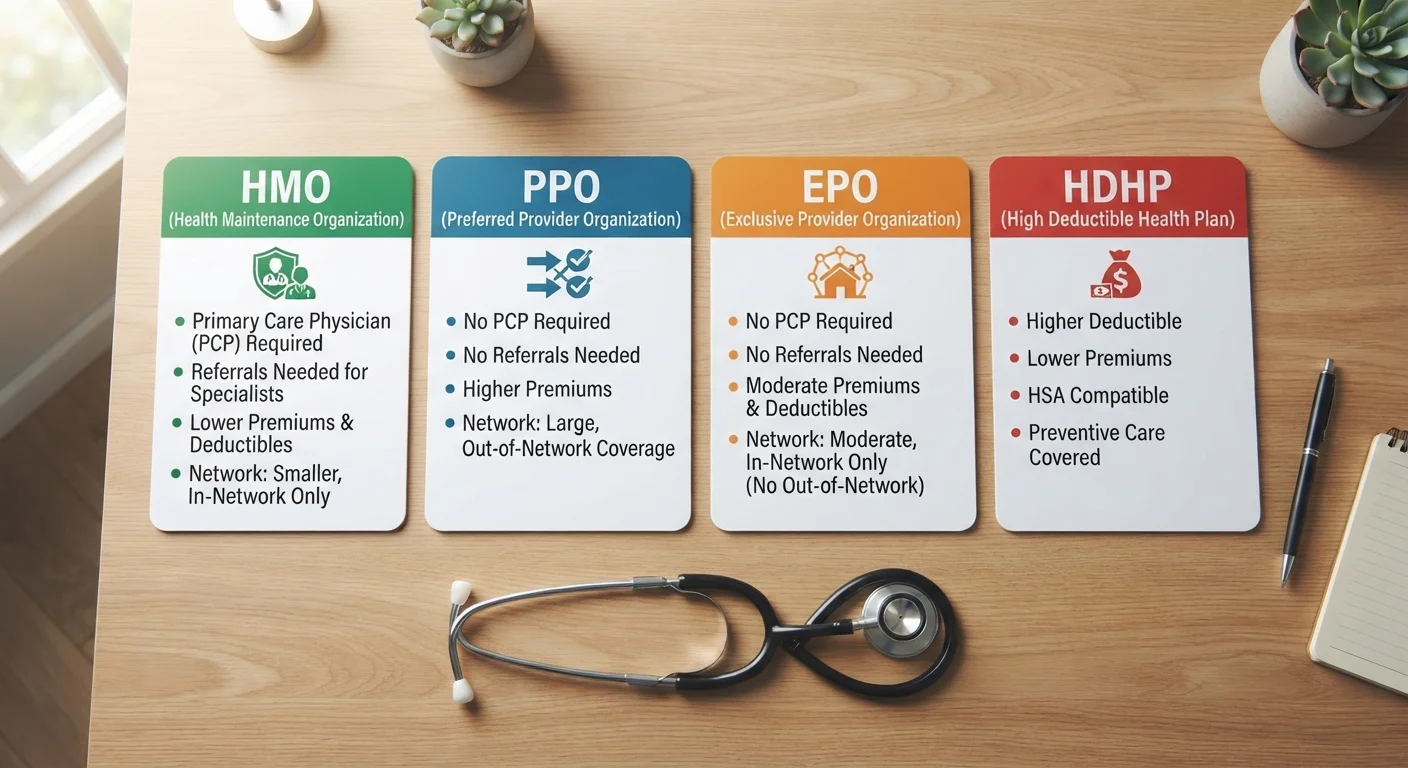
A Health Maintenance Organization (HMO) builds care around a primary care physician (PCP) - a doctor you select who manages your overall health and refers you to specialists when needed. That referral is generally required before a specialist visit will be covered.
HMOs restrict coverage to an established network of providers. Out-of-network care is typically not covered at all, except in genuine emergencies. In exchange for these restrictions, HMOs usually offer lower monthly premiums and predictable copays.
HMOs tend to suit people who:
- Prefer a single doctor coordinating their care
- Want lower premiums and don't have strong attachments to out-of-network providers
- Live or work close to their plan's provider network
PPO: Flexibility at a Higher Price
A Preferred Provider Organization (PPO) gives you the broadest access to care. You can see any doctor - in-network or out-of-network - without a referral. In-network care costs less, but the plan contributes something toward out-of-network visits too, unlike HMOs and EPOs.
That flexibility comes with a higher premium and often a higher deductible than an HMO. PPOs are the most common plan type offered through large employers and tend to appeal to people managing complex or ongoing health conditions who need to see multiple specialists.
For a deeper comparison of these two structures, see HMO vs. PPO: Choosing Between Network Flexibility and Cost Control.
Always Check the Provider Directory First
Before enrolling in any plan - HMO, PPO, or EPO - search the insurer's online provider directory to confirm your current doctors and any specialists you see regularly are listed as in-network. Provider directories can be outdated, so call the provider's office directly to confirm their current network participation before making a final decision.
EPO: In-Network Only, No Referrals Required
An Exclusive Provider Organization (EPO) occupies a middle ground. Like a PPO, it does not require referrals to see a specialist. Like an HMO, it provides no coverage for out-of-network care outside of emergencies.
Because EPOs eliminate out-of-network coverage, insurers can offer them at lower premiums than a comparable PPO. They work well for people who want flexibility in choosing specialists but are confident their preferred providers are in-network - and who are willing to accept the risk of no out-of-network benefit if they travel or need care away from home.
49%
Workers enrolled in PPO plans
According to the Kaiser Family Foundation's 2023 Employer Health Benefits Survey, PPOs remain the most common plan type offered through employers, covering roughly half of covered workers.
29%
Workers enrolled in HDHPs with savings options
The same KFF 2023 survey found that HDHP/HSA-eligible plans account for nearly three in ten covered workers, reflecting steady growth over the past decade.
$1,600
IRS minimum deductible for individual HDHP (2024)
The IRS sets HDHP qualifying thresholds annually; for 2024, an individual plan must carry at least a $1,600 deductible to qualify its enrollee for an HSA.
HDHP: Lower Premiums, Higher Upfront Costs, and the HSA Advantage
A High-Deductible Health Plan (HDHP) is defined by the IRS based on annual deductible thresholds - not by network or referral rules. An HDHP can be structured as an HMO, PPO, or EPO; what makes it an HDHP is that you pay a larger share of costs before the plan begins covering services.
The key benefit: HDHPs are the only plan type that qualifies you to open a Health Savings Account (HSA) - a tax-advantaged account you can use to pay medical expenses. Contributions reduce your taxable income, grow tax-free, and can be withdrawn tax-free for qualified medical costs.
For an honest look at the trade-offs involved, including when an HDHP with an HSA makes sense and when it doesn't, see High-Deductible Health Plans and HSAs: The Trade-offs Worth Understanding.
HDHPs tend to suit people who:
- Are generally healthy and don't anticipate frequent medical visits
- Want to build tax-advantaged savings for future healthcare costs
- Can afford to cover a higher deductible if a significant health event occurs
Preventive Care and HDHPs
Under the Affordable Care Act, most HDHPs must cover a defined set of preventive services - such as annual wellness visits and recommended screenings - at no cost to you, even before you meet your deductible. This means routine preventive care typically does not trigger out-of-pocket costs on an HDHP. See What the ACA's Essential Health Benefits Actually Guarantee for the full list of covered categories.
Putting It Together: How to Think About Which Type Fits
Plan type is one dimension of a health plan decision - cost-sharing structure is another equally important one. Understanding how deductibles, premiums, copays, and out-of-pocket maximums interact across the year helps you estimate your realistic total cost under each option. Deductible, Premium, Copay, and Out-of-Pocket Maximum: How the Four Cost Layers Interact walks through exactly that.
Also consider where your plan comes from: employer-sponsored plans and Marketplace plans follow different rules around eligibility, subsidies, and available options. See Employer-Sponsored vs. Marketplace Health Insurance: Key Differences for more on that distinction.
Regardless of which plan type you choose, verify that your current providers participate in the network before enrolling, confirm that your regular prescriptions are covered under the plan's formulary, and read the actual plan documents - not just the summary. Coverage details, exclusions, and out-of-pocket limits vary significantly between plans of the same type.
This article provides general educational information about health insurance plan types and is not personalized insurance, financial, or medical advice. Coverage rules, costs, and eligibility vary by provider, employer, and state. Consult a licensed insurance agent or benefits adviser for guidance specific to your situation.
Frequently Asked Questions
HMOs require you to choose a primary care physician who coordinates your care and provides referrals to specialists. PPOs let you see any in-network or out-of-network provider without a referral. PPOs generally cost more in premiums but offer greater flexibility.
Yes. EPOs typically do not require referrals to see an in-network specialist. However, EPOs do not cover out-of-network care at all, except in genuine emergencies, so your choice of specialist is limited to the plan's network.
The IRS defines an HDHP each year by minimum deductible and maximum out-of-pocket thresholds. For 2024, a plan must have a deductible of at least $1,600 for individuals ($3,200 for families) to qualify. Meeting these thresholds is what allows you to open a Health Savings Account (HSA).
It depends. HDHPs can work well for people who are generally healthy and can absorb higher upfront costs, especially when paired with an HSA. People who use regular prescriptions or frequent specialist care often find that a lower-deductible plan results in lower total annual costs. Comparing total potential cost - not just the premium - is essential.
In most HMOs, out-of-network care is not covered at all, except in genuine medical emergencies. You would be responsible for the full cost of services received outside the network. Always verify a provider's network status before scheduling care.
Generally, no. HSAs are only available to people enrolled in an IRS-qualifying HDHP. A standard PPO, even one with a relatively high deductible, does not automatically qualify unless it meets the IRS deductible and out-of-pocket limits for HDHPs.
The content on this site is for informational purposes only and is not a substitute for professional advice. Always consult a qualified professional for guidance specific to your situation.