

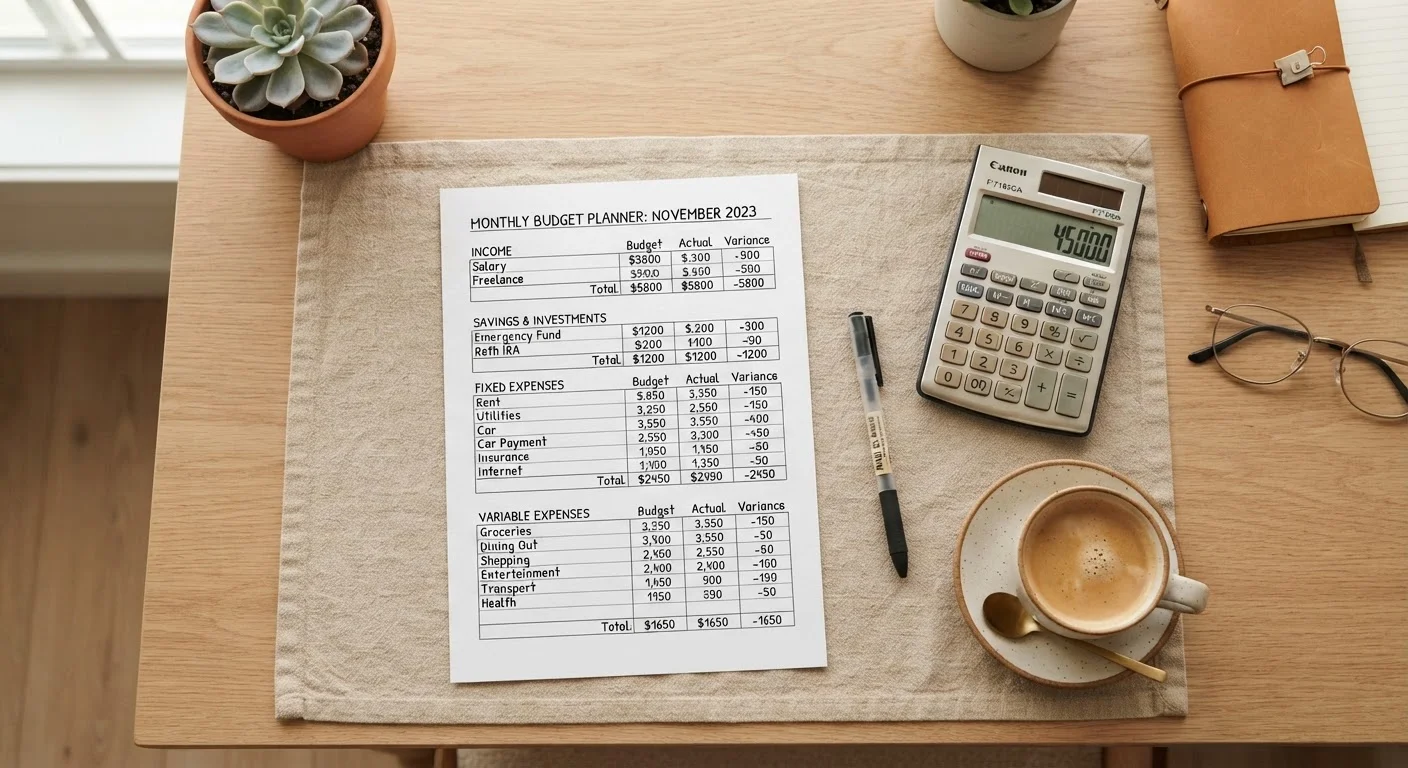
Why Expense Categories Matter
Most people know they spend money on rent, food, and entertainment — but treating all expenses as interchangeable makes budgeting harder than it needs to be. When you sort costs by how they behave, you gain a clearer picture of what's truly fixed in your financial life versus where you have real flexibility.
This distinction matters most when money is tight. If you need to cut $300 from your monthly spending, knowing which expenses are negotiable — and which are locked in — is the starting point. Without that clarity, budgeting often turns into guesswork. For a broader grounding in budgeting vocabulary, see our personal finance terminology guide.
33%
Share of income spent on housing by average US household
According to the U.S. Bureau of Labor Statistics Consumer Expenditure Survey, housing consistently represents the largest single spending category for American households.
~$6,000
Average annual US household food spending
The BLS Consumer Expenditure Survey indicates American households spend thousands annually on food — split between groceries and dining out — a classic mix of variable and discretionary costs.
60%+
Consumers who underestimate monthly discretionary spending
Research from financial planning institutions has consistently found that people substantially underestimate what they spend on optional categories when asked to recall rather than track spending.
Fixed Costs: Your Non-Negotiable Baseline
Fixed expenses are the costs that stay the same every billing cycle regardless of how you behave or what you consume. They typically arrive on a predictable schedule and for a predictable amount. Common examples include:
- Rent or mortgage payments
- Car loan or lease payments
- Health, auto, and life insurance premiums
- Student loan payments on a standard repayment plan
- Fixed-rate internet or phone plans
Because fixed costs don't change, they form the floor of your budget — the minimum you must cover before anything else. The upside is that they're easy to plan around. The downside is that reducing them usually requires a significant life change, like refinancing a loan or moving to a less expensive home.
Audit Your Fixed Costs Annually
Even though fixed expenses don't change month to month, they aren't necessarily permanent. Review insurance premiums, subscription plans, and loan terms at least once a year. Rate changes, better plans, or improved credit scores may open the door to lower fixed obligations — freeing up room in your budget without changing any daily habits.
Variable Costs: The Numbers That Move
Variable expenses are costs that fluctuate from month to month based on usage, consumption, or pricing. They are necessary in the broad sense — you can't avoid buying groceries or paying for electricity — but the exact amount is within your influence.
Common variable expenses include:
- Groceries and household supplies
- Utilities (electricity, gas, water)
- Gasoline or transportation costs
- Medical copays or out-of-pocket healthcare costs
Variable costs are where behavioral changes can directly reduce spending. Shorter showers, meal planning, and combining errands can lower these bills meaningfully over time. People with unpredictable income — freelancers, gig workers, seasonal employees — often find variable costs the hardest to manage, since both income and expenses may shift simultaneously. Our article on budgeting on an irregular income covers frameworks designed for exactly that challenge.
Discretionary Costs: Wants, Not Needs
Discretionary expenses are optional — spending you choose to do because it adds enjoyment, comfort, or convenience to your life, not because it's a necessity. These costs are the most flexible part of any budget and the first place most financial guidance suggests looking when you need to reduce spending.
Examples of discretionary costs include:
- Dining out and takeout
- Streaming, gaming, and entertainment subscriptions
- Clothing beyond basic needs
- Gym memberships and fitness classes
- Travel and vacations
- Hobbies and recreational activities
It's worth noting that discretionary doesn't mean unimportant. Many discretionary expenses support mental health, relationships, and quality of life. The goal isn't to eliminate them entirely but to spend on them intentionally and within your means. Tracking discretionary spending across tools — a notebook, spreadsheet, or app — can make patterns visible. See our comparison of budgeting tracking formats for help choosing an approach.
“A budget is telling your money where to go instead of wondering where it went. The categories you build your budget around determine how much control you actually have.”
— Dave Ramsey, Personal finance author and radio host
Putting All Three Categories to Work in Your Budget
A functional budget accounts for all three expense types rather than focusing narrowly on any one. A simple approach: start by listing all your fixed costs — these are non-negotiable and go in first. Then estimate your variable costs based on recent bank or credit card statements, and finally list your discretionary spending.
Once laid out, you can see how much of your income is already spoken for before you make a single discretionary purchase. If fixed and variable costs consume more than your income, you'll need to look at reducing fixed commitments over time (refinancing, downsizing, changing plans) or trimming variable spending. If there's room after essentials, you can make deliberate choices about discretionary spending rather than watching it disappear without a plan.
For costs that don't arrive monthly — annual insurance renewals, holiday gifts, car maintenance — consider building a sinking fund. Our sinking fund guide explains how to smooth out irregular expenses so they don't disrupt your monthly plan. Once you have a handle on spending categories, you may also want to explore how your habits affect your broader financial picture — including your savings and investment goals and how spending relates to managing debt responsibly.
This article is for general informational and educational purposes only and does not constitute personalized financial advice. Consult a qualified financial professional for guidance tailored to your individual circumstances.
Frequently Asked Questions
Variable expenses change in amount from month to month, such as your grocery or utility bill. Discretionary expenses are optional — things you want but don't strictly need, like streaming services or dining out. An expense can be both variable and discretionary, but not all variable costs are optional (groceries are variable but necessary).
Utilities are typically variable expenses because the amount you owe changes based on usage, seasonal factors, and pricing. Your electricity bill in July may be much higher than in April. Some providers offer budget billing plans that average your costs into a fixed monthly payment.
Categorizing expenses reveals where your money is truly going and highlights where you have room to adjust. Fixed costs establish your non-negotiable floor, while variable and discretionary categories show where behavioral changes can free up cash.
Rent is generally a fixed expense because it stays the same each month for the duration of your lease. However, it becomes variable if you move, if your lease terms change, or if you pay rent on a month-to-month basis.
Yes. A gym membership, for example, is a fixed cost in terms of its monthly amount, but it is discretionary because it is optional. Canceling it would not eliminate a necessity. Fixed and discretionary are not mutually exclusive categories.
Irregular expenses — like annual insurance premiums or car repairs — don't fit neatly into monthly budgeting. One effective approach is a sinking fund, where you set aside a small amount each month toward a predictable future cost. See our <a href="/money-finance/budgeting-basics/sinking-funds-the-budgeting-tool-that-turns-irregular-expenses-into-non-events">guide to sinking funds</a> for how this works in practice.
The content on this site is for informational purposes only and is not a substitute for professional advice. Always consult a qualified professional for guidance specific to your situation.