

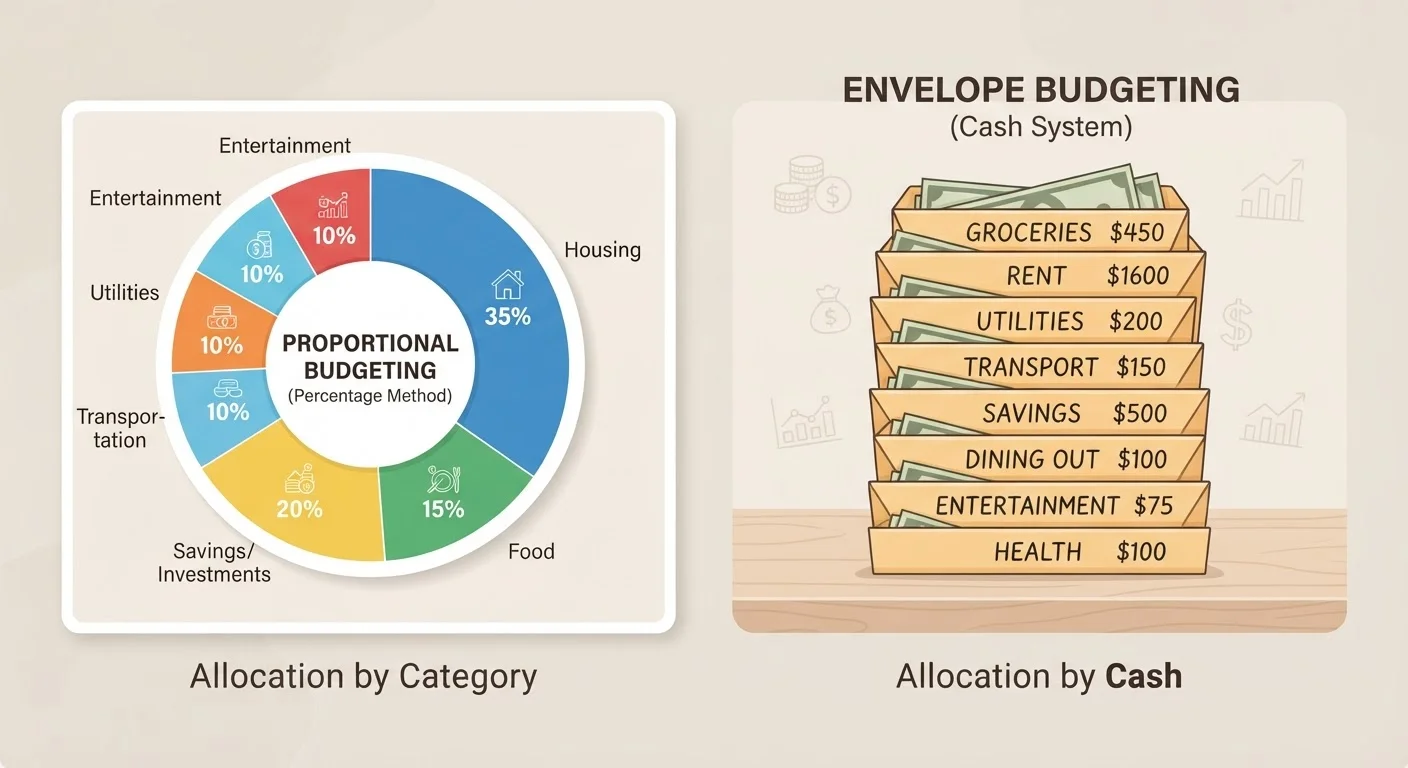
Option A
The 50/30/20 Rule
The flexible, percentage-based framework for modern households.
Best for: People who want a broad, low-maintenance structure that scales automatically with income changes.
Option B
The Envelope Method
The hands-on, cash-based system that makes spending limits tangible.
Best for: People who want strict, category-by-category spending discipline enforced through physical cash.
How Each Framework Works
The 50/30/20 rule is a percentage-based guideline that divides your monthly after-tax income into three broad buckets: 50% toward needs (rent, utilities, groceries, insurance), 30% toward wants (dining out, entertainment, subscriptions), and 20% toward savings and debt repayment. The simplicity is intentional — it gives structure without demanding granular tracking of every transaction.
The envelope method operates on a fundamentally different premise. At the start of each budgeting period — typically monthly or biweekly — you withdraw physical cash and divide it into labeled envelopes, one per spending category (groceries, gas, dining, clothing, and so on). When an envelope is empty, spending in that category stops for the period. No credit cards, no digital top-ups, no exceptions.
These two systems share the same ultimate goal — spending intentionally and building financial stability — but they disagree sharply on how that discipline is created. One trusts percentages and awareness; the other enforces limits through the physical reality of cash.
| Criterion | 50/30/20 Rule | Envelope Method |
|---|---|---|
| Core mechanism | Percentage targets for broad categories | Fixed cash amounts per category |
| Spending enforcement | Awareness-based; no hard stop | Hard stop when envelope is empty |
| Works with digital payments | Yes, fully compatible | Limited; requires cash handling |
| Adapts to variable income | Yes, percentages recalculate | Requires manual recalculation |
| Category specificity | Broad (needs, wants, savings) | Granular (one envelope per category) |
| Setup complexity | Low; one-time percentage setup | Moderate; requires monthly cash prep |
| Best for impulse control | Moderate | High |
| Suited for couples | Generally easier to coordinate | Can be complex with shared spending |
Practical Trade-Offs You Should Weigh
The 50/30/20 rule's biggest strength is its adaptability. If your income rises or falls, the percentages recalculate automatically. You can use a budgeting app, a spreadsheet, or even mental math. It works seamlessly with direct deposit, credit card rewards, and digital payments — the dominant way most Americans handle money today. Its weakness is ambiguity: the line between a "need" and a "want" is subjective, and the rule offers no mechanism to stop you from overspending beyond awareness alone.
The envelope method's strength is its enforcement power. When the grocery envelope is empty on the 25th, that fact is undeniable. Research in behavioral economics consistently shows that people spend less when paying with cash compared to cards — a phenomenon sometimes called the "pain of paying." The trade-off is friction: carrying cash, finding an ATM, maintaining physical envelopes, and dealing with categories that don't map neatly to cash (rent paid by check, online subscriptions billed automatically).
~18%
Average US personal savings rate
The U.S. Bureau of Economic Analysis tracks the personal saving rate; it has historically fluctuated, highlighting how few households consistently hit the 20% savings target.
~$1,000
Median monthly discretionary spending
U.S. Bureau of Labor Statistics Consumer Expenditure data shows that discretionary categories represent a significant share of average household spending, making them a key target for both frameworks.
For a deeper look at how strict spending rules affect behavior over time, see our piece on strict budgeting's advantages and hidden costs.
Which Framework Fits Your Life
The right framework is determined less by which system is objectively better and more by which one you'll actually maintain. A budget you abandon in week two delivers zero value, regardless of its theoretical elegance.
Consider the 50/30/20 rule if:
- Your income is irregular or varies month to month.
- You primarily use cards or digital payments and prefer not to handle cash.
- You want a framework that scales with life changes — a raise, a new expense, a family addition.
- You're managing shared finances with a partner. See our full guide on budgeting as a couple for practical approaches.
Consider the envelope method if:
- You've tried awareness-based budgeting and continue to overspend in specific categories.
- You respond well to physical, tactile limits rather than digital dashboards.
- You have predictable, recurring income that makes cash withdrawal practical.
- You want to build stronger spending habits from scratch.
Some households use a hybrid approach: the 50/30/20 rule to set macro targets, and envelopes (or digital equivalents like dedicated debit accounts) to enforce limits in high-risk categories like dining and discretionary spending.
Whichever method you choose, pairing it with a regular review process amplifies its impact. Our monthly budget checkup guide walks through a structured way to audit your spending and catch drift before it compounds. You might also consider a weekly money check-in to stay aligned throughout the month, not just at the end of it.
Once your budgeting framework is stable, your attention can shift toward growth. Explore the Saving & Investing hub for foundational concepts on putting your savings to work.
For help choosing how to track your spending within either framework, comparing paper ledgers, spreadsheets, and apps can clarify your options.
This article provides general financial education and is not personalized financial advice. Consult a qualified financial professional for guidance specific to your situation.
The content on this site is for informational purposes only and is not a substitute for professional advice. Always consult a qualified professional for guidance specific to your situation.