

How Credit Scores Actually Work
A credit score is a three-digit number—typically ranging from 300 to 850—that summarizes how reliably you've managed borrowed money. Lenders, landlords, and sometimes employers use it to assess risk. The most widely used scoring models weight five core factors:
- Payment history (≈35%): Whether you pay on time is the single largest driver.
- Credit utilization (≈30%): The share of your available revolving credit you're using. Keeping it below 30% is a commonly cited guideline.
- Length of credit history (≈15%): How long your accounts have been open, on average.
- Credit mix (≈10%): Having both revolving accounts (credit cards) and installment loans (auto, mortgage) can help.
- New credit inquiries (≈10%): Applying for several new accounts in a short window can temporarily lower your score.
Scores don't move overnight. They reflect months and years of behavior. Understanding these levers lets you make changes that actually matter rather than chasing quick fixes that rarely work.
35%
Weight of payment history in FICO score
According to FICO's published scoring model breakdown, on-time payment history is the single largest factor in your credit score.
1 in 5
Americans with credit report errors
A Federal Trade Commission study found that roughly one in five consumers had an error on at least one of their credit reports.
30%
Recommended maximum credit utilization
Credit scoring guidance consistently cites keeping revolving utilization below 30% as a benchmark for maintaining a healthy score.
Reading and Monitoring Your Credit Report
Your credit report is the raw data behind your score—a detailed record of every account, balance, payment, and public record tied to your name. You're entitled to a free report from each of the three major bureaus (Equifax, Experian, and TransUnion) through AnnualCreditReport.com, the official federally authorized source.
When reviewing your report, focus on four areas: account accuracy (are all listed accounts truly yours?), payment history (do any late payments appear in error?), balances (do they match your records?), and public records (bankruptcies, judgments). Errors are more common than most people expect. Disputing inaccuracies directly with the bureau is your right under the Fair Credit Reporting Act (FCRA).
For a detailed walkthrough of every section of a credit report and what each entry means, see our guide to reading your credit report.
Checking Your Own Credit Doesn't Hurt It
Reviewing your own credit report or score is classified as a 'soft inquiry' and has no negative effect on your score. Only 'hard inquiries'—initiated when a lender checks your credit for a new application—can temporarily lower it. You can and should check your own report regularly without concern.
Debt Payoff Strategies: Avalanche vs. Snowball
Two structured approaches dominate personal finance guidance on debt elimination:
- Avalanche method
- Pay minimums on all debts, then direct any extra money toward the account with the highest interest rate. This approach minimizes total interest paid over time and is mathematically optimal for most borrowers.
- Snowball method
- Pay minimums on all debts, then attack the smallest balance first regardless of rate. Paying off individual accounts faster delivers psychological wins that help some people stay motivated.
Neither strategy is universally superior. Research suggests that the snowball method can be more effective for people who struggle with motivation, while high-interest-rate situations—such as credit card debt above 20% APR—can make the avalanche method significantly more cost-effective. A hybrid approach, targeting a small balance first to build momentum before shifting to the highest-rate debt, is also a legitimate option.
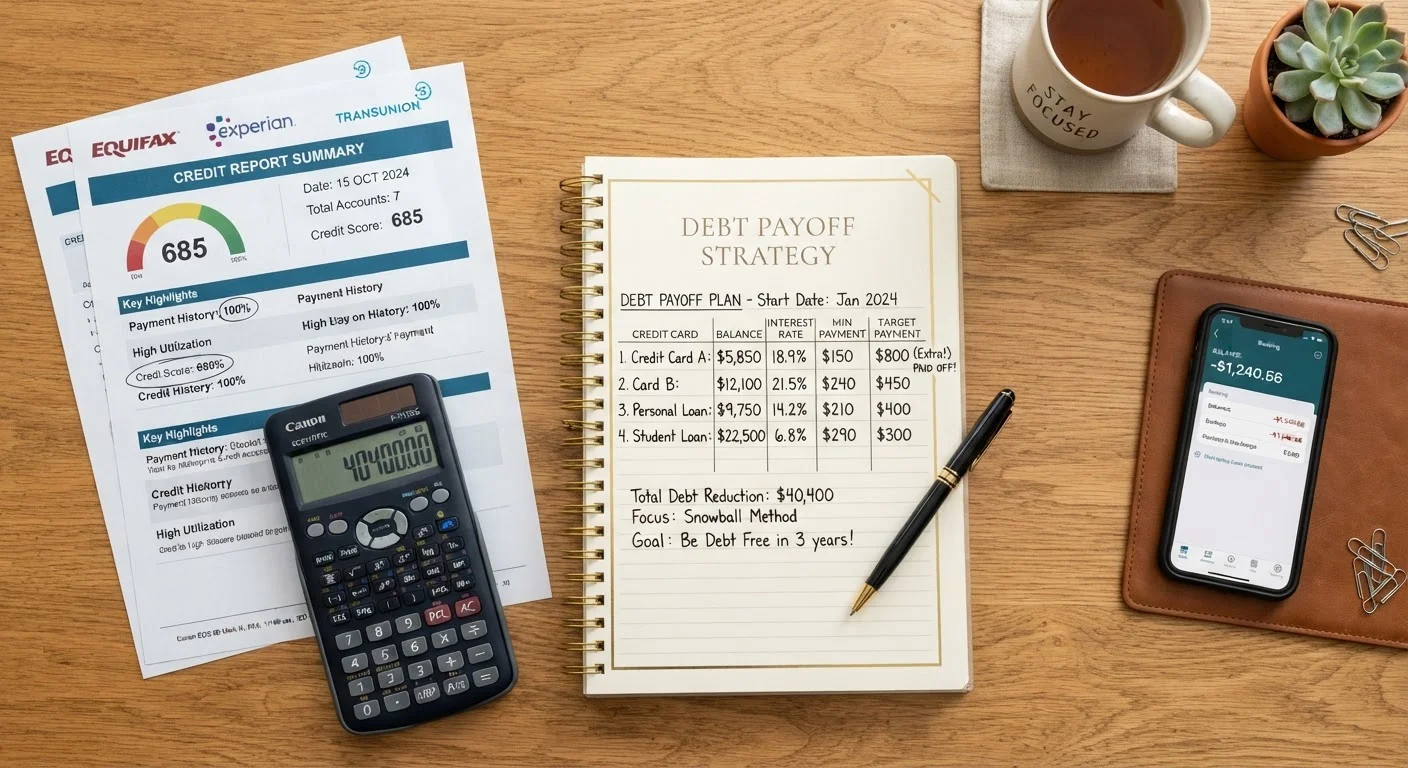
Before committing to a payoff method, list all your debts with their balances, interest rates, and minimum payments in one place. Seeing the full picture often clarifies which approach will have the most impact for your specific situation.
Borrowers frequently underestimate how much high-rate debt is costing them monthly; a clear comparison table makes the case for prioritization concrete rather than abstract.
If you receive a windfall—a tax refund, bonus, or gift—consider directing at least a portion directly to your highest-cost debt before adjusting your lifestyle spending.
Lump-sum payments applied to principal reduce the total interest accrued over time more efficiently than spreading the same amount over many months of slightly higher regular payments.
Whatever method you choose, automating minimum payments first prevents accidental late fees from derailing your progress. Pair your payoff plan with a realistic spending framework—our budgeting basics hub offers practical frameworks for tracking spending alongside debt goals.
Borrowing Decisions: What to Weigh Before You Sign
Not all debt is harmful, but all debt carries cost and risk. Before taking on any new loan, a sound evaluation covers:
- Debt-to-income (DTI) ratio: Divide your total monthly debt payments by your gross monthly income. Most conventional lenders prefer a DTI below 36%, though thresholds vary by loan type.
- Total cost of borrowing: The Annual Percentage Rate (APR) reflects interest plus fees. On a long-term loan, even a 1% difference in APR can translate to thousands of dollars over the life of the loan.
- Necessity vs. convenience: Borrowing for a home or education involves different risk calculus than borrowing for discretionary spending.
- Repayment flexibility: Understand prepayment penalties, grace periods, and what happens if your income changes.
For a deeper look at principles that apply across every loan type, see borrowing responsibly.
Variable Rate Loans Carry Future Risk
Loans with variable interest rates may look attractive when rates are low, but your monthly payment can increase substantially if benchmark rates rise. Before choosing a variable-rate product, model what your payment would look like at a meaningfully higher rate and confirm your budget can absorb it. If it cannot, a fixed rate may offer more predictable protection.
Habits That Protect Your Credit Over Time
Strong credit is built through repetition, not dramatic moves. The behaviors that matter most are also the most mundane: paying every bill on time, keeping card balances well below their limits, and avoiding unnecessary new applications.
Several everyday habits quietly cause damage without obvious warning signs—carrying high balances month to month, co-signing loans without understanding the exposure, or closing old accounts impulsively. Our look at habits that quietly damage credit covers these in detail.
It's also worth noting that financial stress has a documented relationship with mental health. Managing debt isn't only a numbers exercise—if you find that money worries are affecting your sleep or daily wellbeing, the mental wellbeing hub has relevant resources.
Set Up Autopay for Minimums First
Automating at least the minimum payment on every account eliminates the risk of accidental late payments—one of the fastest ways to damage a credit score. You can always pay more manually; the automation serves as your safety net. Review your autopay settings after any income or account change to ensure they remain accurate.
When to Seek Professional Help
There are situations where self-directed strategies aren't enough. If your debt-to-income ratio is unmanageable, you're receiving collection calls, or you're considering debt settlement or bankruptcy, consulting a licensed professional is prudent—not a last resort.
Nonprofit credit counseling agencies—many affiliated with the National Foundation for Credit Counseling (NFCC)—offer free or low-cost guidance and can negotiate with creditors on your behalf through a Debt Management Plan (DMP). Be cautious of for-profit debt settlement companies that charge high fees and can cause significant credit damage. A licensed financial adviser, CPA, or consumer law attorney can also clarify options specific to your situation.
This article provides general financial education only and does not constitute personalized financial, legal, or credit advice. Readers with complex debt situations should consult a qualified, licensed professional.
This article is for informational purposes only and does not constitute financial, legal, or credit advice. Consult a qualified financial professional before making decisions about your specific financial situation.
The content on this site is for informational purposes only and is not a substitute for professional advice. Always consult a qualified professional for guidance specific to your situation.