

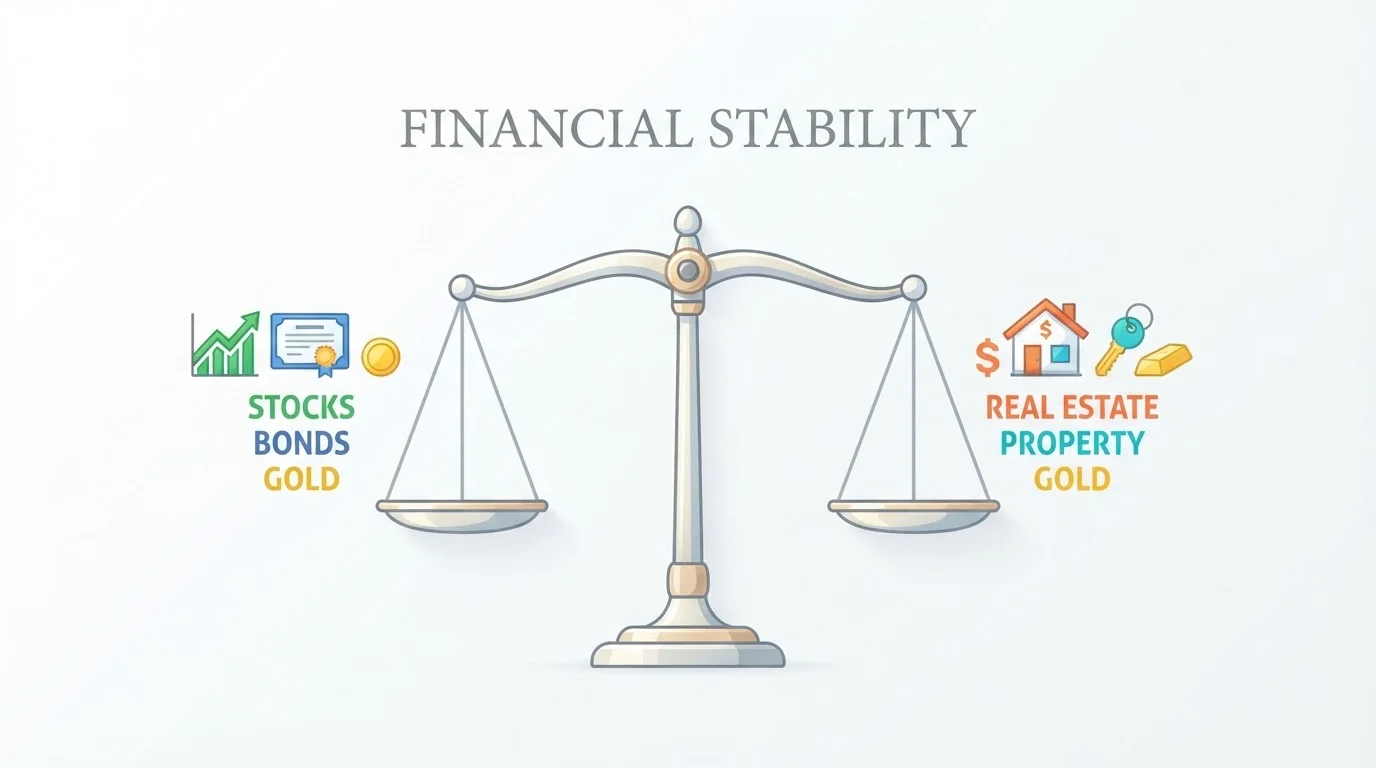
Why "Don't Put All Your Eggs in One Basket" Is Financial Wisdom
The old saying about eggs and baskets captures the essence of diversification perfectly. If you place all your savings into a single company's stock and that company collapses, you lose everything. But if that same investment represents just one part of a broader portfolio, the damage is contained.
Diversification is the formal application of this logic. It is one of the most widely cited principles in personal finance — not because it guarantees gains, but because it gives your portfolio a better chance of surviving turbulent markets. For everyday investors, it is arguably the most practical tool available for managing risk without requiring expert-level market knowledge.
To understand why diversification works, it helps to recognize that different assets don't always move in the same direction at the same time. When stock markets fall sharply, bonds have historically — though not always — held their value better. When domestic markets struggle, international ones may not. Diversification takes advantage of this variation. See also: the difference between saving and investing, since understanding both concepts is essential context for any investing conversation.
What Diversification Actually Looks Like
Many people assume diversification simply means owning more than one stock. In practice, it's more nuanced than that. True diversification spans multiple dimensions:
- Asset classes: Holding a mix of stocks, bonds, cash equivalents, and potentially real assets like real estate investment trusts (REITs).
- Sectors: Within stocks, spreading across industries — technology, healthcare, energy, consumer goods — so weakness in one sector doesn't dominate your results.
- Geographies: Including both domestic and international investments to reduce dependence on a single country's economic performance.
- Company size: Mixing large-cap and small-cap companies, which can behave differently under similar market conditions.
Owning 50 technology stocks might feel diversified, but those holdings will likely all respond to the same industry-level pressures. Genuine diversification requires meaningful differences between what you hold.
500+
Companies in a broad US index fund
The S&P 500 index includes over 500 large US companies across 11 sectors, giving a single index fund exposure to a wide range of industries and company types.
~20%
Risk reduction from basic diversification
Academic research in modern portfolio theory, associated with Nobel laureate Harry Markowitz, suggests that diversification can substantially reduce portfolio volatility compared with concentrated single-stock holdings.
3
Core asset classes for a basic diversified portfolio
Financial educators commonly reference stocks, bonds, and cash equivalents as the three foundational asset classes that form the basis of a diversified investment strategy.
The Limits of Diversification
Diversification is a powerful tool, but it has real limits that every investor should understand. It eliminates what financial professionals call unsystematic risk — the risk tied to a specific company or sector. If one company faces a scandal or a single industry collapses, a diversified portfolio absorbs only a portion of that shock.
What diversification cannot protect against is systematic risk — the broad market risk that affects nearly all investments simultaneously. During the 2008 financial crisis and the early months of the 2020 pandemic, stock markets fell sharply across almost all sectors and geographies. Diversified portfolios still declined; they simply declined less severely than concentrated ones in many cases.
Understanding your risk tolerance is a natural companion to diversification — because how you spread your investments should reflect how much uncertainty you can realistically handle, both financially and emotionally.
Diversification Isn't a Set-and-Forget Strategy
Over time, strong performance from one asset class can shift your portfolio's balance — a process called 'drift.' For example, if stocks rise significantly, they may come to represent a much larger share of your portfolio than intended. Periodically reviewing your allocation — a process called rebalancing — helps maintain the level of diversification you originally aimed for. A financial professional can guide you on how often and how to rebalance.
Practical Ways Everyday Investors Achieve Diversification
Building a diversified portfolio doesn't require trading dozens of individual securities. Several common investment vehicles are specifically designed to provide built-in diversification:
- Index funds: These track a broad market index — such as the S&P 500 or a total market index — automatically spreading exposure across hundreds or thousands of companies. Learn more about how index funds work and why they're frequently discussed in financial education.
- Target-date funds: These automatically adjust their asset mix — gradually shifting from stocks toward bonds — as a specified retirement year approaches.
- Exchange-traded funds (ETFs): Like index funds, many ETFs offer broad exposure to a market segment in a single purchase.
Pairing diversification with a consistent contribution strategy — such as dollar-cost averaging — can further smooth out the effects of market volatility over time.
Start Simple, Then Refine Over Time
If building a diversified portfolio feels overwhelming, a single broad market index fund is a reasonable starting point for many investors. Over time, you can consider adding bond funds or international exposure as your knowledge and financial situation evolve. A licensed financial adviser can help you build a strategy suited to your specific goals and timeline.
This article is for general informational and educational purposes only. It does not constitute personalized financial, investment, tax, or legal advice. Consult a qualified financial professional before making decisions about your own financial situation.
Frequently Asked Questions
No. Diversification reduces certain types of risk but cannot prevent losses, especially during broad market downturns that affect virtually all asset classes. It is a risk-management strategy, not a guarantee of positive returns. Always consult a financial professional before making investment decisions.
There's no single number, but research in portfolio theory suggests that holding a range of uncorrelated assets matters more than a specific count. Owning 30 stocks in the same sector offers less diversification than owning assets across multiple sectors and asset classes.
Broad market index funds — like those tracking the total US stock market — offer significant diversification within equities. However, a single index fund still concentrates you in one asset class. A fully diversified portfolio typically includes a mix of stocks, bonds, and potentially other asset types.
Over-diversification occurs when adding more holdings no longer meaningfully reduces risk but increases complexity and potential costs. At some point, spreading investments too thin can dilute returns without providing proportional protection.
Generally, yes. As investors approach retirement, shifting toward a more conservative mix — with a higher proportion of bonds relative to stocks — is a common strategy to reduce exposure to market volatility when there is less time to recover from losses.
The content on this site is for informational purposes only and is not a substitute for professional advice. Always consult a qualified professional for guidance specific to your situation.