

Why 'Spite' Is the Wrong Explanation
Few cat behaviors frustrate owners more than finding waste outside the litter box. The instinct is to assume the cat is angry, punishing, or "getting back" at you for a perceived slight. It's a deeply human interpretation — and it's almost always wrong.
Cats lack the executive function required for premeditated revenge. What looks like spite is invariably a communication signal. Your cat is telling you something is wrong — with their body, their box, or their environment. Misreading that message as attitude leads owners to respond with punishment, which makes the problem worse and damages the trust between pet and owner.
Understanding what actually drives litter box avoidance puts you in a position to solve it. The myths below are among the most common — and most consequential — that veterinary professionals and behaviorists encounter.
Myth
My cat is urinating outside the box to punish me for being away too long.
Fact
Cats do not plan or execute revenge. Outside-the-box urination is almost always a medical or environmental signal.
Feline cognition does not include the capacity for spite. Studies in animal behavior consistently show that cats lack the theory of mind — the ability to attribute mental states to others — needed to plan retaliatory behavior. When a cat urinates on your pillow or laundry, it is seeking a surface with a familiar scent to feel safer, often because something about the litter box has become aversive or because the cat is experiencing physical discomfort.
Urinary tract infections (UTIs), feline idiopathic cystitis (FIC), kidney disease, and bladder stones are among the most common reasons a cat suddenly avoids the box. Pain during urination becomes associated with the box itself, so the cat seeks an alternative location. This is a veterinary issue first — not a behavior issue.
Myth
A covered litter box gives cats more privacy and they prefer it.
Fact
Many cats actually dislike covered boxes because they trap odors and limit escape routes.
From a human perspective, a covered box seems considerate. From a cat's perspective, it can feel like a trap. Odors concentrate inside enclosed boxes at levels that are repellent to the highly sensitive feline nose — even when the box smells clean to you. Covered designs also restrict the cat's ability to monitor its surroundings for threats, which matters to a prey species that is instinctively vulnerable when eliminating.
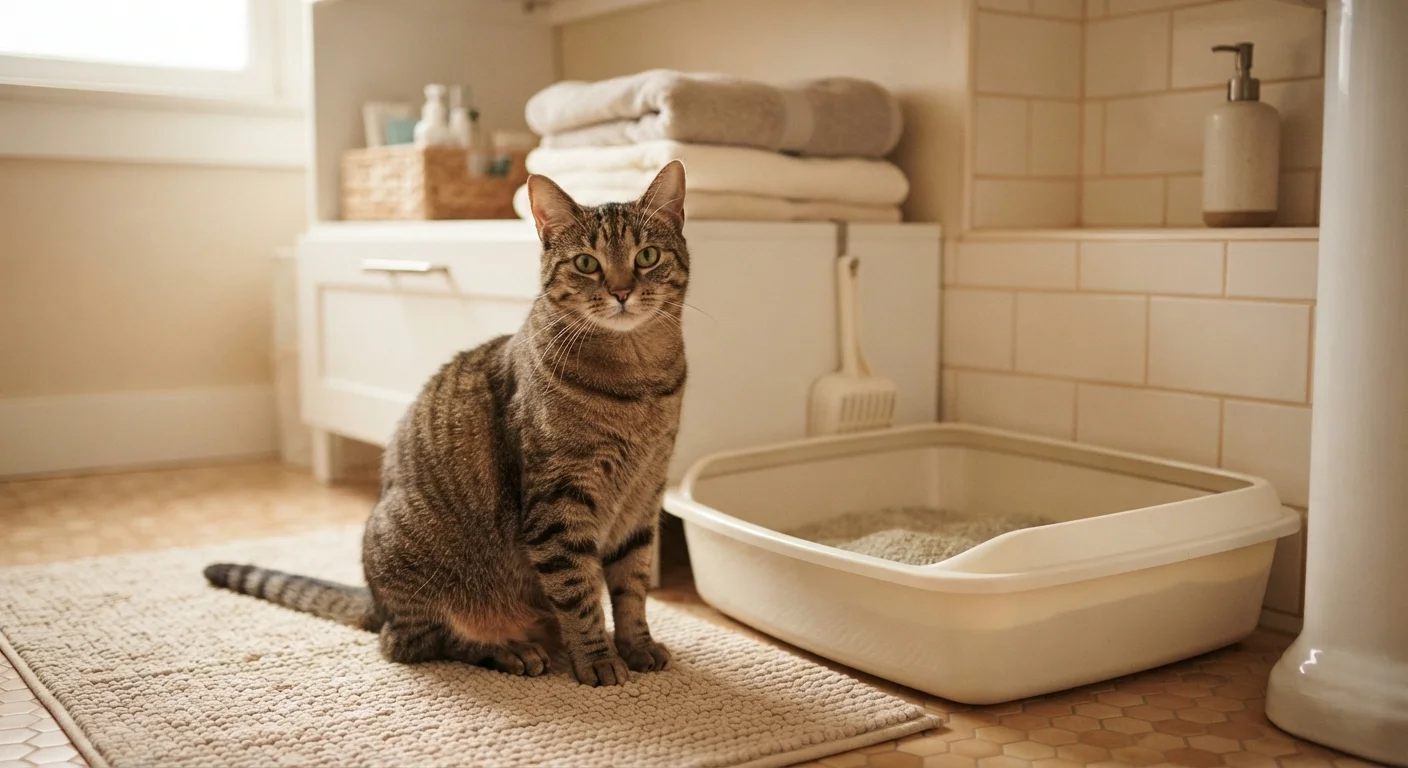
Research and clinical experience in veterinary behavioral medicine consistently find that open, large, low-sided boxes are preferred by the majority of cats. If your cat has been avoiding a covered box, try switching to an open one before assuming anything else is wrong.
Myth
Cats don't care what kind of litter you use, as long as the box is clean.
Fact
Litter texture and scent are significant factors — many cats have strong preferences and will avoid litters they find aversive.
Cats walk barefoot on their litter. Texture matters enormously. Veterinary behaviorists note that most cats prefer an unscented, fine-grained clumping litter that mimics the feel of soft outdoor soil or sand. Heavily perfumed litters, coarse pellets, or crystal-based products may be convenient for owners but are often rejected by cats.
Abrupt litter changes are a common trigger for avoidance. If you need to switch litters, do so gradually — mixing increasing amounts of the new litter with the old over one to two weeks. This approach respects the cat's sensitivity while achieving the transition.
Myth
As long as I scoop once a week, the litter box is fine.
Fact
Most cats require scooping at least once daily and a full litter change regularly to use the box consistently.
A cat's sense of smell is estimated to be roughly 14 times more powerful than a human's. What smells tolerable to you after two or three days can be overwhelmingly offensive to your cat. Cats are fastidiously clean animals by nature, and refusing to use a dirty box is not stubbornness — it is a reasonable response to an unsanitary condition.
The standard veterinary recommendation is to scoop solid waste at least once daily, and to fully empty, wash with mild unscented soap, and refill the box every one to two weeks. The number of boxes, the number of cats, and individual preferences can require more frequent maintenance than this baseline.
Myth
If my cat occasionally uses the box, the problem must be behavioral, not medical.
Fact
Partial or inconsistent box use can still indicate an underlying medical condition that needs veterinary evaluation.
Medical conditions rarely cause complete, immediate litter box abandonment. More commonly, a cat with a UTI, early kidney disease, hyperthyroidism, or arthritis will use the box erratically — sometimes making it, sometimes not. Older cats with joint pain may reach the box but struggle to posture correctly, leading to accidents on the rim or nearby floor.
Any new pattern of avoidance — even occasional — warrants a veterinary check-up, particularly if accompanied by straining, crying, blood in urine, or changes in frequency. Waiting to see if the behavior resolves on its own can allow a treatable condition to progress. See also how lifestyle affects feline health across a cat's lifetime for broader context on indoor cat wellness.
How Environment and Routine Shape Litter Box Success
Even when medical causes are ruled out, the physical setup of the litter box is a frequent culprit. Cats are highly sensitive to smell, texture, and location — more so than most owners realize.
Male Cats Straining to Urinate: Seek Immediate Veterinary Care
A male cat that is repeatedly visiting the litter box, producing little or no urine, or crying while attempting to urinate may have a urinary blockage — a life-threatening emergency. Do not wait to see if it resolves. Contact a veterinarian or emergency animal clinic immediately.
A useful benchmark is the n+1 rule: provide one litter box per cat, plus one additional box. In multi-cat households, resource competition is a leading cause of avoidance, especially for more submissive cats who feel unsafe using a box another cat guards. Similarly, boxes placed in loud, high-traffic, or hard-to-reach areas may be avoided even when they are clean.
Changes in your household — a new baby, a move, a new pet, or even a shift in your daily schedule — can also trigger avoidance. Just as separation anxiety and boredom can look alike, environmental stress and true medical problems can produce identical litter box symptoms. A systematic approach — ruling out health issues first, then auditing the environment — is the most reliable path to a resolution.
~10%
Cats affected by feline idiopathic cystitis
Veterinary estimates suggest roughly 1 in 10 cats will experience feline idiopathic cystitis at some point, a painful condition commonly misread as a behavior problem.
14×
Cats' smell sensitivity vs. humans
A cat's olfactory system is estimated to be approximately 14 times more sensitive than a human's, explaining why litter box hygiene matters far more to your cat than it may appear to you.
Your cat's indoor environment shapes far more than litter box habits. For a broader look at how lifestyle affects feline behavior and wellbeing, see how environment shapes a cat's health and behavior.
This article is for general informational and educational purposes only and is not a substitute for professional veterinary advice. If your cat has stopped using the litter box or shows signs of discomfort, consult a licensed veterinarian.
The content on this site is for informational purposes only and is not a substitute for professional advice. Always consult a qualified professional for guidance specific to your situation.