

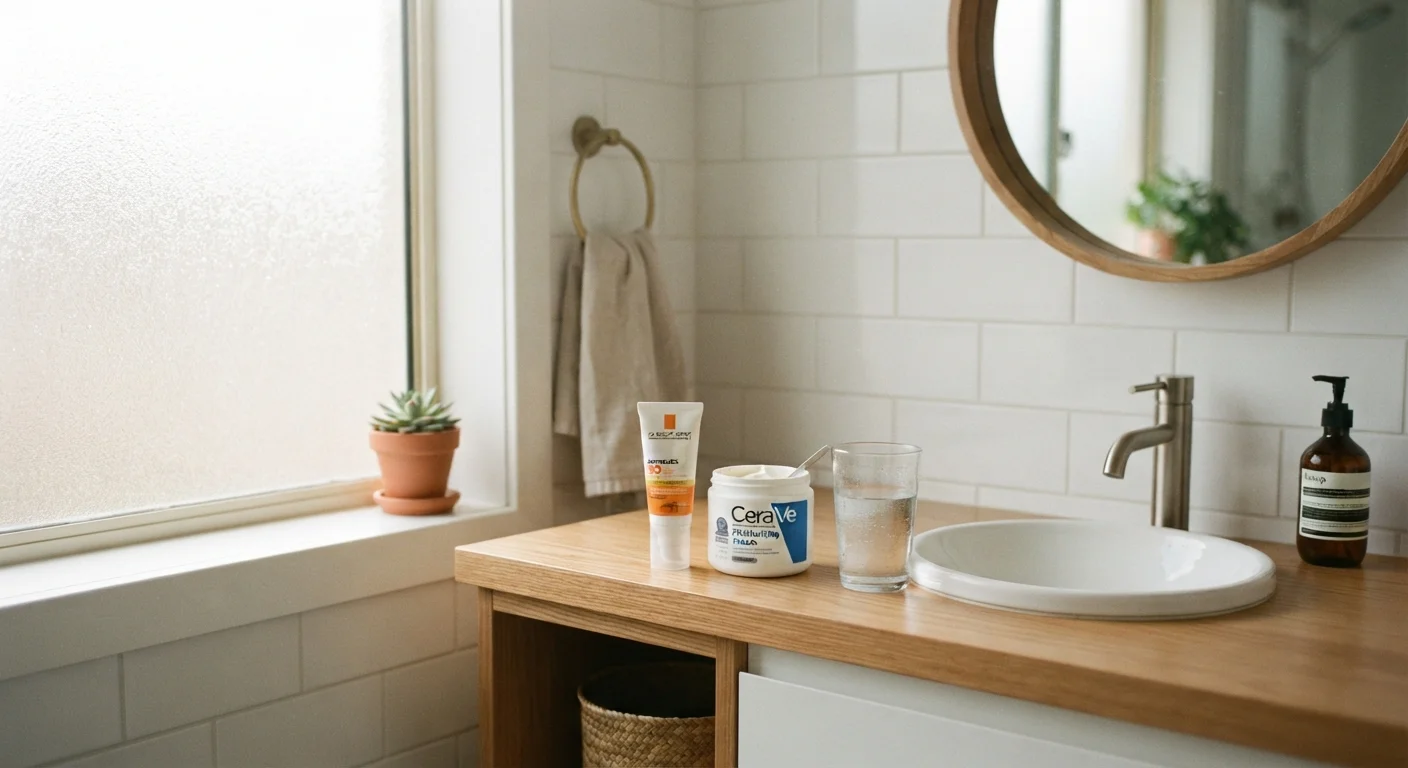
UV Exposure Is Not a Seasonal Event
Most of us associate sunscreen with beach bags and pool days. But UV radiation doesn't clock out when summer ends. The sun emits two types of UV rays that matter to skin health: UVA rays, which penetrate deeply and contribute to premature aging and pigmentation changes, and UVB rays, which cause sunburn. Both are present year-round, even in winter months and overcast weather.
Here's the part that surprises many people: UVA rays pass through glass. That means time spent near a sunny window at home, in a car, or at an office desk counts as UV exposure. Your commute, a lunch break walk, or grabbing the mail — these add up over weeks and years into cumulative skin stress.
80%
UV rays that penetrate cloud cover
The Skin Cancer Foundation notes that up to 80% of UV rays pass through clouds, making cloudy-day protection just as relevant.
SPF 30
Dermatologist-recommended daily minimum
Major dermatology organizations broadly recommend SPF 30 broad-spectrum sunscreen as the baseline for everyday use.
90%+
Skin aging attributed to UV exposure
Research published in dermatology literature suggests the majority of visible skin aging signs, like wrinkles and spots, stem from cumulative UV damage rather than chronological aging alone.
If you're already thinking through a morning skincare routine, building a skincare routine from scratch is a great place to see where SPF fits alongside your cleanser and moisturizer.
What 'Broad-Spectrum SPF 30' Actually Means
Labels on sunscreen can feel like a quiz you didn't study for. Here's a plain-language breakdown of what actually matters:
- SPF number: Indicates UVB protection level. SPF 30 filters roughly 97% of UVB rays; SPF 50 filters about 98%. No sunscreen blocks 100%.
- Broad-spectrum: This label means the product protects against both UVA and UVB rays — always look for this on the package.
- Mineral vs. chemical: Mineral formulas (zinc oxide, titanium dioxide) sit on top of skin and reflect UV rays. Chemical formulas absorb UV energy and convert it to heat. Both work; choice often comes down to skin type and feel preference.
Understanding your skin's other needs is just as important. Check out how the skin barrier works and why routines should protect it — SPF is one of the most direct ways to preserve it.
A Simple Test for Even Coverage
Most people apply about half the sunscreen needed to reach the labeled SPF. For the face alone, a nickel-sized amount is a commonly cited guideline. Don't forget the ears, neck, and the back of hands — areas that see consistent sun exposure but are often skipped.
Making Daily SPF a Habit That Actually Sticks
The most effective sunscreen is the one you actually use consistently. A few practical approaches make daily SPF feel seamless rather than like an extra chore:
- Stack it onto an existing step. Apply sunscreen as the last step of your morning skincare routine, right before makeup if you wear it. Habit-stacking — attaching a new behavior to one you already do — is one of the most reliable ways to build consistency.
- Keep texture in mind. Lightweight, fast-absorbing formulas work well under makeup. Tinted SPF options can double as a light coverage base. If a formula feels heavy or leaves a white cast, try a different type — there are enough options that comfort shouldn't be a barrier.
- Reapply when it counts. For typical indoor days with brief outdoor exposure, a morning application generally holds. For extended outdoor time, reapplication every two hours is the standard recommendation.
Staying consistent week over week is what delivers long-term benefit. The weekly skincare checklist for a consistent, balanced routine can help you track SPF alongside other skin habits.
SPF and Sensitive or Acne-Prone Skin
If you've avoided sunscreen because it broke you out or irritated your skin, mineral formulas are often better tolerated by sensitive and acne-prone skin types. Look for labels like 'non-comedogenic' (meaning it won't clog pores) and fragrance-free to minimize reaction risk. A dermatologist can help narrow down options if standard formulas continue to cause problems.
This article is for general informational and educational purposes only. It is not a substitute for professional medical or dermatological advice. Consult a qualified healthcare provider with any questions about your skin health.
Frequently Asked Questions
Yes. Up to 80% of UV rays can penetrate cloud cover, according to dermatology guidance. Overcast skies reduce visible light, not ultraviolet radiation, so skin exposure continues even when the sun isn't visible.
Most dermatologists recommend at least SPF 30 for everyday use, which blocks roughly 97% of UVB rays. Higher SPF values offer marginally more protection but no formula blocks 100% of UV radiation.
Research suggests that incidental sun exposure — through windows, short walks, and gaps in application — typically provides sufficient vitamin D for most people. If you have concerns about vitamin D levels, speak with a healthcare provider.
SPF-infused makeup and moisturizers offer some protection, but most people don't apply enough to reach the labeled SPF value. A dedicated sunscreen layer applied underneath provides more reliable coverage.
Yes. While higher melanin levels provide some natural UV protection, all skin tones are susceptible to UV-related skin damage, hyperpigmentation, and skin cancer. Daily SPF is a broadly recommended practice regardless of skin tone.
The content on this site is for informational purposes only and is not a substitute for professional advice. Always consult a qualified professional for guidance specific to your situation.