

Start here
Why a Simple Routine Beats a Complicated One
Next
The Core Three: Cleanser, Moisturizer, SPF
Then
Understanding Your Skin Type
When you're ready
When to Add More to Your Routine
Why a Simple Routine Beats a Complicated One
Walk into any beauty aisle and it's easy to feel like skincare requires a ten-step regimen and a chemistry degree. It doesn't. The truth is, a simple, consistent routine almost always outperforms a cluttered one — especially when you're starting out.
Skin needs time to adjust to new products. Piling on serums, toners, acids, and masks all at once makes it nearly impossible to know what's helping and what's causing breakouts or irritation. Starting with fewer products isn't a compromise — it's the smarter approach. Once the basics feel automatic, you can expand thoughtfully.
Start With What You'll Actually Use
The best skincare routine is the one you'll follow every day. If a ten-step process sounds exhausting, don't start there. Choose products with textures and scents you enjoy — you're far more likely to stay consistent. Consistency over months beats perfection applied sporadically.
For anyone curious about how a general self-care framework fits around skincare, the Grooming & Self-Care hub is a useful starting point for the bigger picture.
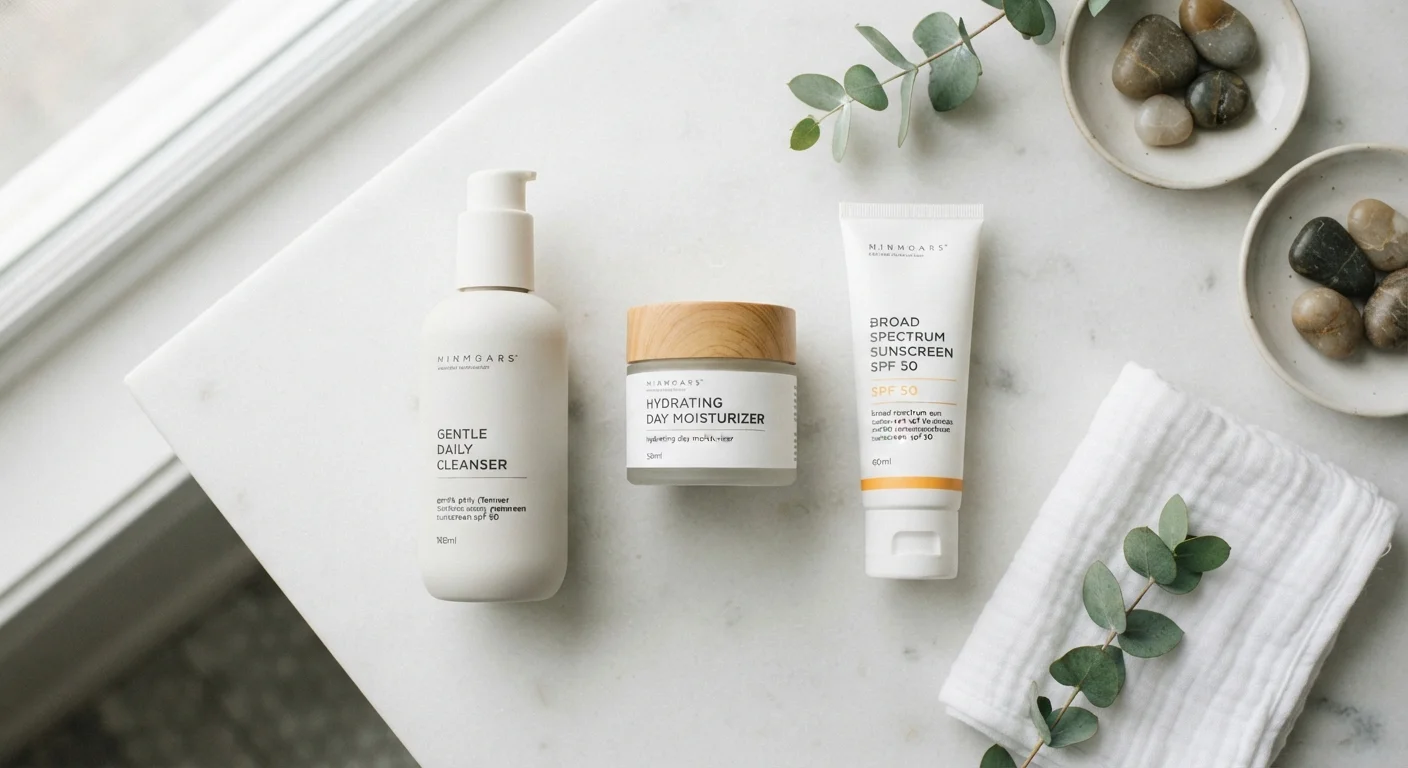
The Core Three: Cleanser, Moisturizer, SPF
These three steps form the backbone of any solid skincare routine — morning and night, for any skin type, any budget.
Cleanser
A gentle cleanser removes dirt, excess oil, and environmental residue without stripping your skin's natural barrier. Look for terms like "gentle," "sulfate-free," or "pH-balanced" as general signals of a mild formula. Cleansing twice a day — once in the morning and once at night — is a standard recommendation, though very dry skin types sometimes do better with just a rinse in the morning.
Moisturizer
Every skin type needs hydration, including oily skin. A moisturizer helps maintain your skin barrier, which is what keeps irritants out and moisture in. The right texture for you depends on your skin type: lightweight gels for oilier skin, creamier formulas for drier skin. Apply it while your skin is still slightly damp for better absorption.
SPF (Sunscreen)
This is non-negotiable. Daily broad-spectrum sun protection — SPF 30 or higher — is widely considered the most impactful step you can take for long-term skin health. UV exposure is a leading factor in premature aging and uneven tone. Apply it every morning as the last step, even on cloudy days or when you're mostly indoors near windows.
Getting the application order right matters too. See why layering products in the wrong order backfires to avoid common mistakes.
Skin barrier
The outermost layer of your skin that acts as a protective shield, keeping moisture in and irritants out. A healthy skin barrier is essential for comfortable, resilient skin.
Broad-spectrum SPF
A sunscreen that protects against both UVA rays (which age skin) and UVB rays (which burn skin). Look for this label when choosing a daily sunscreen.
Non-comedogenic
A product formulated to not clog pores. This label is especially useful for people with oily or acne-prone skin shopping for moisturizers or sunscreens.
T-zone
The forehead, nose, and chin area of the face, which forms a T-shape. This zone tends to be oilier than the rest of the face in many skin types.
Humectant
An ingredient that draws moisture into the skin from the environment or deeper layers. Common humectants include glycerin and hyaluronic acid, often found in moisturizers.
Understanding Your Skin Type
You don't need a professional analysis to get a general sense of your skin type — just some observation. After cleansing and waiting about 30 minutes without applying anything, notice how your skin feels and looks.
- Normal: Feels balanced, not particularly tight or oily.
- Oily: Looks shiny, especially in the T-zone (forehead, nose, chin); pores may appear larger.
- Dry: Feels tight, rough, or flaky; may look dull.
- Combination: Oily in the T-zone, drier on the cheeks.
- Sensitive: Reacts easily to new products, weather changes, or certain ingredients with redness or stinging.
Skin type can shift with the seasons, hormones, age, or environment — so check in with it periodically rather than assuming it's fixed forever.
Skin Type Can Change Over Time
Your skin in your 20s may behave very differently from your skin in your 40s, or even season to season. Hormonal shifts, climate changes, and life stressors can all influence how your skin behaves. Revisit your skin type assessment whenever your current products stop feeling right — your routine should evolve with you.
When to Add More to Your Routine
Once your core three feel consistent and your skin is responding well — typically after four to six weeks — you can consider layering in targeted treatments. Common additions include exfoliants to address texture and tone, or serums with ingredients like niacinamide or vitamin C for brightening.
The key rule: introduce one new product at a time, wait at least two weeks before adding another, and pay attention to how your skin responds. This is how you build a routine that's genuinely tailored to you rather than just borrowed from someone else's shelfie.
If you're curious about exfoliation next, chemical exfoliants vs. physical scrubs breaks down the differences clearly. And when you're ready to build on everything you've started, the weekly skincare checklist can help you stay consistent.
Weekly Skincare Checklist
Once your basics are in place, this checklist helps you maintain a consistent routine — covering daily steps, weekly treatments, and periodic product reviews.
Grooming & Self-Care Hub
A broader resource covering skin, hair, nails, and hygiene habits — useful context for anyone building their first personal care routine from the ground up.
This article is for general informational purposes only and is not a substitute for advice from a qualified dermatologist or healthcare professional. If you have a skin condition or concern, consult a licensed professional.
Frequently Asked Questions
Three products — a cleanser, a moisturizer, and a broad-spectrum sunscreen — are all you need to begin. Once your skin has adjusted and your routine feels consistent, you can consider adding targeted treatments. Starting simple prevents overloading your skin and makes it easier to identify what's working.
The foundational steps — cleansing, moisturizing, and sun protection — apply to every skin tone and type. What varies is the formula you choose: for example, oilier skin tends to prefer lighter, non-comedogenic textures. Certain concerns like hyperpigmentation may benefit from specific ingredients, which is worth exploring after your basics are locked in.
Your morning and evening routines can share steps, but they aren't identical. Sunscreen is a morning essential and isn't needed at night. Nighttime is a great window for richer moisturizers or any treatments that work while you sleep, since your skin goes into natural repair mode overnight.
Skin typically cycles through in about four to six weeks, so give a new routine at least that long before judging. Hydration and texture improvements can appear sooner, while changes in tone or breakouts take longer. Patience and consistency are the two most underrated skincare tools.
Price doesn't reliably predict effectiveness. Many well-formulated, gentle products are available at accessible price points. What matters most is that the formulation suits your skin type and that you use it consistently. A modest routine you stick with every day outperforms an expensive one you abandon.
The content on this site is for informational purposes only and is not a substitute for professional advice. Always consult a qualified professional for guidance specific to your situation.