

Why Outfit Formulas Actually Work
Getting dressed shouldn't feel like a puzzle. But when your mornings are rushed or you're staring down an event with an unclear dress code, even a full closet can feel useless. That's where outfit formulas come in — tried-and-true clothing combinations that take the guesswork out of getting dressed without forcing you into a boring uniform.
Think of a formula as a reliable framework: a specific category of top paired with a specific category of bottom, finished with footwear and a layer. Swap individual pieces within each category, and the formula holds. The result is an outfit that works across a wide range of situations with minimal effort.
These formulas are especially powerful when your wardrobe is built around versatile, well-fitting basics. If you're still building that foundation, our complete everyday wardrobe guide walks through every element from fit to fabric. Once your closet is stocked with the right pieces, the formulas below will do the heavy lifting.
Slim Trousers + Tucked-In Knit + Loafers
This is the workhorse of smart-casual dressing. Slim or straight-leg trousers — in navy, grey, tan, or olive — paired with a fitted crew-neck or mock-neck knit, tucked in at the front or fully, creates a look that reads as intentional without being stiff. Loafers (leather or suede) complete the formula with quiet confidence.
Use this for: casual office days, dinner with friends, weekend errands that require a step up from jeans. Add a structured coat in cooler months and it transitions to an evening setting with ease.
Slim trousers and a tucked knit is the most quietly versatile formula in everyday dressing.
Dark Jeans + Crisp Button-Down + Clean White Sneakers
Dark-wash jeans sit in a uniquely flexible zone — casual enough for a coffee run, polished enough for a casual meeting when paired with the right top. A fitted button-down shirt (cotton or chambray) worn tucked or half-tucked, with clean white sneakers, hits the sweet spot between relaxed and put-together.
Roll the sleeves to the elbow to soften the formality slightly, or leave them down and add a slim watch to sharpen it up. Avoid distressed or heavily faded denim if you want maximum range across situations.
Dark jeans are the rare denim that earns respect in settings where regular jeans might not.
Tailored Chinos + Plain Tee + Unstructured Blazer
The unstructured blazer — sometimes called a sport coat or soft blazer — is one of the most underused tools in everyday dressing. Throw it over a plain, well-fitted crew-neck tee and tailored chinos, and the result looks effortlessly composed. The blazer does the heavy lifting, elevating the casual base beneath it.
Choose a blazer in a neutral — camel, charcoal, navy, or stone — and it will work over nearly anything. This formula handles business-casual environments, smart-casual events, and casual dinners without requiring a full wardrobe change.
An unstructured blazer transforms a plain tee into something that looks genuinely considered.
Midi Skirt or Wide-Leg Trousers + Simple Fitted Top + Block-Heel Mule
This formula works beautifully for those who prefer silhouettes with more volume or flow. A midi skirt or wide-leg trouser in a solid or subtle print grounds the look, while a simple fitted top — tucked cami, slim ribbed tee, or lightweight turtleneck — keeps the silhouette balanced. A block-heel mule adds height and polish without discomfort.
The key is proportion: a looser bottom needs a closer-fitting top, and vice versa. This combination translates from weekend brunches to low-key professional settings with just a jacket swap.
Balancing a relaxed bottom with a fitted top is the secret to looking intentional, not oversized.
Monochromatic Layers in One Neutral
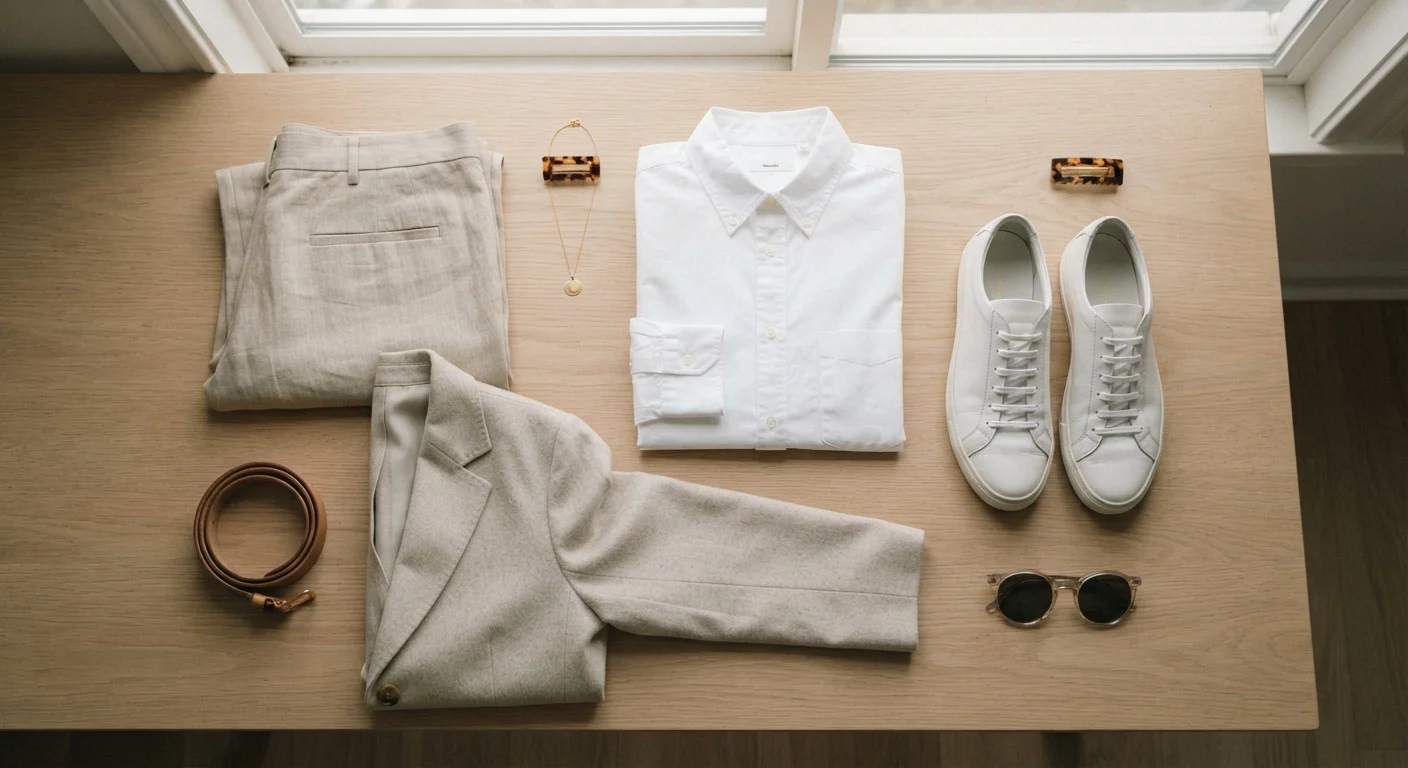
Dressing in a single neutral tone head to toe — varying shades of the same color — creates a look that reads as sophisticated and visually elongating. Think cream trousers with an off-white knit and ivory sneakers, or charcoal joggers with a dark grey crewneck and black boots. Exact matches aren't necessary; slight tonal variation adds depth.
This formula works especially well when you're unsure about color coordination, because the problem solves itself. It's also a strong choice for travel days or any situation where you want to look polished with minimal mental load.
A tonal monochromatic outfit removes color-matching stress while looking more elevated than expected.
Straight-Leg Jeans + Striped or Solid Crew Tee + White Leather Sneaker
Sometimes the formula you need is simply a very good casual outfit that never reads as sloppy. Straight-leg jeans in a clean mid-wash or dark indigo, paired with a well-fitted crew-neck tee (stripe, solid, or subtle graphic), and finished with white leather sneakers, delivers exactly that. The footwear is doing more work than it gets credit for — leather sneakers sharpen the overall look compared to athletic trainers.
Layer a denim jacket or overshirt when temperatures drop or you want additional visual interest. This is the formula for confident casualwear that still signals self-awareness.
Swapping athletic sneakers for leather ones is the simplest single upgrade to a casual outfit.
Making These Formulas Your Own
The real power of outfit formulas is in the details you bring to them. A blazer in a bold print, a shoe in an unexpected color, or a statement bag can all express personality within a structured framework. You're not dressing like a clone — you're making smart decisions faster.
Start With Three Formulas, Not Ten
If you're new to building outfit formulas, resist the urge to create a system for every situation immediately. Pick two or three formulas that cover your most frequent scenarios — your weekday routine, casual weekends, and one slightly elevated setting. Wear those consistently, refine them over time, and add new formulas only when there's a genuine gap. A small, practiced set of formulas outperforms a long list you never use.
Pay attention to fit above everything else. A formula built on ill-fitting pieces loses its polish regardless of how well the colors coordinate. When in doubt, prioritize fit before adding variety. And remember that fabric matters too — certain combinations look better in structured materials than in relaxed ones. Our guide to common clothing fabrics can help you understand which materials hold their shape and work hardest across situations.
Once you've got a formula dialed in, protect your investment by caring for those pieces properly. Everyday clothing care habits extend the life of the pieces you rely on most. And if you're ever unsure whether your formula fits the occasion, decoding the dress code first makes the final call much easier.
The content on this site is for informational purposes only and is not a substitute for professional advice. Always consult a qualified professional for guidance specific to your situation.