

Why Dress Codes Are So Confusing
You've been there: you get an invitation that says "smart casual" and suddenly your whole wardrobe feels like a question mark. Dress code labels were invented to communicate expectations quickly, but without a shared reference point, they often do the opposite. The gap between what hosts intend and what guests interpret can be surprisingly wide.
The good news? These three codes — casual, smart casual, and business casual — follow a pretty consistent internal logic once you understand what each one is actually optimizing for. If you've ever felt like getting dressed was a puzzle with missing pieces, our guide on why getting dressed feels hard digs into the root causes. For now, let's decode the codes themselves.
| Most misunderstood code | Smart Casual |
| Business Casual anchor pieces | Chinos, collared shirt or blouse, blazer, loafers |
| Casual: key rule | Clean and condition-appropriate — not necessarily formal |
| Smart Casual: the formula | One elevated piece + one relaxed piece |
| Jeans in business casual | Acceptable only if dark, unripped, and paired with a polished top |
| When in doubt, dress code rule | Go one notch above, not below |
Casual, Smart Casual, and Business Casual — Defined
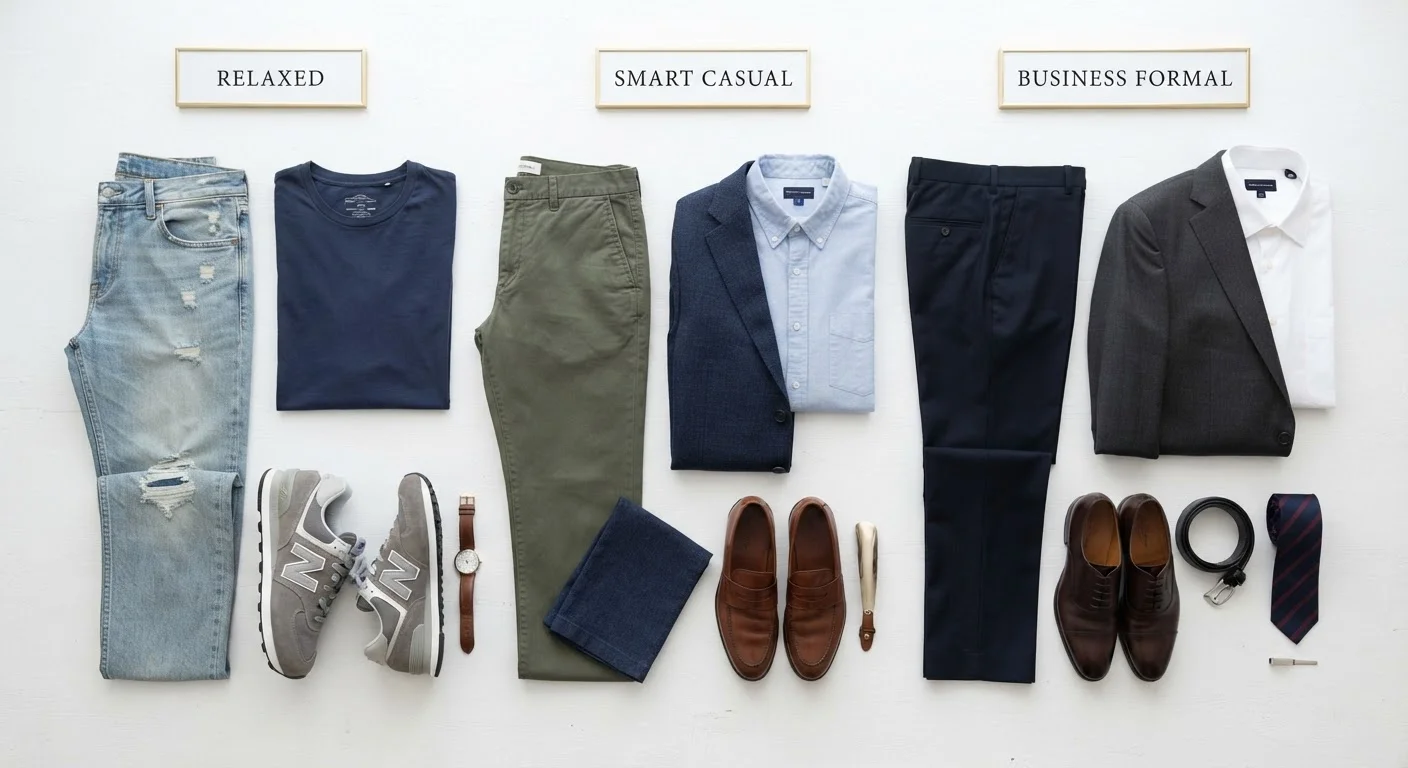
Casual means comfort-first dressing with no expectation of formality. Think jeans, T-shirts, sneakers, sweatshirts, and athletic-inspired pieces. The primary rule: your clothing should be clean, in good condition, and appropriate for the specific setting (a backyard cookout has different casual norms than a movie theater). Casual does not mean sloppy — ripped or stained items rarely read as intentional outside very specific subcultures.
Smart casual is the middle ground that trips people up most. It asks you to look put-together without going full professional. A reliable smart casual formula: one elevated piece (a blazer, a structured blouse, leather shoes, a well-cut trouser) paired with something more relaxed. Dark, clean denim can work here. Athletic wear and flip-flops typically don't. The word "smart" is doing real work — it signals that your outfit should appear considered.
Business casual leans toward the professional end of the spectrum without requiring a suit or formal dress. In most American workplaces, this means tailored trousers or chinos, button-down or collared shirts, blouses, blazers, and closed-toe shoes. Jeans are sometimes acceptable if they're dark, unripped, and paired with a polished top — but when in doubt, leave them out. Outfit formulas that work across nearly any situation are especially handy here, since business casual is where most daily wardrobe decisions live.
Casual
A dress code that prioritizes comfort and personal expression over formality. Clean, well-maintained clothing is expected, but structured or professional pieces are optional.
Smart Casual
A middle-ground dress code that combines relaxed elements with at least one polished or elevated piece. The goal is to look intentional and put-together without appearing formal.
Business Casual
A professional-leaning dress code that stops short of requiring a full suit or formal attire. Tailored trousers, collared shirts, blouses, and closed-toe shoes are standard anchors.
Elevated Piece
Any item that reads as more polished or structured than typical casual wear — a blazer, leather shoe, pressed trouser, or quality blouse. One elevated piece can shift an entire outfit up a dress-code level.
Dress Code Spectrum
The continuous range from most relaxed (casual) to most formal (black tie), with smart casual and business casual occupying the middle ground. Understanding where a code sits on this range helps inform appropriate choices.
Quick Reference: What to Wear and What to Skip
Understanding the principle is one thing; knowing which specific items land where is more practical. Use the table below as a fast reference.
| Item | Casual | Smart Casual | Business Casual |
|---|---|---|---|
| Dark, clean jeans | ✓ | ✓ | Sometimes |
| Distressed or ripped jeans | ✓ | ✗ | ✗ |
| Chinos / tailored trousers | ✓ | ✓ | ✓ |
| T-shirt (plain, clean) | ✓ | ✓ (under a blazer) | ✗ |
| Button-down / blouse | ✓ | ✓ | ✓ |
| Blazer or structured jacket | Optional | ✓ | ✓ |
| Sneakers (clean, minimal) | ✓ | Sometimes | ✗ |
| Loafers / dress shoes | ✓ | ✓ | ✓ |
| Athletic wear / hoodies | ✓ | ✗ | ✗ |
| Formal suit / evening dress | ✗ | ✗ | ✗ |
Fabric choices also influence how polished an outfit reads — a cotton poplin shirt sits differently than a jersey knit, even in the same silhouette. Our guide to common clothing materials breaks down exactly how fabric affects the look and feel of everyday pieces.
3
Dress codes most Americans encounter daily
Casual, smart casual, and business casual cover the vast majority of everyday social and professional occasions in the U.S.
1 piece
Needed to shift casual to smart casual
Style experts generally agree that adding a single elevated item — a blazer, structured shoe, or tailored trouser — is enough to move an outfit up a dress-code tier.
Reading Context Clues When the Code Is Vague
Dress codes exist on a spectrum, and the same label can shift depending on industry, region, and occasion. "Business casual" at a law firm reads differently than at a creative agency. "Smart casual" at a rooftop bar is not the same as smart casual at a daytime wedding brunch.
When you're unsure, these context clues help narrow it down:
- Venue type — A hotel ballroom implies more formality than a brewery event space, even under the same label.
- Time of day — Evening events trend dressier across all dress codes.
- Industry norms — Finance and legal settings default toward the formal end of any code; tech and creative industries often interpret codes more loosely.
- The invitation itself — Formal stationery or a detailed itinerary suggests the host takes presentation seriously.
When genuinely uncertain, it's almost always better to land one notch above rather than below. Wearing a blazer you can remove is far less awkward than being the most underdressed person in the room. Building a wardrobe anchored to your actual daily life means having the right versatile pieces ready for exactly these moments.
Dress Codes Are Guidelines, Not Rules
No dress code is universally enforced the same way, and personal style still has room within each category. These definitions reflect broadly accepted American norms, but workplaces, hosts, and regions will always vary. When attending a new environment for the first time, observing what others wear can be just as informative as any written guide.
The content on this site is for informational purposes only and is not a substitute for professional advice. Always consult a qualified professional for guidance specific to your situation.