

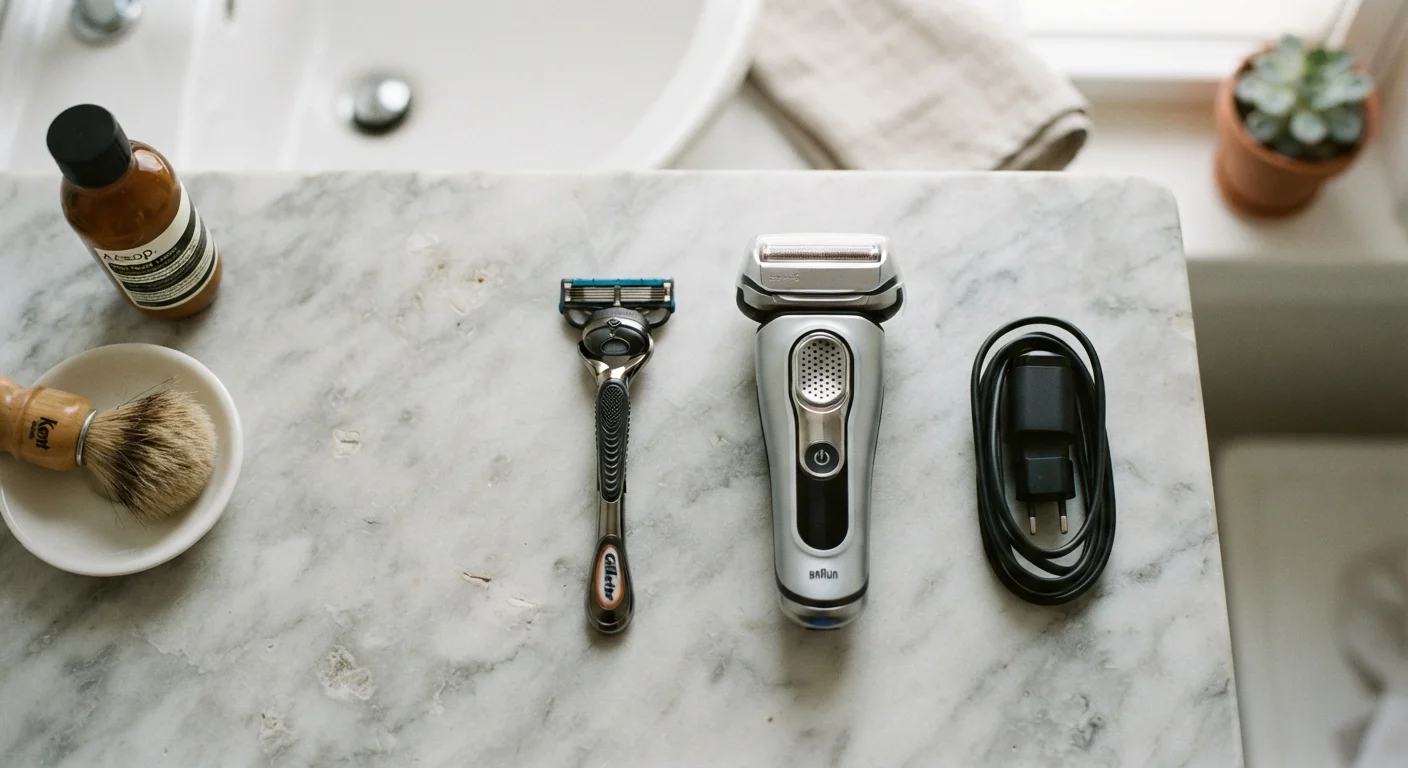
Option A
Manual Razor
The precision-first classic for a close, smooth finish.
Best for: Anyone who prioritizes closeness of shave, enjoys a deliberate grooming ritual, or shaves infrequently enough that upfront cost is the main consideration.
Option B
Electric Shaver
The speed-and-convenience choice for daily or on-the-go grooming.
Best for: People who shave frequently, have sensitive skin prone to nicks, or need a fast, waterless option that fits a packed schedule.
What Actually Separates These Two Methods
At the most basic level, a manual razor uses a sharp blade pressed directly against skin to slice hair at or just below the surface. An electric shaver uses oscillating or rotating blades housed inside a protective foil or guard, cutting hair slightly above the skin. That mechanical difference drives almost every trade-off between the two.
Manual razors — whether cartridge, safety, or straight styles — are passive tools. Your technique, prep work, and blade freshness determine the outcome. Electric shavers are active tools: a motor does the cutting work, which standardizes the result regardless of angle or pressure. Neither is objectively better; they're solving slightly different problems.
If you're also thinking through how shaving fits into a broader self-care picture, our guide on grooming habits by life stage offers useful context on how skin needs shift over time.
| Criterion | Manual Razor | Electric Shaver |
|---|---|---|
| Closeness of shave | Very close — blade at skin level | Slightly less close — guard lifts blade |
| Irritation risk | Higher, especially with dull blades | Generally lower for sensitive skin |
| Upfront cost | Low | Moderate to high |
| Ongoing running cost | Recurring blade replacement | Infrequent head replacement |
| Speed of use | Slower — requires prep and lather | Faster — dry use possible |
| Travel friendliness | Compact but needs liquids | Cordless models very portable |
| Maintenance required | Minimal — rinse and replace blades | Regular cleaning and occasional oiling |
| Best surface area | Face and large body areas | Face and detailed edge work |
Comfort, Skin Sensitivity, and the Irritation Factor
For anyone dealing with razor burn, ingrown hairs, or reactive skin, this is often the deciding category. Manual blades make direct skin contact with significant pressure — great for closeness, but more likely to cause irritation when technique is off, skin is dry, or blades are dull. Foil and rotary electric shavers stay separated from skin by a thin guard, which most dermatologists consider gentler for daily use on sensitive areas.
That said, electric shavers aren't automatically irritation-free. Rotary models, in particular, can tug at coarser or curlier hair rather than cutting cleanly, which may cause its own discomfort. Foil shavers tend to perform more consistently across hair textures.
If you're experiencing persistent irritation regardless of which tool you use, the issue is often technique or prep rather than the tool itself. Our article on why shaving routines cause irritation covers the most common missteps and practical fixes.
~5–7
Recommended shaves per cartridge blade
Dermatologists and grooming experts generally suggest replacing cartridge blades every five to seven uses to reduce tugging and irritation risk.
6–12 months
Typical electric shaver head lifespan
Most manufacturers recommend replacing foil or rotary heads every six to twelve months to maintain cutting efficiency and hygiene.
2–3 min
Average dry electric shave time
A quick dry shave with an electric shaver typically takes two to three minutes, compared to five to ten minutes for a full wet shave with prep.
Cost, Upkeep, and the Long View
Manual razors have a low barrier to entry — a handle plus a pack of cartridges or double-edge blades is inexpensive. The catch is that blades dull relatively quickly (most experts suggest replacing cartridges every five to seven shaves), so the ongoing cost is real. Over a year of regular shaving, blade replacement costs can add up noticeably.
Electric shavers flip that equation. Quality foil or rotary models carry a meaningful upfront price, but replacement heads typically last six to twelve months, and no shaving cream is required for dry use. For frequent shavers, the math can favor an electric shaver over a two-to-three year window, though that depends entirely on individual usage patterns. For general guidance on weighing recurring versus one-time costs in your personal budget, the Budgeting Basics hub is a helpful starting point.
Maintenance also differs meaningfully. Manual razors need only rinsing and occasional cartridge swaps. Electric shavers require regular cleaning (many are waterproof and rinseable, which helps), occasional lubrication, and periodic head replacement to maintain cutting performance.
Matching the Tool to Your Actual Routine
The most practical question isn't "which is better" — it's "which fits how I actually live." A few honest prompts help clarify that:
- How often do you shave? Daily shavers generally see more benefit from an electric's convenience and gentleness. Occasional shavers may prefer a manual for its precision without needing to maintain a charged device.
- What's your skin like? Sensitive, acne-prone, or darker skin types that are more susceptible to ingrown hairs often respond better to the lift-and-cut action of a foil electric shaver than to blade-on-skin contact.
- How much time do you have? A proper manual shave with warm water and shaving cream takes five to ten minutes. A dry electric shave can take two to three. Over a week, that gap compounds.
- Are you shaving face, body, or both? Manual razors handle large surface areas like legs efficiently. Electric shavers excel at facial contouring and edge definition but can be awkward on curved body areas.
It's also worth noting that many people use both — an electric shaver for quick weekday touch-ups and a manual razor for a thorough weekend shave. If you're weighing whether your whole routine is working as well as it should, building a sustainable grooming routine is worth a read.
This article is for general informational purposes only. Individual skin types and sensitivities vary; consult a dermatologist if you experience persistent skin reactions from shaving.
The content on this site is for informational purposes only and is not a substitute for professional advice. Always consult a qualified professional for guidance specific to your situation.