

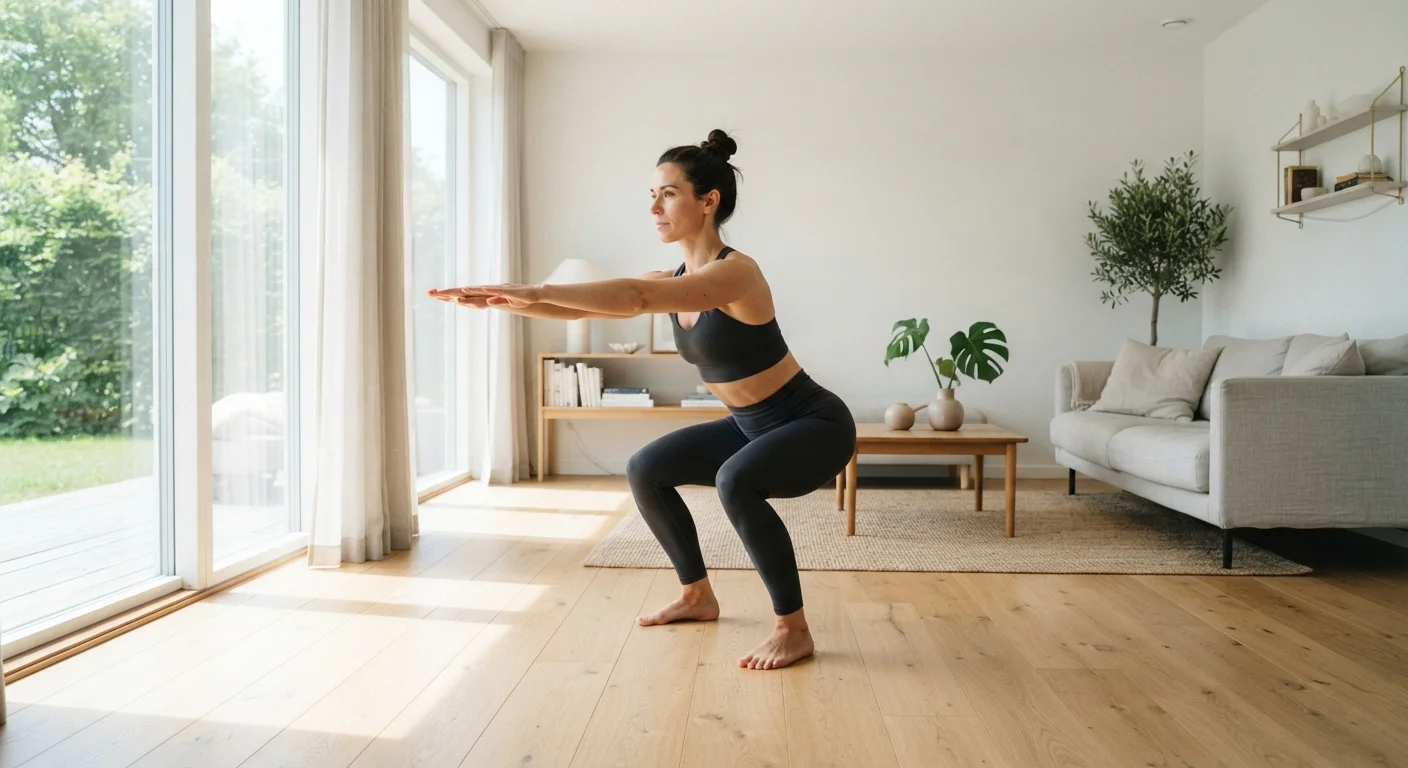
Why Home Strength Training Works
The belief that serious strength training requires a gym full of machines and heavy barbells is a common misconception. Research consistently shows that bodyweight resistance and light loads, when applied with proper programming, produce measurable gains in muscle strength and endurance. The critical variable isn't the equipment - it's the training principle behind the work. See our guide to progressive overload for a deeper look at why this principle drives results at any fitness level.
Training at home also removes friction. When the commute to your workout is ten steps from your bedroom, adherence improves - and consistency is what separates people who make progress from those who don't. That said, home training does require intentional structure. Without a plan, it's easy to drift toward the same comfortable exercises, stall out, and lose motivation.
What you will need
What You'll Need
You don't need much to get started, but a few tools meaningfully expand what's possible as you progress. Below is a practical list - nothing here is mandatory to begin, but each item adds value over time.
Resistance Bands (set of varying tensions)
Adds adjustable load to pulling movements and assists with progressions like pull-ups.
Adjustable Dumbbells or a Single Kettlebell
Provides external load for exercises like goblet squats, hinges, and rows once bodyweight becomes insufficiently challenging.
Sturdy Chair or Elevated Surface
Used for incline or decline push-up variations, step-ups, and Bulgarian split squats.
Exercise Mat
Cushions joints during floor-based movements like glute bridges and core work.
Pull-Up Bar (door-mounted)
Enables vertical pulling movements, which are otherwise difficult to replicate without equipment.
If you're working with a small space, consider how you'll store any equipment you acquire. Our home organization hub has practical storage ideas that work in tight quarters.
How to Structure Your Home Workouts
Effective strength programming rests on a few structural decisions: how often you train, which movement patterns you include, and how you increase difficulty over time.
Training Frequency
Two to three full-body sessions per week is a well-supported starting point for most adults. This frequency allows adequate recovery between sessions while accumulating enough training volume to drive adaptation. For guidance on building a sustainable weekly plan, see our article on building a weekly workout schedule.
The Four Foundational Movement Patterns
Rather than thinking in terms of individual muscles, organize your workouts around movement patterns:
- Squat: Bodyweight squat, split squat, Bulgarian split squat
- Hinge: Hip hinge, single-leg Romanian deadlift, glute bridge
- Push: Push-up variations (standard, incline, decline, archer)
- Pull: Resistance band rows, doorframe pull-ups, inverted rows under a table
Including at least one exercise from each category in every session ensures balanced development and reduces the risk of overuse issues. It's worth noting that home training with bodyweight and bands differs from machine-based gym work - each has distinct trade-offs, which our comparison of free weights vs. resistance machines explores in detail.
Progress by Increasing Difficulty, Not Just Reps
Once you can complete 3 sets of 15 reps of an exercise with good form, it's time to increase the challenge - not just add more reps indefinitely. Progress by moving to a harder variation (e.g., from a standard push-up to a decline push-up), adding resistance via bands or weights, or slowing the lowering phase to increase time under tension. This is the essence of progressive overload applied to home training.
Step-by-Step: Building Your First Home Workout
Follow these steps to design a single training session you can repeat and adapt as you get stronger.
Warm Up for 5 Minutes
Begin with dynamic movement to raise your heart rate and prepare your joints. A simple sequence: 30 seconds each of leg swings, arm circles, hip circles, bodyweight squats, and inchworms. This reduces injury risk and improves movement quality in the working sets that follow.
Choose One Exercise Per Movement Pattern
Select one squat variation, one hinge, one push, and one pull that match your current ability level. For beginners, this might be a bodyweight squat, glute bridge, knee push-up, and resistance band row. Intermediate trainees might use a split squat, single-leg Romanian deadlift, standard push-up, and inverted row.
Perform 3 Sets of Each Exercise
Aim for 8-15 repetitions per set, resting 60-90 seconds between sets. Choose a difficulty that makes the last 2-3 reps genuinely challenging without breaking your form. If all reps feel easy, the variation is too simple - step up to a harder option.
Add a Core Finisher (Optional but Recommended)
After your four main exercises, add 2 sets of a core movement: a plank hold, dead bug, or side plank works well. Core stability supports every other movement pattern and is often undertrained in home routines.
Cool Down and Log Your Session
Spend 3-5 minutes with gentle static stretching of the muscles you worked. Then immediately log your session: which exercises you did, how many sets and reps, and any notes on difficulty. This record is the foundation of progressive overload - you can't consistently improve what you don't track.
Rest Days Are Part of the Program
Strength adaptations occur during recovery, not during the workout itself. Training the same muscle groups on consecutive days without adequate rest can impair progress and increase injury risk. If you feel persistent soreness, fatigue, or declining performance, that's a signal to prioritize rest rather than push through. Most adults benefit from at least one full rest day between strength sessions.
On the question of training every day: more isn't always better. Our article on the trade-offs of working out every day explains when daily exercise helps and when it hinders recovery. For context on how strength work compares to cardio in its effects on your body, our piece on cardio vs. strength training offers a clear, evidence-based breakdown.
This article is for general informational and educational purposes only and is not a substitute for personalized medical or fitness advice. Consult a qualified healthcare professional or certified fitness professional before beginning a new exercise program, especially if you have existing health conditions, injuries, or other concerns.
The content on this site is for informational purposes only and is not a substitute for professional advice. Always consult a qualified professional for guidance specific to your situation.