

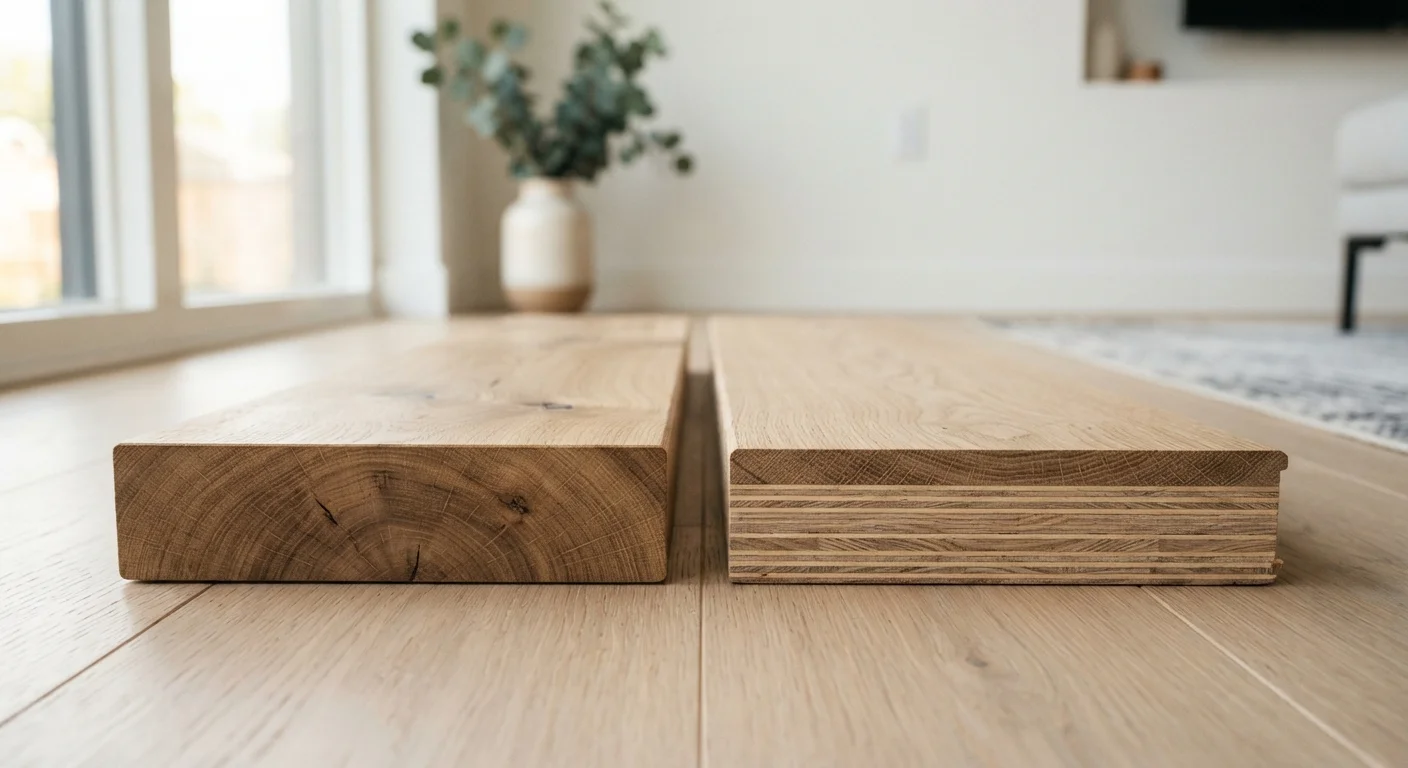
Option A
Engineered Hardwood
The moisture-resistant, versatile performer.
Best for: Homeowners installing flooring over concrete subfloors, in basements, or in climates with significant humidity swings.
Option B
Solid Hardwood
The timeless, refinishable classic.
Best for: Above-grade installations in stable, low-humidity environments where long-term refinishing and resale appeal matter most.
How Each Floor Is Built
Understanding the construction difference is the foundation of every other comparison. Solid hardwood is exactly what the name implies: a single plank of wood milled from one species, typically ¾ inch thick. That thickness is its greatest long-term asset - and its biggest vulnerability to moisture.
Engineered hardwood uses a real hardwood veneer - usually 1/16 to 1/8 inch thick - bonded to a core of cross-layered plywood or high-density fiberboard. That cross-ply construction counteracts wood's natural tendency to expand and contract with humidity changes. The surface looks identical to solid hardwood because it is real wood; only the foundation differs.
This structural difference cascades into every performance category: moisture resistance, installation method, refinishing potential, and compatible subfloor types.
| Criterion | Engineered Hardwood | Solid Hardwood |
|---|---|---|
| Construction | Real wood veneer over cross-ply core | Single solid wood plank |
| Moisture resistance | Good - suitable for below grade | Low - above grade only |
| Radiant heat compatibility | Yes, most products | Generally not recommended |
| Concrete subfloor installation | Yes, with vapor barrier | Not recommended |
| Refinishing cycles | 1-3 depending on veneer thickness | 5-8 over lifetime |
| Typical installation method | Float, glue-down, or nail-down | Nail-down or staple-down |
| DIY friendliness | Moderate to high (click-lock available) | Lower - specialized tools required |
| Lifespan potential | 25-50 years with care | 50-100+ years with refinishing |
Moisture, Subfloors, and Where Each Can Go
Moisture compatibility is the most practical dividing line between these two products. Solid hardwood expands and contracts significantly with humidity swings, which is why most manufacturers recommend it only for above-grade installations on wood subfloors. Installing solid hardwood in a basement or directly over concrete is not recommended - the chronic moisture exposure will cause cupping, warping, or gapping over time.
Engineered hardwood's cross-ply core dramatically reduces that seasonal movement, making it suitable for below-grade spaces and concrete slabs when properly installed with a vapor barrier. It is also compatible with radiant floor heating, where temperature cycles create exactly the kind of stress that splits solid planks.
3%-5%
Wood dimensional change per humidity swing
Solid hardwood can expand or contract 3-5% across its width for every significant change in relative humidity, according to the Wood Flooring Manufacturers Association guidelines.
1/16"-1/8"
Typical engineered veneer thickness range
Veneer thickness directly determines refinishing potential; thicker veneers command higher prices but offer longer usable life.
50°F-80°F
Recommended ambient temperature range during installation
Both flooring types should be acclimated and installed within this temperature range; deviating increases the risk of gapping or buckling post-installation.
Before choosing either product, assess your subfloor carefully. Measure moisture levels using a pin-type or pinless moisture meter. Most manufacturers publish acceptable moisture thresholds in their installation guides - exceed those numbers and you void the warranty regardless of flooring type. If you're also evaluating other flooring options for wet-prone rooms, our guide on tile vs. luxury vinyl plank covers how waterproof alternatives stack up.
Durability, Refinishing, and Long-Term Care
On the surface, both floors look comparable day to day. The difference emerges when the finish wears and it's time to sand. Solid hardwood's ¾-inch thickness typically allows 5-8 sanding and refinishing cycles across its lifetime, which is why well-maintained solid floors in older homes can be restored rather than replaced.
Engineered hardwood's refinishing potential depends entirely on the veneer thickness. Thinner veneers (1/16 inch) may allow only one light sand; thicker veneers (1/8 inch or more) can typically withstand two or three refinishes. If you buy on the lower end of the price range, assume minimal refinishing headroom.
Day-to-day maintenance is essentially the same for both: sweep regularly, use a damp - never saturated - mop, and place felt pads under furniture legs. Avoid steam mops on either product; steam forces moisture into seams regardless of construction type.
Acclimation Matters for Both Products
Before installation, store flooring planks in the room where they'll be installed for at least 48-72 hours - some manufacturers specify longer periods. This allows the wood to adjust to the room's temperature and humidity, reducing movement after installation. Skipping acclimation is one of the most common causes of post-installation gapping and buckling, and it typically voids manufacturer warranties.
Thinking about your full interior design picture? Pairing the right flooring with appropriate wall finishes matters too. Our reference on interior paint finishes explains how sheen levels interact with natural light - useful when planning a cohesive room renovation.
Installation Methods and Cost Considerations
Solid hardwood is almost always nail-down or staple-down over a plywood subfloor. This requires a pneumatic flooring nailer and a compressor - not a typical DIY toolset for first-timers. Professional installation is common and adds to the overall project cost. Material prices vary considerably by species, grade, and width, so get multiple quotes and confirm what's included.
Engineered hardwood offers more installation flexibility: floating click-lock, glue-down, or nail-down methods are all available depending on the product. Floating installation is the most DIY-accessible option, though glue-down over concrete is the more stable choice in moisture-prone areas.
Total project cost for either product depends on species, plank width, finish type, subfloor preparation, and labor rates in your region. As a general pattern, solid hardwood runs higher in both material and installation cost, though engineered products in premium hardwood species can close that gap considerably. Always budget 10% extra material for cuts and waste, and factor in underlayment, adhesive, or vapor barrier as needed.
The content on this site is for informational purposes only and is not a substitute for professional advice. Always consult a qualified professional for guidance specific to your situation.