

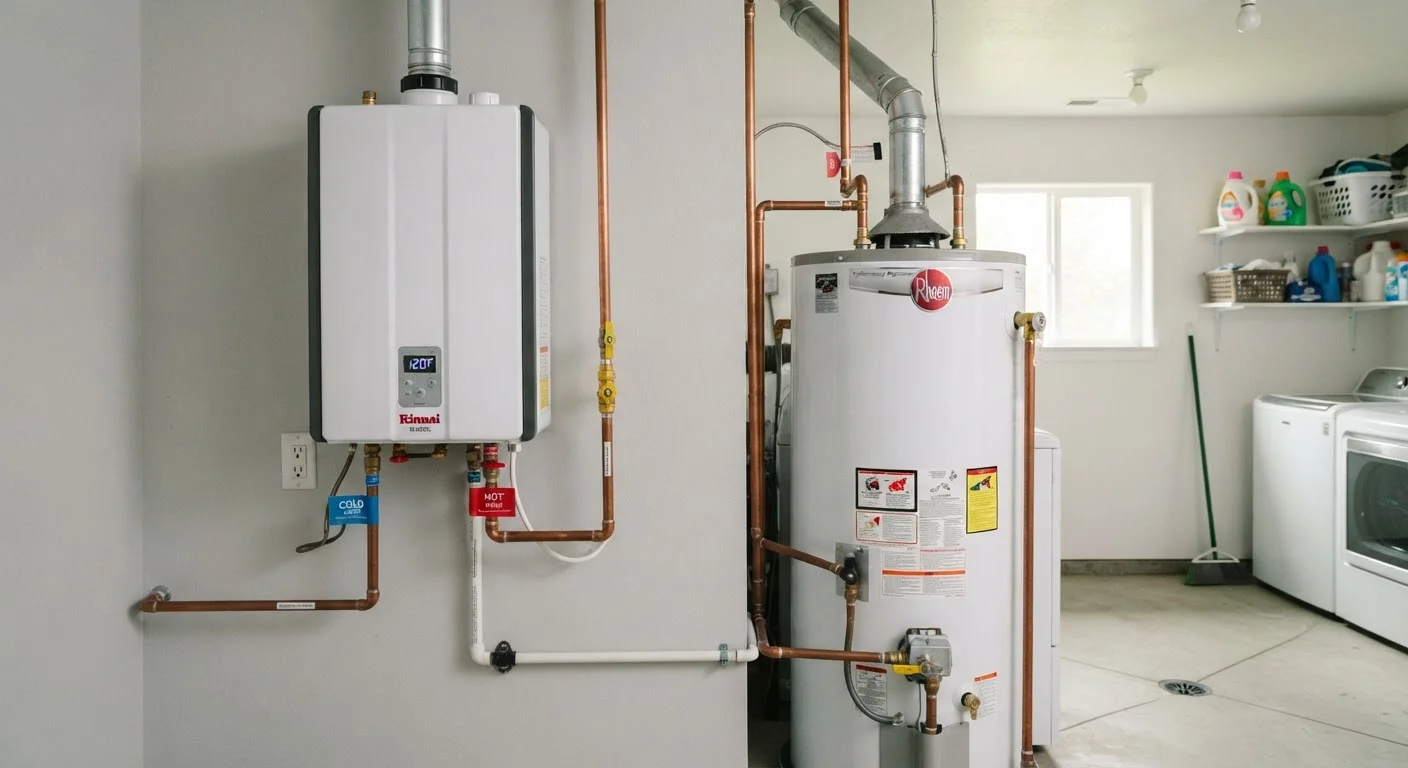
Option A
Tankless Water Heater
The on-demand, space-saving modern option.
Best for: Homeowners who want lower long-term energy use and have budget for higher upfront and service costs.
Option B
Storage Tank Water Heater
The familiar, widely serviced traditional choice.
Best for: Homeowners seeking lower upfront costs and straightforward, broadly available maintenance support.
How Each System Works - and Why It Shapes Maintenance
Understanding what sets these two systems apart mechanically is the foundation for understanding their upkeep differences. A storage tank water heater holds 30-80 gallons of preheated water in an insulated tank, keeping it warm continuously until drawn. A tankless (on-demand) water heater heats water only when a tap is opened, passing cold water through a heat exchanger in seconds.
This operational difference directly shapes the failure points each type develops over time. The storage tank is constantly exposed to water - including minerals, sediment, and oxygen - which gradually degrades the tank's interior lining and steel structure. The tankless unit avoids standing water but pushes high-flow water through narrow internal channels, making mineral scaling a more concentrated problem. As noted in our guide on the hidden costs of deferred home maintenance, skipping routine appliance upkeep compounds minor wear into expensive repairs quickly.
Routine Maintenance Requirements: A Direct Comparison
Both systems share some foundational tasks, but the frequency, complexity, and skill level required differ substantially.
| Criterion | Tankless Water Heater | Storage Tank Heater |
|---|---|---|
| Expected lifespan | 20+ years (with maintenance) | 8-12 years |
| Primary annual task | Descaling heat exchanger | Anode rod inspection/replacement |
| TPR valve testing | Annually | Annually |
| DIY maintenance difficulty | Moderate to difficult | Beginner to moderate |
| Hard water sensitivity | High - clogs narrow passages | Moderate - sediment settles at bottom |
| Typical failure mode | Error codes, reduced flow | Corrosion, sudden tank leak |
| Repair technician availability | Requires brand-familiar tech | Widely serviceable |
Anode rod inspection is the single most important preventive task for storage tank owners. This sacrificial metal rod attracts corrosive elements that would otherwise attack the tank wall. Most manufacturers recommend inspecting it every one to three years and replacing it when it's significantly depleted - typically under $50 in parts, but easy to defer and costly to ignore.
For tankless units, descaling (flushing with white vinegar or a commercial descaler) is the equivalent priority task. Hard water deposits narrow the heat exchanger passages, reducing efficiency and eventually triggering error codes or unit shutdowns. In areas with moderately hard water, this should be done annually; in very hard water regions, every six months is reasonable.
8-12 yrs
Average storage tank heater lifespan
The U.S. Department of Energy notes that storage water heaters typically last 8 to 12 years with normal use and routine maintenance.
20+ yrs
Typical tankless unit lifespan
Manufacturers and energy agencies generally rate properly maintained tankless water heaters at 20 or more years of service life.
~1 in 5
Home insurance water damage claims tied to appliances
Industry loss data consistently shows appliance-related water damage - including water heater failures - as a leading source of homeowner insurance claims.
Lifespan, Failure Modes, and What They Cost You
A well-maintained storage tank water heater typically lasts 8-12 years. Tankless units, maintained consistently, are generally rated for 20 years or more. However, that gap narrows significantly if maintenance is skipped on either system.
The failure modes also differ in character. Storage tanks tend to fail in ways that are sudden and damaging - a corroded tank can leak dozens of gallons before detection, causing significant water damage to floors, walls, and cabinetry. Tankless units more commonly fail progressively: reduced flow, error codes, or partial heating loss - problems that are disruptive but rarely catastrophic in the same way.
Repair costs reflect the mechanical complexity gap. Replacing an anode rod or thermocouple on a storage unit is a straightforward job. Diagnosing a flow sensor, gas valve, or heat exchanger issue on a tankless unit typically requires a certified technician familiar with that specific brand's diagnostic system. This parallels the ownership tradeoffs explored in our gas vs. hybrid vs. electric ownership comparison - more technologically advanced systems often carry higher service complexity.
When to Call a Licensed Plumber
Both water heater types involve pressurized water systems, and gas-fired models add combustion components to the equation. Any work involving gas line connections, TPR valve replacement, or significant component repair should be handled by a licensed plumber or HVAC technician. Many jurisdictions also require permits for water heater replacement - check your local building department before beginning any major work.
Seasonal and Annual Maintenance Checklist for Each Type
Building a maintenance calendar prevents tasks from being forgotten and helps you catch small issues before they escalate.
Storage Tank Heater - Annual Tasks
- Test the temperature and pressure relief (TPR) valve by briefly lifting the lever - water should discharge, then stop cleanly when released.
- Flush 1-2 gallons from the drain valve to remove sediment buildup from the tank bottom.
- Inspect the anode rod every 1-3 years; replace when less than ½ inch of core wire is visible.
- Check the temperature setting - 120°F is the commonly recommended default for safety and efficiency.
Tankless Heater - Annual Tasks
- Flush the unit with a descaling solution using a submersible pump and hoses connected to the service ports.
- Clean the inlet filter screen - sediment here restricts flow and triggers error codes.
- Inspect venting for blockages, corrosion, or improper clearance (gas models).
- Test the TPR valve the same as you would on a tank unit.
- Check for error code history using the unit's diagnostic panel if available.
For either system, if you notice discolored water, inconsistent temperatures, or unusual sounds, contact a licensed plumber promptly rather than waiting for the next scheduled service interval.
The content on this site is for informational purposes only and is not a substitute for professional advice. Always consult a qualified professional for guidance specific to your situation.