

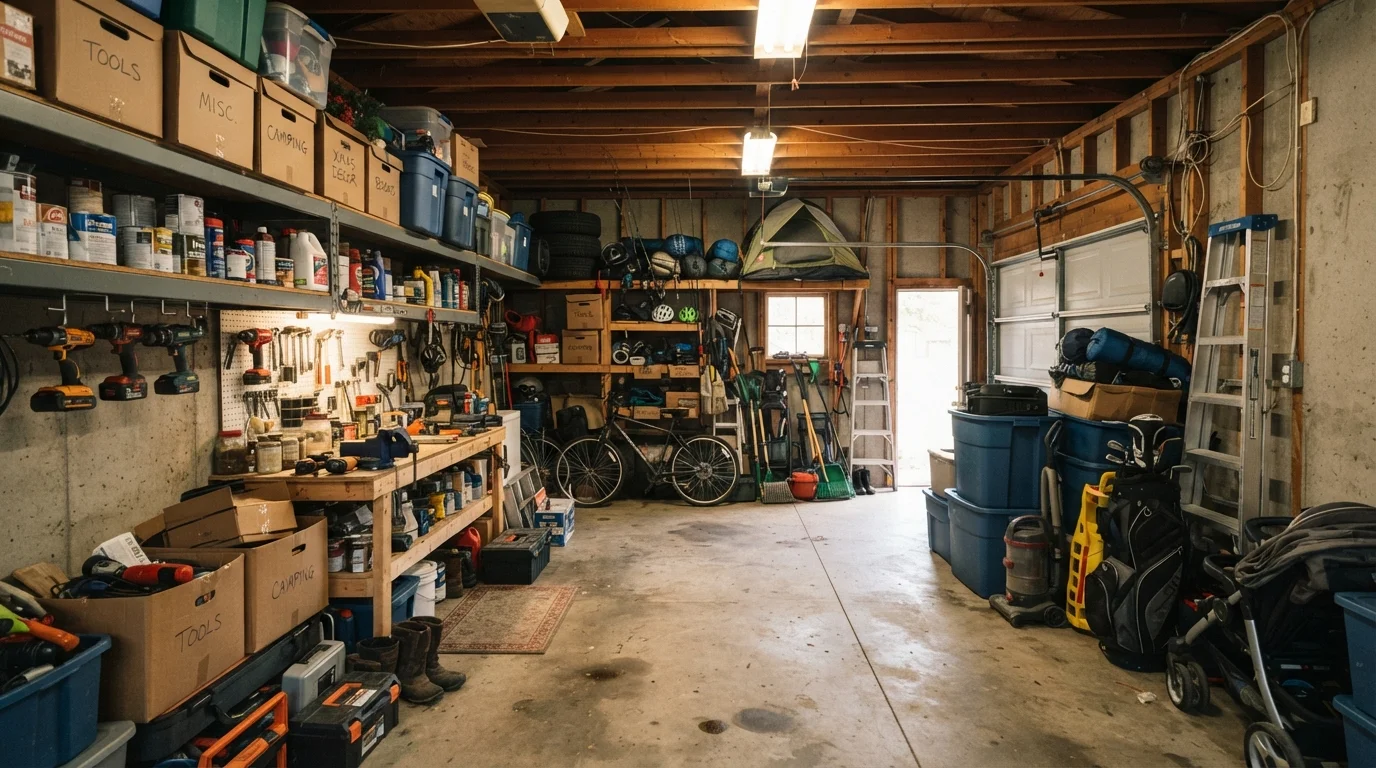
Why Secondary Spaces Are the Real Clutter Culprits
Most home organization advice focuses on kitchens, closets, and living rooms - the spaces you see every day. But the garage, attic, and basement operate by a different logic. Because they're out of sight, they absorb items without resistance: the broken lamp you'll fix someday, the boxes from a move three years ago, the holiday decorations mixed in with camping gear and outgrown sports equipment.
The result is a feedback loop. When secondary storage fills up, items that belong there start living in hallways, bedrooms, and corners of common rooms. The visible spaces become cluttered not because of how you manage them, but because the invisible spaces have hit capacity.
Solving this requires treating each zone as its own system - with its own rules about what belongs, how items are accessed, and how often the space is reviewed. The zone-based organization approach applies directly here: secondary spaces are zones too, and they need the same intentional structure as any living area.
Start with one zone, not three
Tackling the garage, attic, and basement simultaneously is overwhelming and often leads to partial projects that stall. Choose the zone causing the most visible spillover into your living spaces and complete it fully before moving on. A finished single zone builds momentum and gives you a working model to replicate in the others.
Seven Strategies for Bringing Order to Each Zone
Empty the zone completely before reorganizing
Attempting to reorganize around existing clutter almost always fails. The only reliable starting point is a full empty-out - every box pulled from the attic, every item moved from the garage floor, every bin brought out of the basement corner. This reveals the actual footprint of what you own, surfaces duplicates and forgotten items, and gives you a clean space to work with.
Sort items into four piles as you go: keep, donate, dispose, and relocate (things that belong in a different part of the house). Don't skip the relocate category - a significant portion of secondary zone clutter is simply items that drifted from their proper home.
Reorganizing around existing clutter almost always fails - start with a full empty-out.
Address environmental conditions before you store anything
Temperature swings, humidity, and pests can destroy stored belongings and make any organizational system short-lived. Before placing a single item back, assess the space honestly. Attics routinely exceed 130°F in summer - unsuitable for candles, vinyl records, photographs, or electronics. Basements are prone to moisture; anything stored directly on a concrete floor is at risk.
For basements specifically, waterproofing and humidity control should come before shelving. Use pallets or shelving units to keep items off the floor, and run a dehumidifier in humid climates. In garages, seal gaps around doors and check for rodent entry points before storing food, paper goods, or fabric.
Environmental hazards like moisture and heat should be fixed before you store a single item.
Assign access tiers based on frequency of use
Not everything in a secondary zone deserves equal accessibility. Think in three tiers: items used several times a year (camping gear, power tools, holiday decor) should be reachable without climbing or moving other boxes; items used once a year or less (archived documents, spare appliance parts) can go on higher shelves or deeper in the space; and items you're keeping for sentimental or archival reasons alone can go in the most remote corners.
This tiered approach is especially useful in garages, where daily-use tools should never be buried behind seasonal equipment. The vertical versus horizontal storage comparison can help you decide how to physically structure these tiers within a compact space.
Items used several times a year should never be buried behind things touched once a decade.
Use consistent, readable labeling on every container
The most common reason secondary zones re-clutter quickly is that items get placed wherever there's room rather than where they belong. Consistent labeling on every bin, box, and shelf section removes ambiguity and makes it possible for any household member to return items correctly.
Labels should describe contents specifically - "Holiday: Tree Lights & Ornaments" is more useful than "Christmas." For cardboard boxes in the attic, label all four sides, not just the front. Color-coded labels by category (tools, seasonal décor, sports, archived documents) add another layer of clarity with minimal effort. Those dealing with household members who have different tidiness standards often find that clear labeling reduces friction more than any other single change.
Specific, visible labels are the single most effective tool for keeping secondary zones organized long term.
Rotate storage seasonally rather than storing everything permanently
Secondary zones work best when they're dynamic rather than static. Instead of treating the attic or basement as a permanent archive, build in a seasonal rotation: winter gear comes out in fall and summer equipment moves to accessible storage; holiday decorations cycle in and out on a predictable schedule.
Seasonal rotation forces a natural review of what's being stored and prevents accumulation by default. It also keeps secondary zones from feeling sealed off and unmanageable. For a structured approach to this habit, the seasonal organization rotation guide provides a practical framework you can adapt to any home layout.
Seasonal rotation turns static storage into an active system that naturally resists accumulation.
Dedicate zones within zones for different categories
A garage that holds garden tools, automotive supplies, sports equipment, and holiday decorations needs internal organization just as much as a kitchen does. Divide each secondary space into defined category zones and mark them clearly - wall-mounted pegboards for hand tools, a dedicated corner for lawn and garden, a single shelving unit exclusively for seasonal décor.
The key is that each category has a home with defined boundaries. When a category's zone reaches capacity, that's a signal to declutter the category - not to expand into another area of the space. This prevents the gradual zone creep that turns an organized garage back into a catch-all within a year.
When a category zone hits capacity, it's time to declutter that category - not to expand its footprint.
Set a clear policy for what each space will never hold
Every secondary zone benefits from a "not stored here" list - an explicit set of exclusions that prevents these spaces from absorbing items by default. For the attic: nothing heat-sensitive or moisture-prone. For the basement: nothing that requires climate stability or is vulnerable to flooding. For the garage: nothing that belongs in daily living spaces just because the house feels crowded.
This policy thinking is especially useful when the temptation arises to temporarily store something in a secondary zone as a short-term fix. Temporary storage in these spaces has a way of becoming permanent. Establishing firm rules in advance - and revisiting them with other household members - reduces that drift significantly.
An explicit exclusion list prevents secondary zones from silently absorbing items that don't belong.
When permits and professionals matter
If your garage or basement organization plans involve electrical work - adding outlets, overhead lighting, or a dedicated circuit for a dehumidifier or freezer - consult a licensed electrician. Structural modifications to attic floors or load-bearing walls also require a qualified contractor and, in most jurisdictions, a building permit. Always verify local code requirements before starting any work beyond shelving and storage.
Sustaining the Order You've Built
Organizing these spaces once is meaningful - but the real win is preventing them from reverting. Secondary zones tend to re-clutter faster than living spaces because they lack the social pressure of visibility. A few practices make a difference: schedule a brief walk-through of each zone at the start of each season, resist the habit of placing anything in these spaces without a clear category and location, and adopt the one-in-one-out rule as a default whenever you add something new.
It also helps to be honest about what secondary storage is for. These zones are not indefinite holding areas - they're purpose-built spaces for seasonal items, infrequently used tools, and long-term storage of genuinely valuable belongings. Anything that doesn't fit that description is worth reconsidering. For a broader look at how storage assumptions can backfire, the common storage myths article offers useful perspective.
The content on this site is for informational purposes only and is not a substitute for professional advice. Always consult a qualified professional for guidance specific to your situation.