

Why Organization Myths Are So Persistent
Home organization content floods social media, television, and retail stores - and much of it sells a vision rather than a solution. The problem is that visually appealing systems and functional systems are not always the same thing. When a method looks tidy on screen but falls apart within a week at home, the natural response is to blame yourself, not the myth you followed.
Understanding which widely repeated beliefs actually work against you is the first step toward building storage habits that hold up over time. The myth-and-fact pairs below address some of the most common misconceptions homeowners encounter.
Myth
You just need more storage bins and everything will be organized.
Fact
Containers without prior decluttering simply give clutter a more organized-looking home - they don't reduce it.
The instinct to buy matching bins before sorting through belongings is understandable, but it reverses the correct order of operations. Storage containers are a tool for housing items you've already decided to keep - not a solution to having too much stuff. Purchasing bins first often results in filling them indiscriminately, which makes future sorting harder, not easier. Declutter first, then measure and buy containers sized to what remains. This also prevents the common outcome of having leftover bins that themselves become clutter. If you find out-of-sight storage areas like a garage or basement are quietly absorbing overflow, addressing those secondary zones is often the most impactful starting point.
Myth
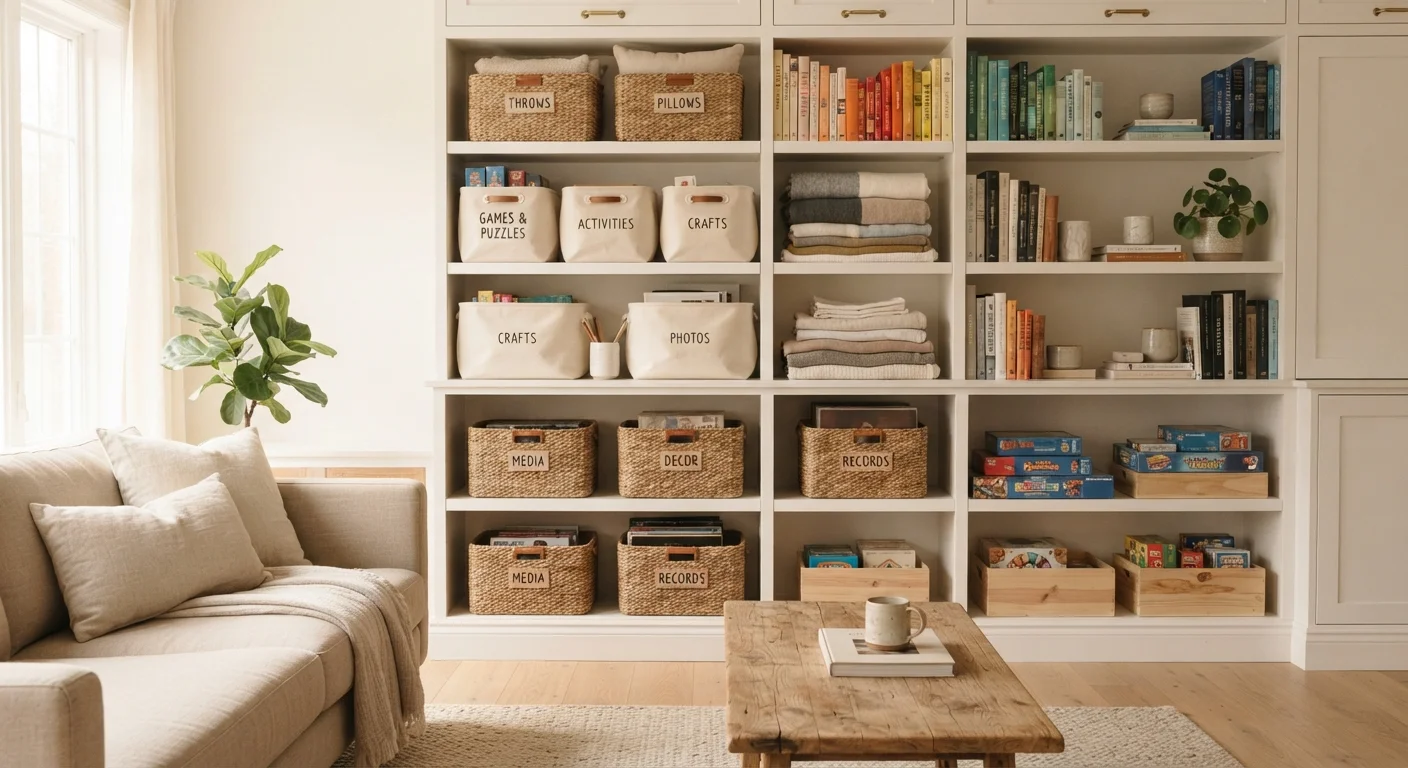
Everything needs a labeled container for an organized home.
Fact
Labels help in shared or high-traffic areas, but over-labeling creates rigidity that makes systems harder to adapt.
Labeling is a genuine organizational tool - but its value depends on context. In a pantry shared by multiple family members, or in a garage with seasonal items, labels reduce decision-making and help others return things correctly. However, labeling every drawer and shelf in a space only one person uses can make the system feel like a chore to maintain. When categories inevitably shift - a product changes, a hobby evolves, a child grows - rigid labeling forces a re-labeling project instead of a simple adjustment. Apply labels strategically: where multiple people need to find or return items, and where categories are stable over time.
Myth
An organized home should look like a magazine spread at all times.
Fact
Visual perfection is a snapshot, not a standard. Sustainable organization looks lived-in and functions smoothly, not necessarily photographically tidy.
The imagery associated with home organization - all-white interiors, perfectly spaced items, no visible daily necessities - represents staged environments, not functioning households. Chasing that aesthetic often leads people to buy decorative but impractical containers, hide necessities in inconvenient places, and feel chronic dissatisfaction with a home that is actually well-organized by functional standards. A genuinely organized home is one where you can find what you need quickly, return it easily, and move through daily routines without friction. Some visible clutter in active living areas is normal and does not indicate organizational failure.
Myth
Decluttering is a one-time project - once you do it, you're done.
Fact
Decluttering is an ongoing practice, not a single event. Households accumulate new items continuously, and systems require periodic reassessment.
The appeal of the one-time purge is real: you dedicate a weekend, sort everything, and the problem is solved. But households are not static. New purchases arrive, gifts accumulate, children's needs change, and hobbies come and go. Without periodic reassessment - even briefly, a few times a year - organized spaces gradually revert. This doesn't mean constant reorganization; it means building light maintenance habits into your routine. Emotional obstacles like the sunk-cost trap - holding onto items because of what you paid for them - are among the most common reasons people stall during these reassessments. Understanding why decluttering stalls can help you move through those moments more effectively.
Myth
Vertical storage is always better in small spaces.
Fact
Vertical storage is effective for many situations, but it introduces accessibility and weight challenges that don't suit every item or user.
Tall shelving and wall-mounted systems do maximize square footage, which matters in compact homes. But items stored above eye level are frequently forgotten, harder to retrieve safely, and impractical for people with limited mobility or shorter stature. Heavy items stored high also create a safety hazard. The right approach depends on what's being stored, who is accessing it, and how often. Comparing vertical and horizontal storage based on your specific space and needs leads to better decisions than defaulting to one approach entirely.
Myth
Paper can be managed the same way as physical clutter.
Fact
Paper clutter follows its own accumulation logic and requires a distinct system - one built around document categories, retention needs, and regular processing.
Physical items can usually be assessed by a simple question: do I use this, and do I need it? Paper is more complex. Documents vary widely in how long they must be kept, whether originals or digital copies are sufficient, and what happens if they're discarded prematurely. Applying the same broad-purge approach used for clothing or kitchen gadgets to paperwork can result in discarding important financial, medical, or legal records. Building a dedicated filing system for paper - one that accounts for these distinctions - is the more reliable path.
What Actually Makes Storage Systems Last
Effective organization is less about products and more about structure and habit. Three principles consistently underpin systems that people maintain long-term:
- Proximity to use: Items should be stored closest to where they are used. A charging cable stored in a bedroom drawer gets put back; one stored across the house often ends up on the nearest flat surface instead.
- Friction reduction: The easier it is to return something to its home, the more likely it will actually go there. Lidded bins, deep shelves, or complicated folding methods all add friction that quietly erodes systems over time.
- Household-specific design: What works in one home may fail in another. A family with young children, a multi-generational household, or roommates with different habits all need different approaches. See strategies for organizing shared spaces when not everyone agrees on standards.
Don't Reorganize Before You Declutter
Rearranging items into new containers or zones before deciding what to keep is one of the most common ways organization projects fail. You end up with the same volume of belongings in a new configuration - and the clutter returns faster because the underlying issue wasn't addressed. Always reduce before you reorganize.
Once your storage system is working, the next challenge is keeping it that way. Everyday habits like the one-in-one-out rule are what prevent organized spaces from reverting to clutter within weeks. Dividing your home into functional zones is another proven approach - zone-based organization reduces the mental load of deciding where things belong and makes tidying faster for everyone in the household.
The content on this site is for informational purposes only and is not a substitute for professional advice. Always consult a qualified professional for guidance specific to your situation.