

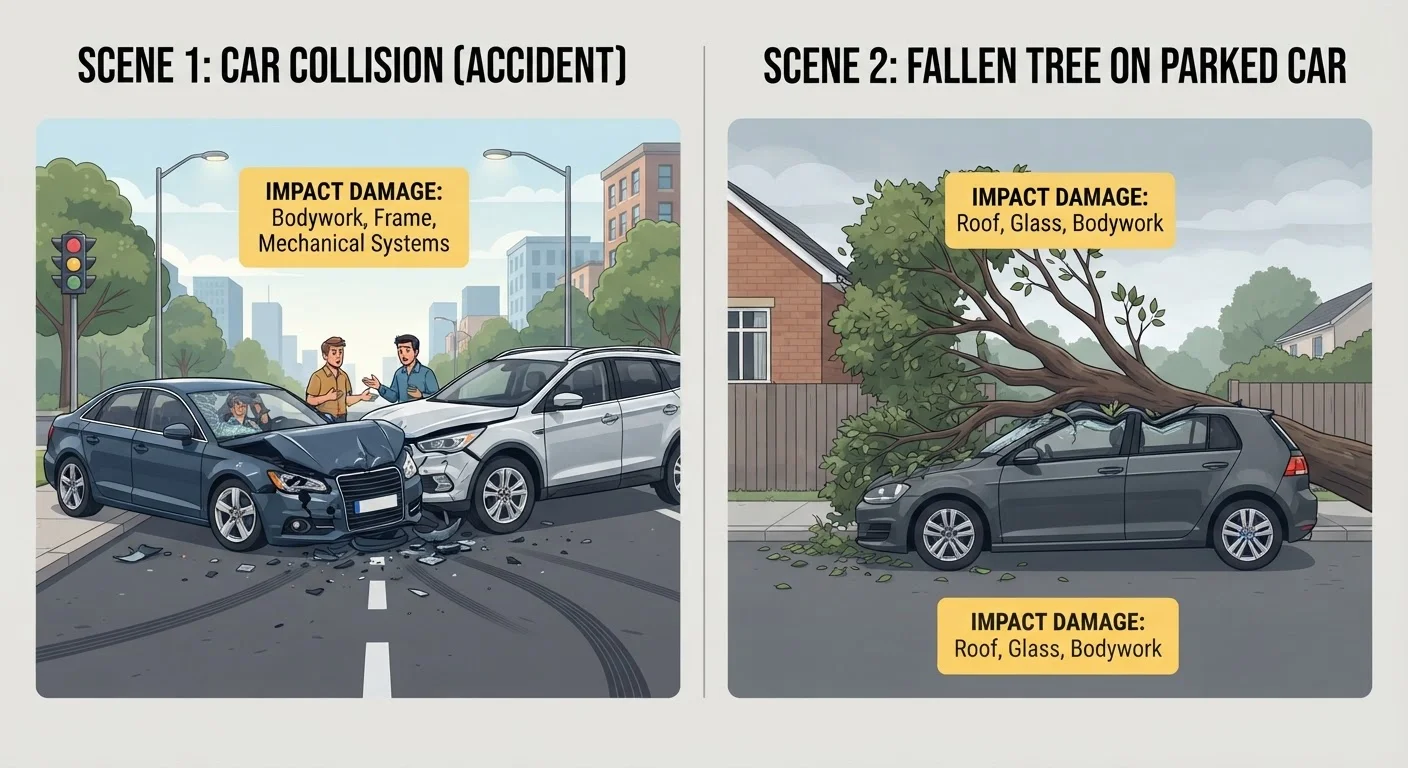
Option A
Collision Coverage
Protection for accidents involving your vehicle and another object.
Best for: Drivers who want financial protection when their car is damaged in an accident, regardless of fault.
Option B
Comprehensive Coverage
Protection for non-collision damage from events outside your control.
Best for: Drivers in areas prone to weather events, theft, or animal encounters who want coverage beyond accidents.
What Each Coverage Actually Protects
Collision coverage pays to repair or replace your vehicle when it's damaged in a collision - meaning physical contact with another vehicle, a guardrail, a fence, a telephone pole, or any other object. It applies whether you're at fault or not, and it also covers single-vehicle accidents such as rolling into a ditch or hitting a curb.
Comprehensive coverage (sometimes called "other than collision") picks up where collision leaves off. It covers damage caused by events generally outside a driver's control: theft, vandalism, fire, flooding, hail, falling objects like tree branches, windshield cracks from road debris, and collisions with animals such as deer. If your car is stolen and never recovered, comprehensive is the coverage that applies.
For a broader look at how these fit alongside liability protection, see our plain-language breakdown of all three coverage types.
| Criterion | Collision Coverage | Comprehensive Coverage |
|---|---|---|
| What triggers a claim | Impact with vehicle, object, or rollover | Theft, weather, fire, animals, vandalism |
| At-fault accident | Covered | Not covered |
| Vehicle theft | Not covered | Covered |
| Hail or flood damage | Not covered | Covered |
| Hitting an animal | Generally not covered | Covered |
| Deductible applies | Yes | Yes |
| Max payout | Actual cash value of vehicle | Actual cash value of vehicle |
| Required by law | No | No |
| Often required by lenders | Yes, for financed/leased vehicles | Yes, for financed/leased vehicles |
How Deductibles and Payouts Work
Both collision and comprehensive coverages operate with a deductible - the amount you agree to pay out of pocket before your insurer covers the rest. Deductibles are typically set per claim, not annually, and common amounts range from $250 to $1,500. A higher deductible generally means a lower premium; a lower deductible means you pay less at claim time but more each month.
In either case, the maximum your insurer will pay is your vehicle's actual cash value (ACV) at the time of the loss - not what you originally paid for it, and not what it would cost to replace it with a new model. Depreciation reduces ACV over time, which is a key reason some drivers of older, lower-value vehicles reconsider whether carrying both coverages makes financial sense.
~$522
Average annual collision premium (US)
According to the National Association of Insurance Commissioners (NAIC), the average annual expenditure for collision coverage across U.S. drivers is approximately $522, though individual premiums vary significantly.
~$182
Average annual comprehensive premium (US)
NAIC data indicates comprehensive coverage costs drivers considerably less on average than collision, reflecting its lower claim frequency in most regions.
~$1,000
Most common deductible chosen by drivers
Industry surveys consistently show $1,000 as one of the most frequently selected deductible amounts, balancing lower premiums against manageable out-of-pocket costs.
If you owe more on your loan than the ACV of your vehicle, a collision or comprehensive payout may not fully cover your remaining balance. Gap insurance addresses exactly this scenario.
When Drivers Typically Carry One, Both, or Neither
Neither collision nor comprehensive is legally required by any U.S. state. However, if you're financing or leasing a vehicle, your lender or leasing company almost always requires both. That requirement exists to protect the lender's financial stake in the car during the loan or lease term.
For drivers who own their vehicles outright, the decision becomes a cost-benefit calculation. Many financial advisors suggest comparing your combined annual premium for both coverages against the actual cash value of your car. If the annual cost is a significant fraction of what you'd recover in a total loss - accounting for your deductible - the coverage may offer limited financial benefit.
The "Comprehensive vs. Collision" Confusion at Claim Time
One of the most common misunderstandings happens when a driver hits a deer. Many assume this is a collision claim - after all, it involves an impact. But most insurers classify animal strikes as a comprehensive claim because the cause is considered an external, uncontrollable event. The same logic applies to a rock cracking your windshield. Always confirm with your insurer how a specific event will be categorized before you file, since the claim type determines which deductible applies.
Understanding where collision and comprehensive sit within your full policy is easier with context. Our article on minimum vs. full coverage explains how these optional coverages relate to state-required liability limits. You can also review all major auto insurance coverage types for a complete picture. Drivers who want to understand what can go wrong at claim time should also read about common coverage gaps after an accident.
This article provides general information about auto insurance concepts and is not personalized insurance, financial, or legal advice. Coverage terms, exclusions, and costs vary by provider, policy, and state. Always read your actual policy documents carefully and consult a licensed insurance agent or adviser to evaluate what coverage is appropriate for your situation.
The content on this site is for informational purposes only and is not a substitute for professional advice. Always consult a qualified professional for guidance specific to your situation.