

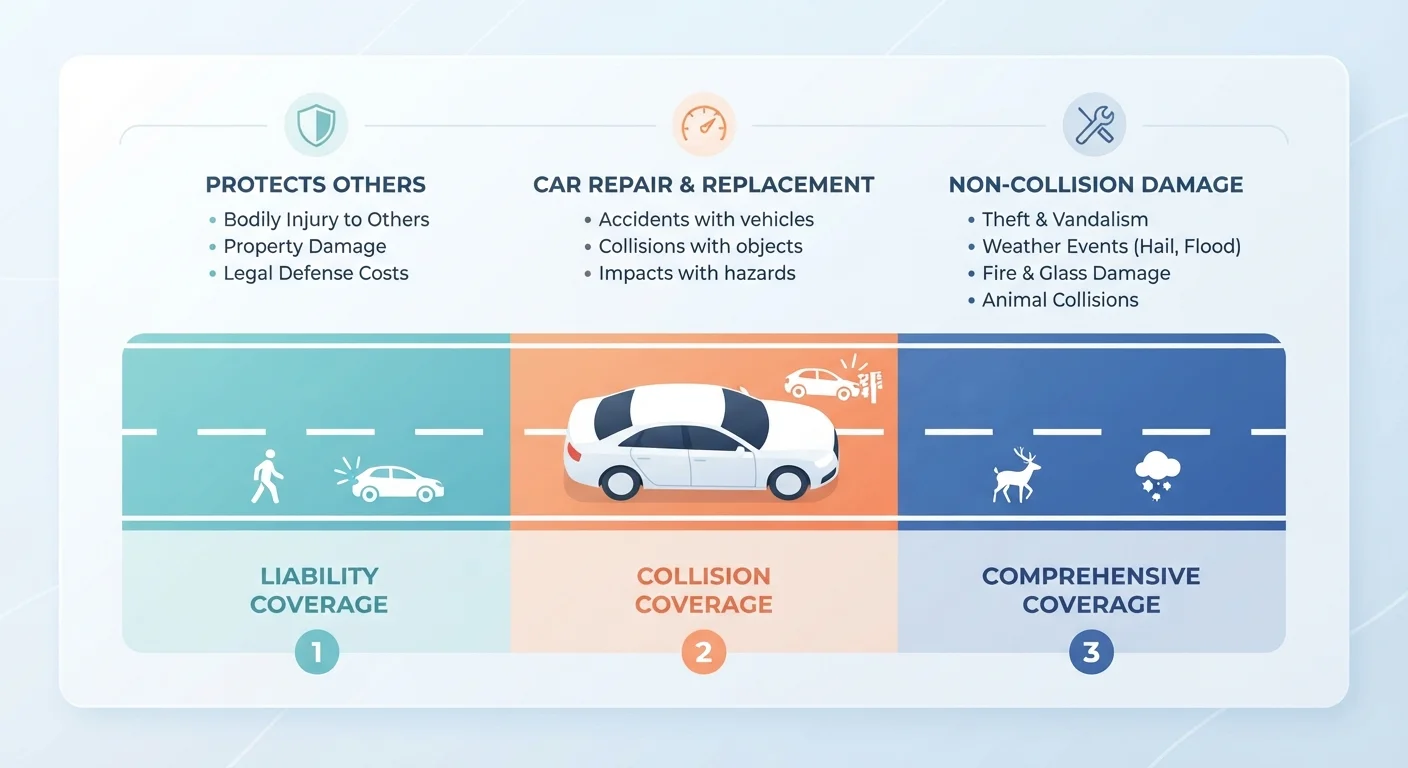
Liability Coverage: Protection for Others, Not Your Car
Liability coverage is the foundation of nearly every personal auto policy in the US - and it is the only type most states legally require. Despite being mandatory, it is also widely misunderstood.
Liability coverage pays for damage or injury you cause to other people and their property in an accident. It does not pay for your own vehicle, your own medical bills, or anything that happens to you directly. There are two components:
- Bodily injury liability - covers medical expenses, lost wages, and legal costs for people injured in an accident you caused.
- Property damage liability - covers repair or replacement costs for another person's vehicle or property damaged by your driving.
Liability limits are expressed as three numbers, such as 25/50/25. This means $25,000 per injured person, $50,000 total per accident for bodily injury, and $25,000 for property damage. If costs exceed your limits, you are personally responsible for the difference.
For a state-by-state view of what the law actually mandates, see state auto insurance requirements.
Liability Limits and Real-World Accident Costs
State-minimum liability limits are often lower than the actual costs of a serious accident. A single hospitalization can easily exceed standard bodily injury limits. Drivers who want stronger financial protection may want to consider higher liability limits or an umbrella policy - a licensed agent can help evaluate what level is appropriate for your situation.
Collision Coverage: When Your Car Is Damaged in an Accident
Collision coverage pays to repair or replace your vehicle when it is damaged in a collision - regardless of who is at fault. This is what makes it distinct from liability: it protects your own car rather than someone else's.
Covered scenarios typically include:
- Hitting another vehicle
- Rear-ending another car or being rear-ended
- Striking a guardrail, fence, tree, or other fixed object
- A single-car rollover
Collision coverage is not legally required in any US state, but lenders and leasing companies almost always require it on financed or leased vehicles because the car serves as collateral for their loan.
When you file a collision claim, you pay your deductible first, and your insurer covers the rest up to your car's actual cash value - meaning the depreciated market value at the time of the loss, not what you originally paid. How depreciation affects your insurance payout is an important concept to understand before assuming a claim will make you whole.
~13%
US drivers estimated to be uninsured
According to Insurance Research Council estimates, roughly one in eight drivers on US roads lacks any insurance coverage.
$4,700+
Average collision claim cost
Industry data from the Insurance Information Institute has consistently shown average collision claims exceeding several thousand dollars, underscoring the financial risk of driving without this coverage.
~$1,800
Average comprehensive claim cost
The Insurance Information Institute reports that comprehensive claims, while less frequent than collision, still represent a significant out-of-pocket risk for unprotected drivers.
Comprehensive Coverage: Everything Else That Can Go Wrong
Comprehensive coverage - sometimes called "other than collision" - protects your vehicle from a wide range of non-accident events. If something damages your car that does not involve a direct impact with another vehicle or object while driving, comprehensive is usually the coverage that applies.
Common covered losses include:
- Theft or attempted theft
- Hail, wind, flooding, or other weather damage
- Fire
- Falling objects (tree branches, debris)
- Vandalism
- Hitting an animal (e.g., a deer strike)
Like collision, comprehensive pays up to your vehicle's actual cash value minus your deductible. It is not state-mandated but is typically required by lenders. For a deeper look at how these two coverages compare when an event occurs, see collision vs. comprehensive coverage.
Review Your Deductibles Before You Need Them
Many drivers set their collision and comprehensive deductibles when they first buy a policy and never revisit them. A higher deductible lowers your premium but means more out-of-pocket cost if you file a claim. Before your next renewal, confirm that your deductible amount is one you could realistically pay on short notice.
How the Three Coverages Work Together
Liability, collision, and comprehensive each address a different category of loss. Understanding how they interact helps clarify what you are - and are not - protected against at any given moment.
| Coverage | What It Covers | What It Does Not Cover |
|---|---|---|
| Liability | Injury and property damage you cause to others | Your own vehicle or your own injuries |
| Collision | Your vehicle after an at-fault or no-fault accident | Theft, weather, or non-collision events |
| Comprehensive | Your vehicle from theft, weather, fire, and more | Collision damage or your own medical costs |
There are notable gaps even when all three are in place. Neither collision nor comprehensive covers your medical bills - that typically requires personal injury protection (PIP) or medical payments coverage (MedPay), which are separate add-ons. And if an uninsured driver hits you, none of these three coverages directly steps in. Uninsured motorist coverage addresses that specific gap.
For a fuller picture of how coverage levels affect your overall protection, minimum vs. full coverage walks through the trade-offs. And for unfamiliar terms encountered in your policy documents, the auto insurance glossary is a useful reference.
This article provides general information about auto insurance coverage types and is not personalized insurance, legal, or financial advice. Coverage terms, exclusions, and requirements vary by provider and state. Read your policy documents carefully and consult a licensed insurance agent for guidance specific to your situation.
Frequently Asked Questions
Liability insurance only covers harm you cause to others - it does not pay for your own vehicle repairs or your own medical bills. If your car is damaged in an accident you caused, you would pay out of pocket without collision coverage. Many drivers find that state-minimum liability limits are also lower than actual accident costs.
Most states only require liability coverage. However, if you have a car loan or lease, your lender will typically require both collision and comprehensive. Whether to carry all three on a paid-off vehicle depends on factors like your car's value and your ability to absorb an unexpected loss.
Liability, collision, and comprehensive do not directly cover this scenario. Uninsured motorist coverage is a separate protection designed specifically for this situation. See <a href="/insurance/auto-insurance/uninsured-and-underinsured-motorist-coverage-a-protection-most-drivers-overlook">how uninsured motorist coverage works</a> for more detail.
Comprehensive coverage does not automatically include a rental car while your vehicle is being repaired. Rental reimbursement is typically a separate, optional add-on. Check your policy or speak with a licensed agent to confirm what is included.
A deductible is the amount you pay out of pocket before your insurer covers the rest of a covered loss. For example, a $500 deductible on a $3,000 repair means you pay $500 and your insurer pays $2,500. Higher deductibles generally lower your premium but increase your cost when you file a claim.
Generally, no. Insurers typically pay the actual cash value of your vehicle at the time of loss, which accounts for depreciation. This means a payout on an older car may be significantly less than what you originally paid for it.
The content on this site is for informational purposes only and is not a substitute for professional advice. Always consult a qualified professional for guidance specific to your situation.