

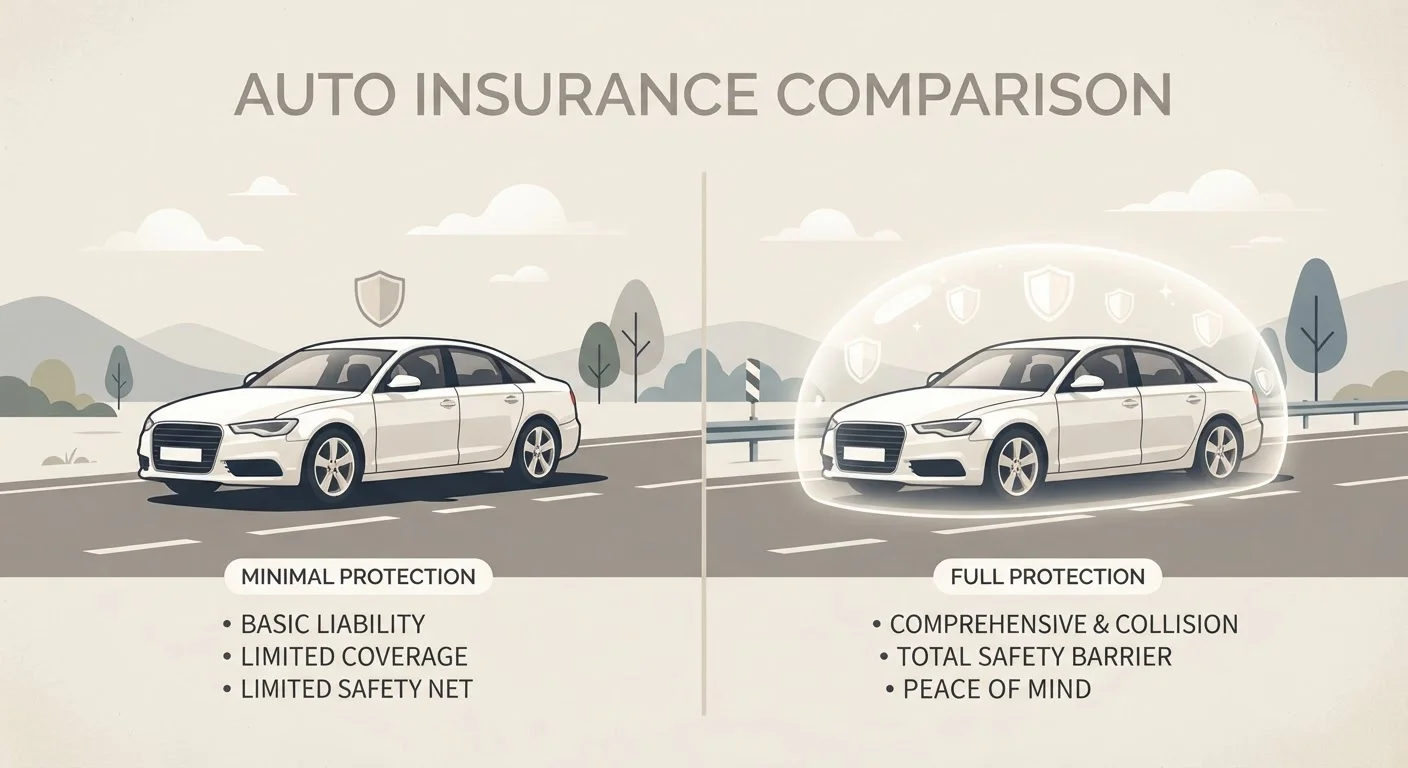
Option A
Minimum Coverage
The legally required baseline - nothing more.
Best for: Drivers of older, low-value vehicles who can absorb out-of-pocket repair costs if their own car is damaged.
Option B
Full Coverage
Broader protection that includes your own vehicle.
Best for: Drivers with newer or financed vehicles who want protection against damage to their own car, not just liability to others.
What Minimum Coverage Actually Means
Every U.S. state requires drivers to carry at least a minimum level of auto insurance before legally operating a vehicle. That baseline - commonly called minimum coverage - is almost always built around liability insurance. Liability pays for bodily injury and property damage you cause to other people in an at-fault accident. It does not pay to repair or replace your own vehicle.
State minimums vary significantly. Some states set low liability limits, while others mandate higher thresholds. A handful of states also require personal injury protection (PIP) or uninsured motorist coverage as part of their minimums. For a state-by-state breakdown, see what the law actually mandates by state.
It's worth noting that meeting the legal minimum is not the same as being adequately insured. If you cause a serious accident and the damages exceed your liability limits, you can be held personally responsible for the difference. Minimum coverage sets a floor - it doesn't define a financially sound strategy.
Minimum Coverage Varies by State
There is no single national standard for minimum auto insurance. Each state sets its own liability limits and may require additional coverages such as personal injury protection (PIP) or uninsured motorist coverage. What satisfies the law in one state may fall short in another, so it's important to verify your state's specific requirements - especially if you've recently moved or purchased a new vehicle.
What Full Coverage Adds to the Picture
The term full coverage is commonly used but not a formal industry category. In practice, it refers to a policy that combines state-required liability insurance with two additional coverage types: collision and comprehensive.
- Collision coverage pays to repair or replace your vehicle after it's damaged in an accident with another car or object, regardless of fault.
- Comprehensive coverage pays for non-collision damage - think theft, vandalism, fire, hail, flooding, or hitting an animal.
Together, these coverages mean your insurer can step in to cover your own vehicle's damage, not just damage you cause to others. For a plain-language explanation of how each layer works, see what liability, collision, and comprehensive actually cover. If you want to understand how collision and comprehensive differ from each other specifically, collision vs. comprehensive coverage is a useful companion read.
Full coverage policies also typically include a deductible - the amount you pay out of pocket before your insurer covers the rest. Higher deductibles generally mean lower premiums, and vice versa.
| Criterion | Minimum Coverage | Full Coverage |
|---|---|---|
| Legally required | Yes - state mandated | No, but often contractually required |
| Pays for others' injuries/property | Yes (liability) | Yes (liability) |
| Pays to repair your own vehicle | No | Yes (collision + comprehensive) |
| Covers theft or weather damage | No | Yes (comprehensive) |
| Typical premium cost | Lower | Higher |
| Deductible applies | Not typically | Yes, for collision and comprehensive |
| Required for financed/leased vehicles | No | Yes, by lender/lessor |
How to Decide Which Level Is Right for You
Neither option is universally correct - the right answer depends on your specific financial situation and the vehicle you drive. A few factors to weigh:
- Your vehicle's current market value. If your car's actual cash value is low, the premium for collision and comprehensive coverage may not make financial sense relative to the maximum payout you'd receive.
- Whether you have a loan or lease. If a lender or lessor holds an interest in your vehicle, full coverage is almost certainly contractually required - this isn't optional.
- Your savings cushion. If you could replace your vehicle out of pocket without serious financial strain, carrying only minimum coverage may be a calculated choice. If not, full coverage limits your exposure.
- Where and how you drive. High-traffic areas increase collision risk; regions prone to severe weather, flooding, or vehicle theft raise the value of comprehensive coverage.
If you're financing a new vehicle, you may also want to consider gap insurance - which covers the difference between what you owe and what your car is worth if it's totaled. And don't overlook uninsured and underinsured motorist coverage, which protects you when the at-fault driver has little or no insurance.
~13%
Uninsured drivers on U.S. roads
According to the Insurance Research Council, roughly one in eight drivers nationwide was uninsured in a recent study period, underscoring the value of uninsured motorist coverage.
3-5×
Full coverage premium vs. minimum
Industry data generally shows full coverage policies can cost two to five times more than a minimum liability-only policy, though the difference depends heavily on vehicle type, driver profile, and location.
This article is for general informational purposes only and does not constitute personalized insurance, financial, or legal advice. Coverage terms, exclusions, and eligibility vary by insurer and state. Always review actual policy documents and consult a licensed insurance agent or adviser for guidance specific to your situation.
The content on this site is for informational purposes only and is not a substitute for professional advice. Always consult a qualified professional for guidance specific to your situation.