

Our Verdict
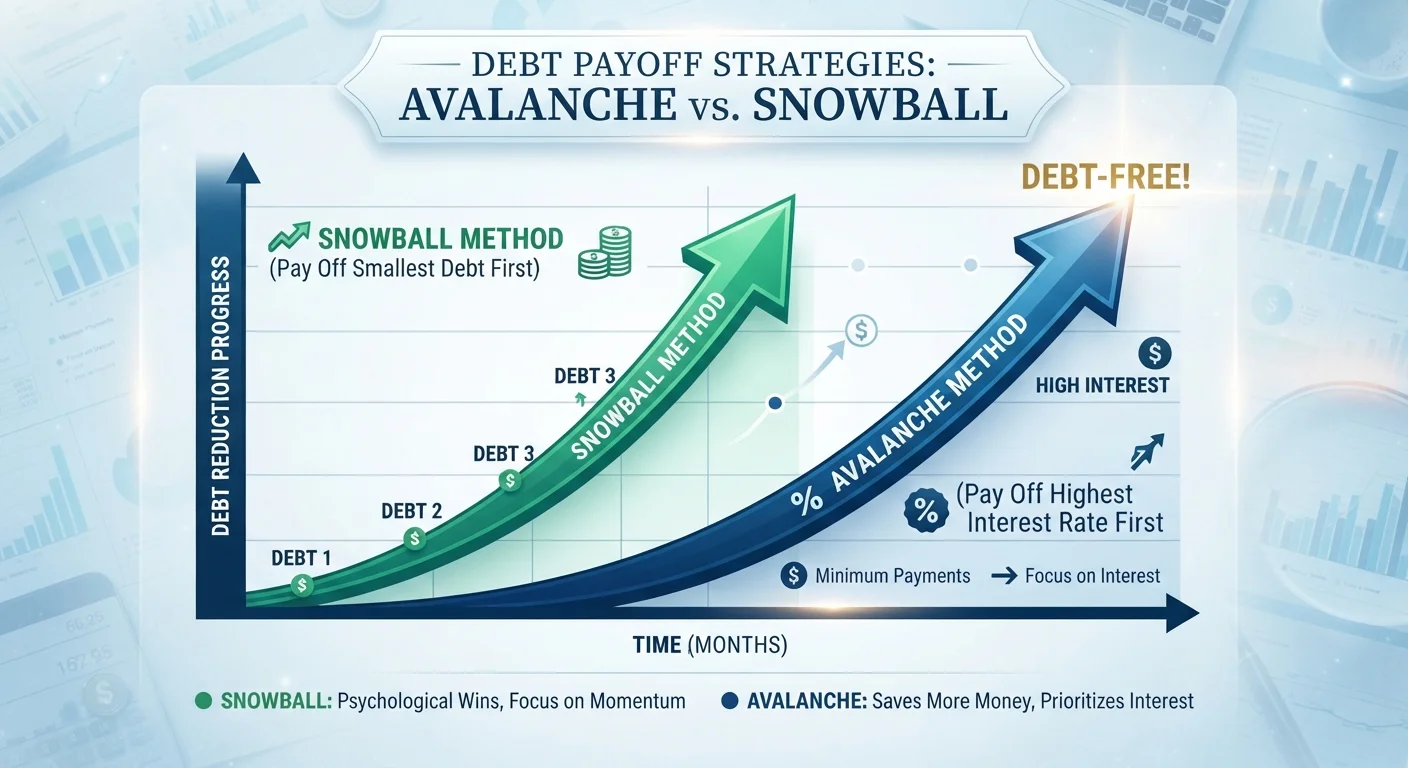
The debt avalanche saves more money over time, making it the stronger choice for those who can stay disciplined without frequent milestones. The debt snowball costs more in interest but delivers faster psychological wins that help many people stay the course. For most people, the right method is simply the one they will actually stick with.
| Best for | Recommended |
|---|---|
| Those motivated by minimizing total interest costs | Debt Avalanche |
| Those who need quick wins to stay motivated | Debt Snowball |
| Those with several small balances close in size | Debt Avalanche |
| Those with a history of abandoned payoff attempts | Debt Snowball |
How Each Strategy Works
Both the debt avalanche and the debt snowball share the same mechanical foundation: you make minimum payments on every debt, then direct any remaining available dollars toward one priority debt at a time. The difference lies entirely in how you rank which debt gets that extra firepower.
Debt Avalanche: Rank your debts by interest rate, highest to lowest. Pour every extra dollar onto the highest-rate balance. Once it's gone, roll that payment onto the next highest rate. Because you're eliminating the most expensive debt first, you reduce the total interest accumulating across all your accounts.
Debt Snowball: Rank your debts by balance, smallest to largest. Ignore interest rates. Attack the smallest balance first. When it's paid off, roll its payment onto the next smallest. Each eliminated account creates a visible win and frees up a payment slot—which behaviorally reinforces the habit. If you're new to debt payoff strategies, this foundational overview of credit and debt explains how interest compounds and why payoff order matters.
The Interest Cost Difference
The avalanche method almost always results in less total interest paid. The gap can be modest or substantial depending on how much your interest rates vary across your debts. When two debts carry similar rates, the real-world difference shrinks considerably. When one debt carries a 24% APR and another carries 8%, the difference can amount to hundreds or even thousands of dollars over a multi-year payoff.
The snowball method accepts a higher interest cost in exchange for faster account closures. If you carry three balances and eliminate the smallest in two months, you've removed an entire line item from your financial picture—even if the remaining two balances grow slightly larger during that time due to continued interest accrual.
~$1,000+
Potential interest savings with avalanche vs. snowball
Estimates vary by debt mix, but the Consumer Financial Protection Bureau notes that payoff order can meaningfully affect total interest costs on high-rate revolving debt.
3–5 years
Typical time to pay off significant consumer debt
The Federal Reserve's Survey of Consumer Finances indicates median credit card balances and payoff timelines vary widely by household income and total debt load.
Understanding whether your debts are secured or unsecured also affects how you prioritize—secured vs. unsecured debt carry meaningfully different risks that can influence which balance you tackle first.
The Psychology of Payoff Momentum
Research in behavioral economics consistently shows that people underestimate how much motivation drives financial follow-through. A strategy that is mathematically superior on paper can fail in practice if the person using it stops sticking to it. This is the snowball method's core argument: account closures create momentum, and momentum reduces dropout rates.
The avalanche method asks for more patience. If your highest-interest debt is also your largest balance, you may spend a year or more paying it down before any account fully closes. That prolonged stretch without a visible win can make the process feel futile—especially when unexpected expenses compete for the same dollars.
Hybrid Approach Worth Considering
Some financial educators suggest a hybrid: use the snowball to eliminate one or two small accounts quickly for an early win, then switch to the avalanche for the remaining balances. This captures some motivational benefit without sacrificing too much in interest savings. Discuss what fits your specific situation with a licensed financial counselor.
Neither approach is superior in the abstract. The better question is: which one will you actually maintain for the months or years it takes to finish? For a broader framework on managing your overall financial standing, this end-to-end resource on credit and debt management provides useful context.
Side-by-Side Comparison
The table below summarizes how the two methods compare across the criteria most relevant to everyday borrowers.
| Debt Avalanche | Debt Snowball | |
|---|---|---|
| Priority basis | Highest interest rate first | Smallest balance first |
| Total interest paid | Lower (mathematically optimal) | Higher (accepts extra cost) |
| Speed to first payoff | Slower if highest-rate debt is large | Faster—smallest balance goes first |
| Motivation style | Requires discipline over long stretches | Delivers frequent visible milestones |
| Best debt profile | Wide spread of interest rates | Multiple small balances to eliminate |
| Dropout risk | Higher if large balance drags on | Lower due to quick early wins |
If you're also evaluating whether to consolidate before choosing a payoff strategy, debt consolidation has its own trade-offs worth understanding before committing to a path. And once you have a strategy in place, pairing it with a structured spending plan is essential—budgeting basics can help you find the extra dollars to accelerate payoff.
This article is for general informational purposes only and does not constitute personalized financial or legal advice. Consult a qualified financial professional regarding your specific circumstances.
The content on this site is for informational purposes only and is not a substitute for professional advice. Always consult a qualified professional for guidance specific to your situation.