

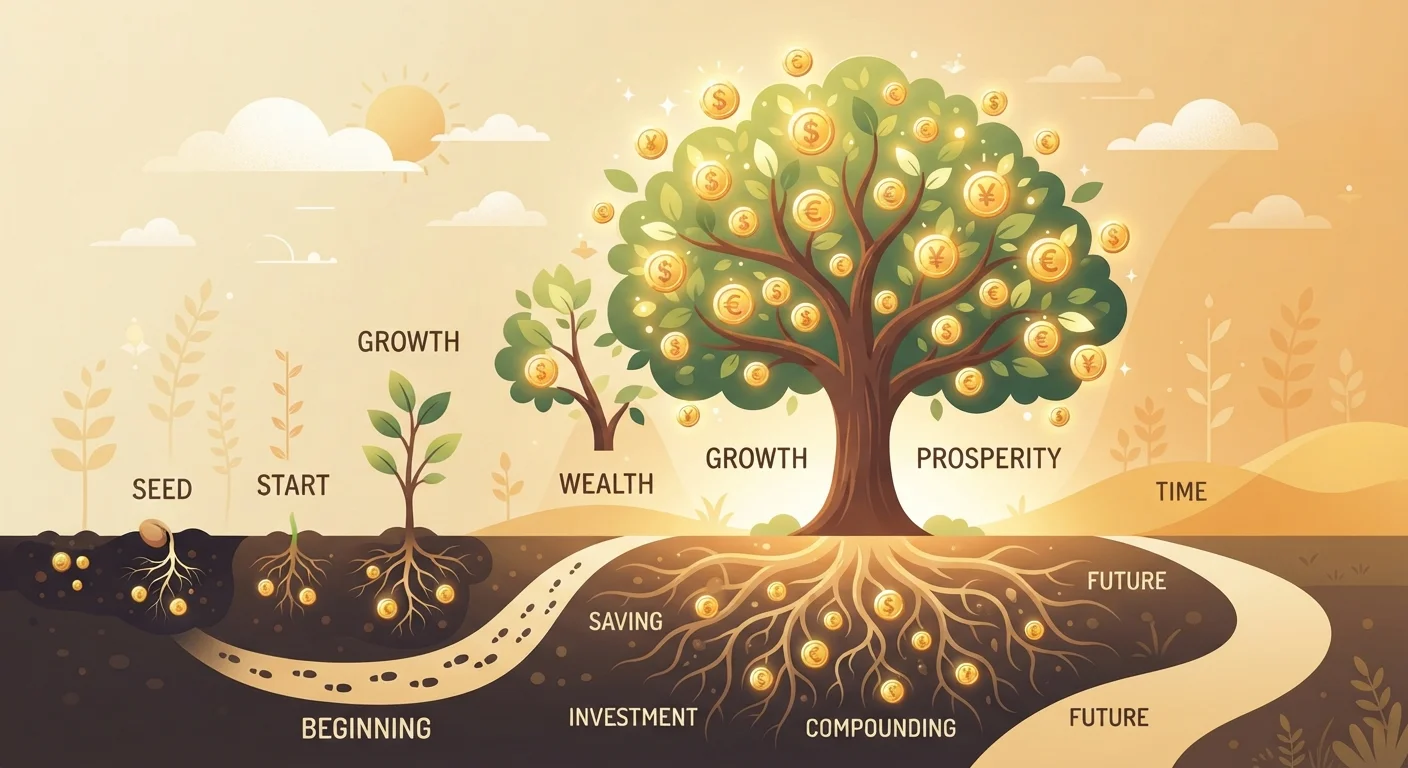
The Core Idea: Interest on Interest
Most people understand interest in the simple sense — borrow money, pay a fee. But compound interest adds a twist: the interest you earn (or owe) is folded back into your balance, and then that larger balance earns interest in the next period.
Think of it like a rolling snowball. A small ball pushed down a hill picks up more snow with every rotation, growing faster and faster. The key ingredients are a starting amount, an interest rate, time, and how often compounding occurs.
For a deeper look at how lenders apply this concept to what you owe, see how lenders calculate interest. And if some of the terminology here is new to you, personal finance terminology every budgeter should know is a solid reference to bookmark.
Simple vs. Compound Interest: A Quick Distinction
Simple interest is calculated only on the original principal — so a $1,000 deposit earning 5% simple interest always earns exactly $50 per year. With compound interest, that $50 is added to the principal, and next year's interest is calculated on $1,050. The difference seems small at first but becomes substantial over longer periods. Most savings accounts, certificates of deposit, and investment vehicles use compound interest.
Time Is the Critical Variable
Compound interest rewards patience more than anything else. The longer money stays invested or saved, the more dramatically it can grow — not in a straight line, but along a curve that steepens over time.
Consider two savers who both set aside the same monthly amount. One starts a decade earlier than the other. By the time both stop contributing, the earlier saver's balance can be substantially larger — not because they contributed more total dollars, but because their money had more time to compound. This concept is sometimes called the time value of money.
10 years
Extra time that can double compound growth impact
Financial educators broadly illustrate that each additional decade of compounding can dramatically amplify long-term savings outcomes, underscoring the value of starting early.
~44%
Americans with no retirement savings
According to the Federal Reserve's Survey of Consumer Finances, a substantial share of American households have little to no retirement savings — missing years of potential compounding growth.
This is why financial educators consistently emphasize starting early, even if contributions are small. A modest regular deposit made consistently over many years can, in principle, outgrow a larger lump sum started later — though individual results always depend on the specific rate, frequency, and circumstances involved. This article provides general educational information, not personalized financial advice; consider speaking with a licensed financial adviser about your own situation.
When Compounding Works Against You
Compound interest is a tool — and like any tool, it can cut in either direction. On savings and investment accounts, compounding builds wealth. On debt, it accelerates what you owe.
Credit card balances are a clear example. When you carry a balance month to month, interest is added to that balance — and next month, interest is calculated on the new, higher total. Over time, this can cause a balance to grow even when you're making payments, particularly if those payments are small relative to the interest accumulating.
Check Your Card's Compounding Schedule
Most credit cards compound interest daily, not monthly — meaning your balance grows faster than you might expect if you carry it forward. When reviewing a credit card agreement, look for the daily periodic rate (the annual rate divided by 365) to understand the true pace of accumulation. Paying the full statement balance each billing cycle eliminates interest charges entirely.
Understanding this dynamic is foundational to managing credit and debt responsibly. If you're working to pay down existing balances, strategies like those covered in the debt avalanche and debt snowball methods can help you minimize the total interest you pay over time.
Putting It Into Practice
Understanding compound interest conceptually is useful — but the practical takeaway matters most. A few principles hold up across most savings and investing contexts:
- Start sooner rather than later. Even small contributions gain compounding momentum over time.
- Look at APY, not just the stated rate. APY (Annual Percentage Yield) reflects what you actually earn after compounding, making it the more meaningful number when comparing accounts.
- Reinvest rather than withdraw. In investment accounts, allowing returns to remain invested — rather than withdrawing them — is what keeps the compounding cycle going.
- Pay down high-interest debt aggressively. When compounding is working against you, reducing the principal faster limits the damage.
Compound interest is also a foundational reason why diversified, long-term investing is so frequently discussed in personal finance. For more on how spreading investments relates to managing risk over time, see diversification and how it manages risk. And if you're newer to how borrowing and credit interact with these ideas, Credit and Debt from the Ground Up is a helpful starting point.
This article is for general informational and educational purposes only and does not constitute personalized financial, investment, or legal advice. Consult a qualified financial professional before making decisions based on your individual circumstances.
Frequently Asked Questions
Simple interest is calculated only on the original principal amount. Compound interest is calculated on the principal plus any interest already earned. Over long periods, compound interest produces significantly larger growth than simple interest on the same starting balance.
The more frequently interest compounds — daily versus monthly versus annually — the faster your balance grows. Daily compounding produces slightly more growth than annual compounding on the same nominal rate because interest is added to the balance more often, creating a larger base for the next calculation.
Yes. On credit cards, personal loans, and other debt products, compound interest means unpaid balances grow over time as interest is added to the amount owed. Carrying a balance without paying it down can cause the total owed to increase substantially. Understanding this is essential to managing debt responsibly.
Generally speaking, earlier is better. Because compounding is time-dependent, the longer money remains invested or saved, the more growth it can accumulate. Even modest amounts saved consistently at a young age can outpace larger amounts saved later, all else being equal.
APY stands for Annual Percentage Yield and reflects your actual rate of return after compounding is factored in. It is a more accurate figure than a stated nominal interest rate when comparing savings accounts or investment products, because it accounts for how often interest compounds.
The content on this site is for informational purposes only and is not a substitute for professional advice. Always consult a qualified professional for guidance specific to your situation.