

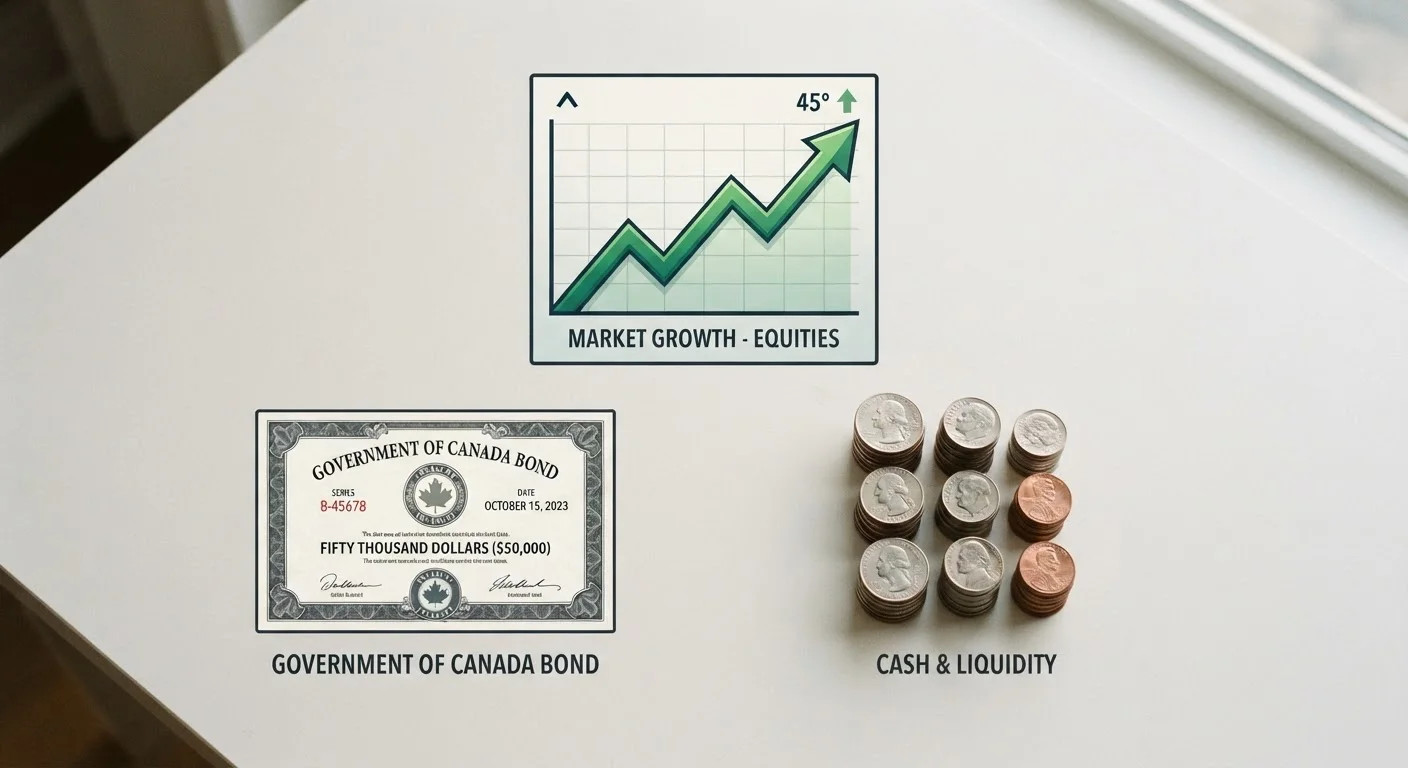
Why Asset Classes Matter
When financial educators talk about building a portfolio, they almost always start in the same place: asset classes. An asset class is a broad category of investments that share similar characteristics — how they generate returns, how they respond to economic conditions, and how much risk they typically carry.
The three foundational asset classes are stocks, bonds, and cash equivalents. Understanding what each one actually does — not just what it is — helps you make sense of why a portfolio is structured the way it is. For a broader foundation of financial vocabulary, see our plain-language personal finance glossary.
| Primary purpose of stocks | Long-term capital growth through company ownership |
| Primary purpose of bonds | Predictable income and portfolio stabilization |
| Primary purpose of cash equivalents | Liquidity, short-term needs, and capital preservation |
| Typical risk level (low to high) | Cash → Bonds → Stocks (General industry convention; risk varies by specific instrument) |
| Inflation sensitivity | Cash most vulnerable; stocks historically most resilient over long periods |
| Key concept linking all three | Asset allocation — how much of each class a portfolio holds |
Stocks: Ownership and Growth Potential
A stock (also called a share or equity) represents a fractional ownership stake in a company. When you buy stock in a company, you become a shareholder — meaning you participate in its financial performance, both up and down.
Stocks have historically offered higher long-term returns than bonds or cash, but they come with significantly more short-term volatility. A stock's price can drop sharply during economic downturns and recover over time, or it may not recover at all if the underlying company struggles. Past performance does not guarantee future results.
In a portfolio, stocks are generally considered the primary growth engine. They carry the most risk and, over long time horizons, have tended to outpace inflation more reliably than other asset classes. Investors with a longer time horizon and a higher tolerance for fluctuation often hold a larger proportion of stocks.
~10%
Average annual U.S. stock market return (historical, pre-inflation)
Based on long-run S&P 500 historical data; past performance does not guarantee future results and actual returns vary significantly by time period.
~4–6%
Typical long-run nominal return range for investment-grade bonds
Historical figures vary by bond type, credit quality, and interest rate environment; individual results differ.
Bonds: Income and Relative Stability
A bond is a loan you make to a borrower — typically a corporation or a government. In exchange, the borrower promises to pay you regular interest (called the coupon) over a set period and return the original loan amount (the principal) when the bond matures.
Bonds generally carry less short-term price volatility than stocks, though they are not risk-free. Bond prices move inversely to interest rates: when rates rise, existing bond prices tend to fall. There is also credit risk — the possibility that the issuer cannot repay. Government bonds issued by stable governments are typically considered lower risk than corporate bonds.
In a portfolio, bonds serve as a stabilizing force and a source of predictable income. They can help cushion the impact of stock market declines, though they generally offer lower long-term growth. Understanding this trade-off is central to the broader difference between saving and investing.
Cash and Cash Equivalents: Liquidity and Capital Preservation
Cash equivalents include money market funds, Treasury bills, and high-yield savings accounts — instruments that are highly liquid and carry very low risk of losing value in nominal terms. Unlike stocks or bonds, their primary purpose is not growth; it is capital preservation and accessibility.
In a portfolio, cash plays a few distinct roles. It provides a buffer to cover near-term expenses or emergencies without requiring you to sell other investments at an unfavorable time. It also gives investors dry powder — available capital to deploy when investment opportunities arise.
The main risk of holding too much cash is inflation erosion: over time, cash tends to lose purchasing power because its returns rarely keep pace with rising prices. Cash is generally not a long-term wealth-building tool, but it is an essential component of a balanced financial strategy.
Cash Equivalents Are Not the Same as Savings Accounts
While an ordinary savings account holds cash, the term 'cash equivalents' in investing refers to specific short-duration instruments like Treasury bills and money market funds. These are designed to maintain a stable value and provide easy access to funds. Your everyday checking or savings account serves a similar preservation and liquidity function, but the investment categories are distinct. Always check what a specific fund or account actually holds before assuming it behaves identically to cash.
How the Three Asset Classes Work Together
No single asset class is ideal in isolation. Stocks offer growth but with volatility; bonds provide stability but with limited upside; cash preserves value but erodes in real terms over time. The way these classes are combined — a concept called asset allocation — determines much of a portfolio's overall risk-and-return profile.
A common general principle is that a portfolio's stock-to-bond ratio can be adjusted based on an investor's time horizon and risk tolerance. A longer runway before needing the money may support a higher allocation to stocks; a shorter horizon or lower tolerance for volatility may favor more bonds and cash. These are broad principles, not personal recommendations — a licensed financial adviser can help you determine what allocation makes sense for your individual situation.
For a closer look at how spreading investments across asset classes reduces concentration risk, see our explainer on diversification in investing. And if you are curious about one practical vehicle for accessing stock exposure, our guide to index funds is a useful next step.
Asset class
A broad category of investments that share similar characteristics, risk profiles, and market behaviors. The three foundational classes are stocks, bonds, and cash equivalents.
Asset allocation
The process of dividing a portfolio among different asset classes. The mix chosen is typically guided by an investor's goals, time horizon, and risk tolerance.
Volatility
The degree to which an investment's price fluctuates over time. Higher volatility means larger and more frequent price swings, in either direction.
Liquidity
How quickly and easily an investment can be converted to cash without significantly affecting its price. Cash is fully liquid; some bonds and stocks can take time to sell at fair value.
Coupon
The periodic interest payment a bondholder receives from the bond issuer, usually expressed as an annual percentage of the bond's face value.
Capital preservation
An investment objective focused on protecting the original value of money rather than growing it. Cash and short-term government securities are commonly used for this purpose.
The content on this site is for informational purposes only and is not a substitute for professional advice. Always consult a qualified professional for guidance specific to your situation.