

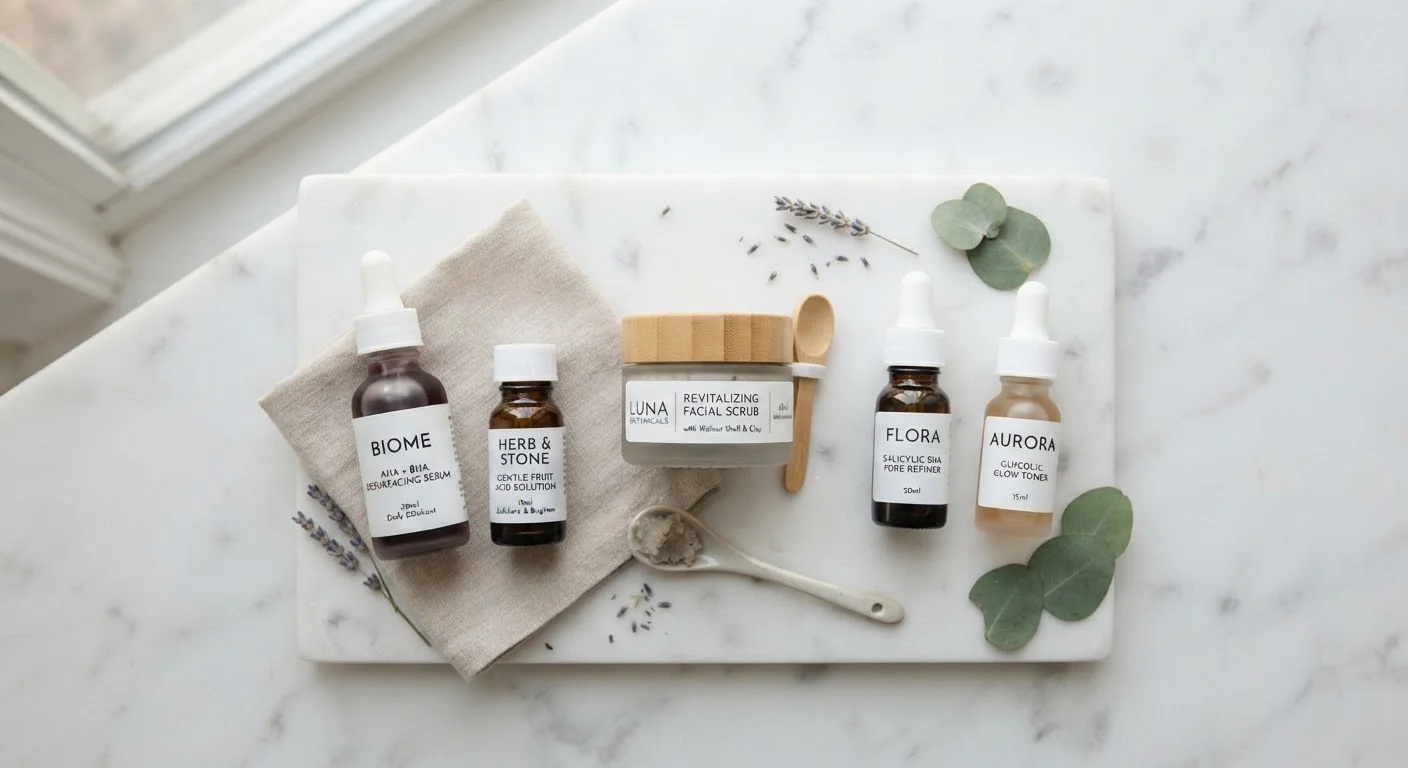
Option A
Chemical Exfoliants (AHAs & BHAs)
The invisible, deeper-working dissolvers.
Best for: Best for those targeting uneven tone, acne, or fine lines who want consistent, controlled exfoliation without manual friction.
Option B
Physical Scrubs
The tactile, instant-gratification option.
Best for: Best for those who enjoy a hands-on skincare ritual and want immediate smoothness on resilient, non-sensitive skin.
How Each Method Actually Works
Exfoliation is the process of removing dead skin cells from the surface of your skin — and how you do it matters enormously. The two main camps work in fundamentally different ways.
Chemical exfoliants use acids or enzymes to loosen the bonds that hold dead skin cells together, allowing them to shed more naturally. The most common types are:
- AHAs (alpha-hydroxy acids) — such as glycolic acid and lactic acid — work primarily on the skin's surface and are water-soluble. They're widely used to address dullness, fine lines, and uneven tone.
- BHAs (beta-hydroxy acids) — most commonly salicylic acid — are oil-soluble, which means they can penetrate into pores. They're particularly useful for oily and acne-prone skin.
- Enzyme exfoliants — often derived from papaya or pineapple — offer a gentler alternative, digesting dead cells without significant acid activity.
Physical scrubs, by contrast, rely on mechanical action. Tiny particles — such as sugar, salt, oat powder, or synthetic microbeads — physically abrade the skin's surface when you massage them in. The friction lifts and removes dead cells immediately.
If you're building a skincare routine from scratch, understanding this distinction helps you choose an exfoliant that fits your skin's needs rather than defaulting to whatever's most familiar.
| Criterion | Chemical Exfoliants | Physical Scrubs |
|---|---|---|
| Mechanism | Dissolves cell bonds with acids/enzymes | Manually buffs away cells with particles |
| Depth of action | Surface to inside pores (BHAs) | Surface only |
| Best for skin type | Most types, especially sensitive/acne-prone | Normal to oily, resilient skin |
| Speed of results | Gradual, builds over consistent use | Immediate tactile smoothness |
| Risk of irritation | Low to moderate if used correctly | Higher with coarse particles or pressure |
| Frequency (general guidance) | 1–3 times per week depending on formula | 1–2 times per week maximum |
| Pore-clearing ability | High (especially BHAs) | Limited to surface debris |
| Learning curve | Moderate — pH, concentration matter | Low — straightforward to use |
Matching the Method to Your Skin Type
No single exfoliation method works for every skin type. Here's how to think through the fit:
Oily or Acne-Prone Skin
BHAs are a strong match here. Salicylic acid's oil-solubility allows it to work inside the pore lining — something no physical scrub can replicate. Physical scrubs may feel satisfying, but they can't clear out the congestion that happens below the surface.
Dry or Sensitive Skin
Low-concentration AHAs or enzyme exfoliants tend to be gentler than gritty scrubs. Harsh physical particles can cause micro-abrasions on fragile skin, worsening redness and irritation. Lactic acid, in particular, also has mild hydrating properties.
Normal or Combination Skin
You have the most flexibility. A well-formulated scrub used once or twice a week can complement an occasional chemical exfoliant, as long as you're not layering them on the same day.
A Note on Exfoliation Frequency
More is rarely better when it comes to exfoliation. Over-exfoliating — whether chemically or physically — can strip the skin's protective moisture barrier, leading to redness, flaking, and increased sensitivity. Most dermatologists suggest starting with once or twice a week and only increasing frequency if your skin tolerates it well. Listening to your skin's signals is more reliable than following a rigid schedule.
Mature Skin
AHAs are generally well-regarded for supporting cell turnover and addressing the appearance of fine lines. Physical scrubs may be too aggressive for skin that has become thinner or more delicate over time.
One thing that applies across all skin types: always follow up exfoliation — chemical or physical — with moisturizer and, during the day, a broad-spectrum SPF. Freshly exfoliated skin is more vulnerable to UV exposure.
Common Mistakes and How to Avoid Them
Both approaches can backfire when overused or misapplied. The most frequent mistake with physical scrubs is pressing too hard or using them too often. Coarse particles applied with heavy pressure can create tiny tears in the skin's surface, triggering inflammation — a phenomenon sometimes called over-exfoliation.
With chemical exfoliants, the pitfalls are different. Starting at too high a concentration, using multiple active acids at once, or combining them carelessly with other potent ingredients can compromise your skin barrier. For example, pairing a strong AHA with a retinoid on the same night is a combination worth approaching cautiously. Our guide to ingredients that don't play well together walks through the pairings most likely to cause trouble.
A general rule of thumb: start slow. Whether you're trying a new chemical exfoliant or reintroducing a scrub, once a week is a reasonable starting frequency. From there, you can adjust based on how your skin responds.
2–3×
How often most people over-exfoliate vs. recommended
Dermatologists frequently note in clinical practice that patients use exfoliants more often than their skin can tolerate, resulting in compromised barrier function.
~8% glycolic acid
Typical OTC AHA concentration threshold
Over-the-counter chemical exfoliants in the U.S. generally contain up to around 10% AHA; higher concentrations are typically used in professional settings.
Also consider where exfoliation fits in your cleansing routine. Chemical exfoliants are typically applied to clean, dry skin after cleansing, while a physical scrub is usually used in place of — or after — your cleanser. Speaking of which, the type of cleanser you use can also affect how well your exfoliant performs. Different cleanser formulas interact differently with skin before you add any active ingredients.
This article is for general informational purposes only and is not intended as medical or dermatological advice. If you have a skin condition or concerns about a new product, consult a qualified dermatologist or healthcare professional.
The content on this site is for informational purposes only and is not a substitute for professional advice. Always consult a qualified professional for guidance specific to your situation.