

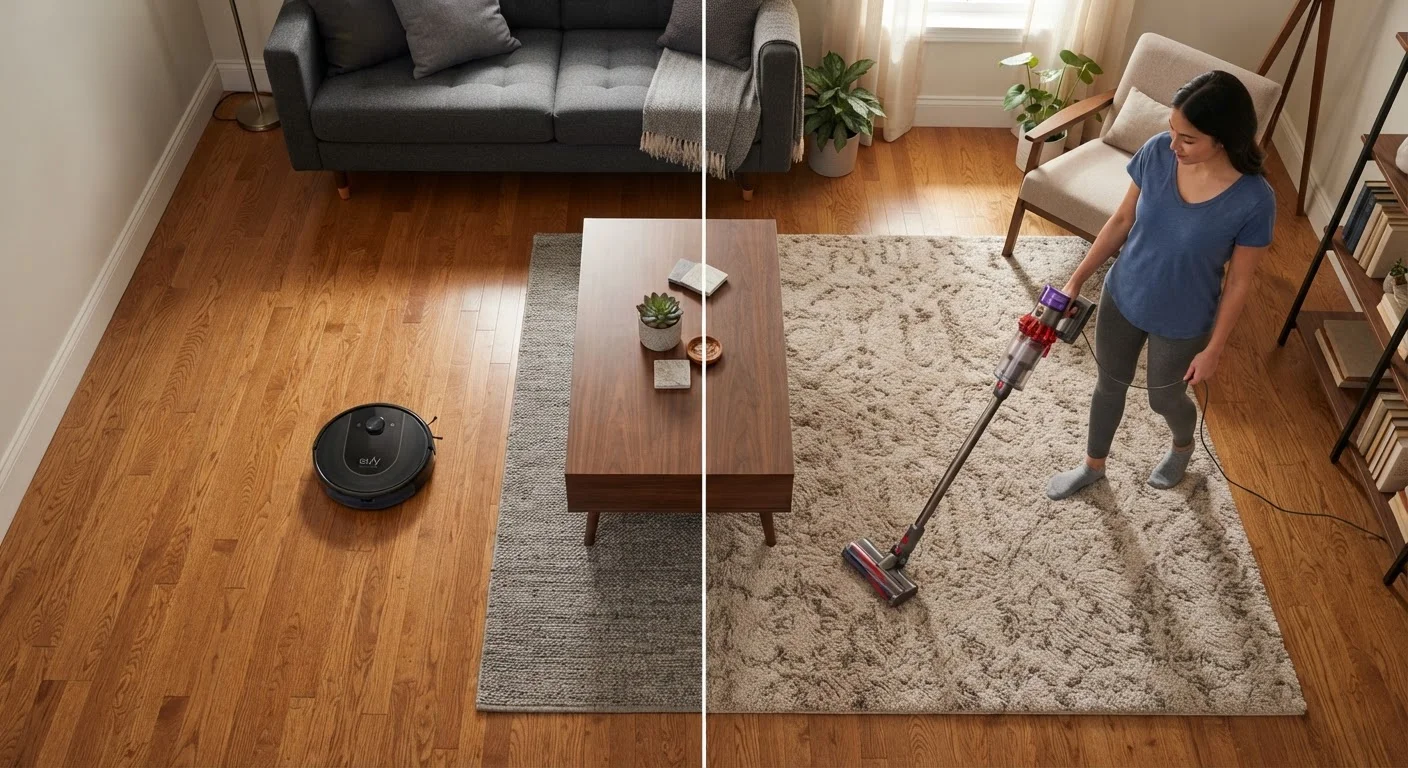
Option A
Robot Vacuums
The hands-free, set-it-and-forget-it approach to daily floor maintenance.
Best for: Households wanting consistent, low-effort maintenance cleaning between deeper sessions.
Option B
Traditional Vacuums
The thorough, user-directed tool for deep and versatile cleaning.
Best for: Anyone who needs strong suction, flexible attachments, and complete control over cleaning results.
What Each Type Actually Does
Robot vacuums are autonomous, disc-shaped devices that navigate your floors using sensors, mapping technology, or a combination of both. They operate on a schedule or at a button press, depositing debris into a small internal bin. Traditional vacuums — uprights, canisters, and stick models — are manually operated and powered by stronger motors, with a range of attachments designed for different surfaces and messes.
The core distinction isn't just automation. It's the trade-off between consistency and thoroughness. A robot vacuum can run every day with zero effort; a traditional vacuum delivers more cleaning power when it does run. Understanding this framing matters more than any single spec comparison.
| Criterion | Robot Vacuums | Traditional Vacuums |
|---|---|---|
| Daily effort required | Very low — scheduled or one-touch | High — manual operation each use |
| Suction power | Moderate | Strong to very strong |
| Carpet deep-cleaning | Limited on high-pile | Effective across carpet types |
| Hard floor maintenance | Excellent for daily upkeep | Good, but manual each time |
| Pet hair on carpet | Surface pickup only | Deep extraction with right head |
| Edge and corner cleaning | Often misses corners | Complete with crevice tool |
| Stairs and upholstery | Not possible | Yes, with attachments |
| Maintenance frequency | High — bins, brushrolls, filters | Low — periodic bag or bin emptying |
| Works in cluttered spaces | Poorly — navigation limited | Yes — user guides the tool |
Cleaning Performance: Carpets, Pet Hair, and Corners
On bare hardwood or tile, robot vacuums perform genuinely well for everyday debris like dust, crumbs, and pet dander. Their brushroll and suction lift light particles effectively during scheduled passes. However, performance drops on medium- to high-pile carpets, where robot vacuums often lack the suction and brush agitation needed to dislodge embedded dirt.
Pet hair is a particular challenge. Robot vacuums can pick up surface fur efficiently but wrap it around their brushrolls quickly — requiring frequent cleaning to maintain performance. Traditional vacuums with motorized pet-tool attachments tend to extract embedded fur more thoroughly from upholstered furniture and deep-pile carpet. If your household includes heavy shedders, this gap is meaningful. For more on managing pet-related home care, see multi-pet household considerations.
Corner and edge cleaning is another area where traditional vacuums hold a clear advantage. Most robot vacuums use a single side-brush to sweep debris toward their main intake, leaving a small margin along walls and in right-angle corners consistently uncleaned. Uprights and canisters with crevice tools eliminate this problem directly.
~30%
Floor area robot vacuums may miss near edges
Independent home technology testing has found that robot vacuums can leave a consistent gap of several centimeters along walls and in corners during typical operating runs.
3–5×
More suction in typical upright vs. robot models
Consumer testing organizations have generally found that mid-range upright vacuums outperform comparably priced robot vacuums in measured airflow and embedded-dirt extraction on carpet.
Every 1–3 runs
Recommended robot vacuum bin emptying frequency
Most robot vacuum manufacturers recommend emptying the dustbin after every one to three cleaning cycles to maintain suction performance, compared with less frequent maintenance on full-size vacuums.
Effort, Maintenance, and the Automation Trade-Off
The appeal of robot vacuums is real: you spend less active time cleaning, and floors stay tidier day-to-day. But the word "automatic" can be misleading. Robot vacuums require regular maintenance — their small bins fill quickly and must be emptied every one to three runs, brushrolls need hair removed weekly, and filters need periodic replacement. Mapping-based models also require that floor areas stay relatively clear of clutter to navigate effectively.
A cluttered floor layout directly reduces a robot vacuum's effectiveness, because obstacles create zones the device avoids or misses. Homes with lots of furniture legs, charging cables, or scattered objects will see significantly less coverage than open-plan spaces.
Traditional vacuums demand your time and physical effort while in use, but they need less routine upkeep. Most use larger dust bins or bags that require emptying far less often, and there's no sensor or navigation system to troubleshoot.
Self-Emptying Bases Change the Equation
Higher-end robot vacuums now include a base station that automatically empties the onboard bin into a larger bag or container, reducing hands-on maintenance to once every few weeks. This feature meaningfully addresses one of the most common complaints about robot vacuum ownership. However, these systems add to the overall cost and the base station itself requires periodic bag replacement or emptying.
Which Setup Makes Sense for Your Home?
Rather than declaring a winner, the practical reality for many American households is that these tools are more complementary than competitive. A robot vacuum running daily on hard floors reduces the frequency of full vacuuming sessions. A traditional vacuum, run weekly or biweekly, handles deeper carpet cleaning, stairs, upholstery, and the corners the robot missed.
Budget is a real factor. Entry-level robot vacuums and basic upright vacuums occupy similar price ranges, but advanced robot models with self-emptying bases and LIDAR mapping can cost significantly more than a quality traditional vacuum. The investment calculus depends on how much you value daily automation versus deep-cleaning capability.
Home technology decisions often work similarly to grooming choices — the "best" tool depends on your routine, not on spec sheets alone. Just as explored in manual versus electric shaver comparisons, matching the tool to your actual habits matters more than choosing the most technically capable option.
The content on this site is for informational purposes only and is not a substitute for professional advice. Always consult a qualified professional for guidance specific to your situation.