

Option A
Wi-Fi 6 (802.11ax)
The proven, widely compatible upgrade for most homes.
Best for: Households with mixed devices — phones, laptops, smart TVs — that want meaningfully faster and more reliable Wi-Fi without replacing every gadget.
Option B
Wi-Fi 6E
The next step, unlocking a brand-new 6 GHz band.
Best for: Power users, dense multi-device environments, or early adopters who own compatible devices and want the lowest possible interference and latency.
What Actually Separates Wi-Fi 6 from Wi-Fi 6E
Both standards are built on the same underlying 802.11ax specification, so they share the same core improvements: better handling of multiple simultaneous connections (via OFDMA), improved power efficiency for battery-powered devices, and higher theoretical peak throughput than Wi-Fi 5. The one thing that distinguishes Wi-Fi 6E is a single letter — and a third radio band.
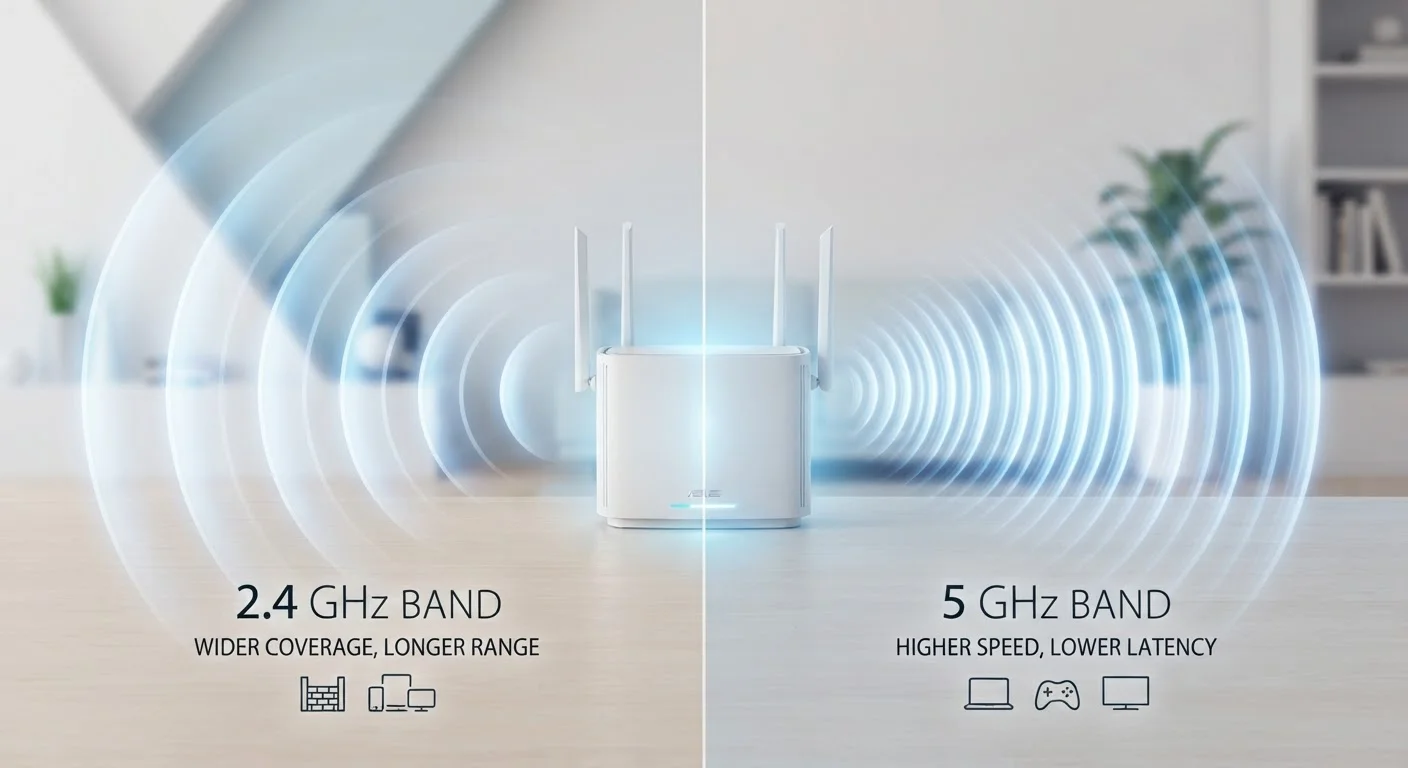
Wi-Fi 6 operates on the 2.4 GHz and 5 GHz bands, the same two frequencies used by every Wi-Fi generation since Wi-Fi 5. Wi-Fi 6E adds access to the 6 GHz band, a chunk of spectrum the FCC opened for unlicensed use in 2020. That opening added up to 1,200 MHz of new spectrum — compared to just 70 MHz available on 2.4 GHz and roughly 500 MHz on 5 GHz. In plain terms: a much wider highway with very little traffic on it yet.
For an overview of the terminology involved — from bands to channels to spectrum — the Home Network Glossary is a useful plain-language reference before diving deeper.
| Criterion | Wi-Fi 6 | Wi-Fi 6E |
|---|---|---|
| Frequency bands | 2.4 GHz and 5 GHz | 2.4 GHz, 5 GHz, and 6 GHz |
| Available spectrum | ~570 MHz total | Up to ~1,770 MHz total |
| Interference level | Moderate (crowded bands) | Low on 6 GHz (uncrowded) |
| Range at top speed | Good (5 GHz) to excellent (2.4 GHz) | Shorter range on 6 GHz band |
| Device compatibility | Very broad — most current devices | 6 GHz requires Wi-Fi 6E hardware |
| Typical router cost | Lower (wider product range) | Higher premium for tri-band models |
| Best suited for | Mixed-device households | High-density, compatible-device setups |
Range, Speed, and the Real Tradeoffs of 6 GHz
Higher frequencies carry more data but travel shorter distances and penetrate walls less effectively. The 6 GHz band sits above 5 GHz, which means it faces the same range limitations — amplified. In a large home with thick walls, a 6 GHz signal may not reach reliably from one end to the other. If you're planning a mesh setup to extend coverage, the guide to setting up a mesh Wi-Fi network covers how node placement affects multi-band performance.
That range constraint matters because the 6 GHz band's real advantage — low interference and wide 160 MHz channels — is only available to Wi-Fi 6E-certified devices. A 2021 laptop, most current smart speakers, older phones, and most smart-home sensors connect on 2.4 GHz or 5 GHz regardless of what router you buy. A Wi-Fi 6E router still serves those devices well on the older bands; the 6 GHz band simply sits idle for them.
1,200 MHz
New spectrum added by the 6 GHz band
The FCC's 2020 ruling opened this spectrum for unlicensed Wi-Fi use, dwarfing the combined usable width of the 2.4 GHz and 5 GHz bands.
160 MHz
Maximum channel width on 6 GHz
Wider channels allow higher per-device throughput; such wide channels are rarely achievable on 5 GHz due to competing networks in most neighborhoods.
4–6 years
Typical home router lifespan
Industry guidance generally suggests routers remain functional and secure for roughly this window, making future-proofing a relevant factor in purchasing decisions.
Speed gains on 6 GHz are measurable in controlled tests, but real-world throughput in a home environment also depends on your internet service plan, the quality of in-wall wiring to your router, and how many devices are competing simultaneously.
Device Compatibility: The Factor That Shapes Your Decision
As of recent product cycles, Wi-Fi 6E support has been appearing in flagship smartphones, newer laptops, and high-end laptops — but it remains far from universal. Budget phones, most tablets, smart-home hubs, streaming sticks, and IoT sensors typically do not include a 6 GHz radio. This matters because a Wi-Fi 6E router doesn't automatically make non-compatible devices faster; it just ensures compatible devices get a dedicated, interference-free lane.
If the majority of devices in your home are not Wi-Fi 6E-certified, the practical argument for upgrading shifts from "I'll get faster speeds" to "I'm future-proofing." That's a legitimate reason to choose 6E — routers last four to six years in most households — but it's worth being clear-eyed about the distinction. Upgrading your home network also intersects with how your devices handle wireless versus cellular connections, a topic explored in the comparison of mobile data vs. Wi-Fi.
Wi-Fi 7 Is Already on the Horizon
Wi-Fi 7 (802.11be) routers began appearing in 2024, and the standard builds further on the 6 GHz band while introducing multi-link operation. If you're on an older router and not in a rush, it's worth knowing the landscape is still evolving. That said, Wi-Fi 6 and 6E remain fully capable standards for home use and will continue to receive device support for years to come.
The content on this site is for informational purposes only and is not a substitute for professional advice. Always consult a qualified professional for guidance specific to your situation.