

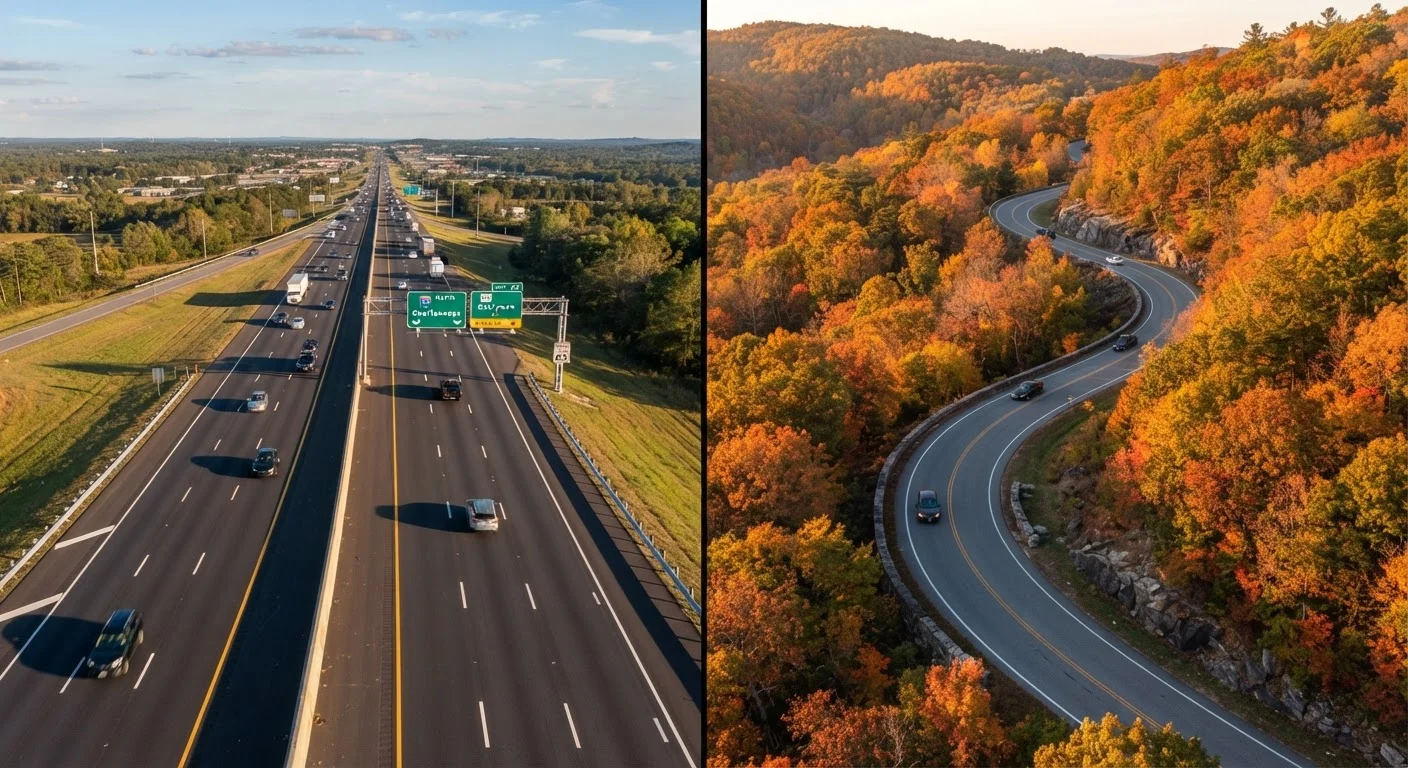
Option A
Interstate Highway
The efficient, predictable backbone of long-distance driving.
Best for: Travelers who need to cover ground quickly, stick to a schedule, or drive long distances with minimal stops.
Option B
Scenic Route
The slower, richer road built around the journey itself.
Best for: Travelers who want immersive landscapes, local character, and flexibility over raw speed.
What Each Route Type Actually Offers
When planning a road trip, the route choice is one of the most consequential decisions you'll make - and it's often treated as an afterthought. Interstates and scenic routes aren't simply fast versus slow. They represent fundamentally different travel philosophies.
Interstates are engineered for throughput. Divided lanes, controlled access, consistent speed limits, and regular service plazas mean you can move predictably across long distances. They're the logical backbone for any trip where arrival matters as much as - or more than - the drive itself. For context, the US Interstate Highway System spans roughly 48,000 miles, connecting nearly every major metro area in the country.
Scenic routes - whether a designated National Scenic Byway, a coastal highway, or a mountain two-lane - are engineered for experience. They pass through terrain, towns, and landscapes that interstates were explicitly built to bypass. That's both their appeal and their limitation. See our region-by-region geography guide for a breakdown of what different American corridors look and drive like.
| Criterion | Interstate Highway | Scenic Route |
|---|---|---|
| Travel speed | Fast, consistent | Slower, variable |
| Fuel efficiency | Generally higher | Often lower on grades |
| Scenery | Limited, uniform | Rich, varied |
| Service access | Frequent, predictable | Sparse, plan ahead |
| Navigation complexity | Low | Moderate to high |
| Weather resilience | Better maintained | More exposure risk |
| Driver engagement | Can induce fatigue | More attentiveness required |
| Best for schedules | Yes | Requires flexibility |
The Real Costs: Time, Fuel, and Stress
The most obvious trade-off is time. A scenic alternative to a given interstate stretch can easily add 30-90 minutes per 100 miles, depending on terrain and road quality. On a multi-day trip, those increments compound quickly. If you're planning a multi-state route, underestimating scenic-road time is one of the most common planning errors drivers make.
Fuel costs are another consideration. Highway driving at steady speeds is generally more efficient than navigating steep grades, sharp curves, or frequent stops on back roads. Your vehicle's actual fuel economy on a winding mountain route may drop noticeably compared to flat interstate cruising - something worth factoring into your budget before departure.
Stress profiles differ too. Interstates demand less active decision-making but can induce fatigue through monotony. Scenic routes require more attentiveness - particularly on narrow roads, mountain passes, or unfamiliar terrain. Driving in unfamiliar terrain has its own preparation demands that deserve honest assessment before you commit to a route.
~48,000
Miles in the US Interstate System
The Federal Highway Administration reports the Interstate Highway System covers approximately 48,000 miles across the contiguous US, Alaska, and Hawaii.
150+
Designated National Scenic Byways
The US Department of Transportation's National Scenic Byways Program has recognized over 150 roads across the country for their cultural, historical, or natural qualities.
Safety and Service Access
Interstates have a structural safety advantage in one specific sense: they offer more consistent access to help. Rest stops, fuel stations, and emergency services appear at regular intervals. Cell coverage, while not universal, tends to be stronger along major corridors. If your vehicle is older, your travel party includes young children, or your trip spans remote geography, these factors matter.
Scenic routes can run through areas with limited cell service, infrequent fuel stops, and long gaps between towns. This isn't a reason to avoid them - it's a reason to prepare differently. Checking fuel levels more frequently, downloading offline maps, and carrying basic emergency supplies becomes more important, not optional. Our article on why road trips go wrong covers these preparation gaps in detail.
Weather is a compounding variable on scenic routes. Mountain roads can close or become hazardous with little notice. Coastal highways may face fog or wind. Interstates are typically better maintained year-round and cleared faster after weather events.
How to Blend Both for the Best Result
The false choice is thinking you have to pick one for your entire trip. Most experienced road trippers use interstates to eat up distance efficiently and switch to scenic routes for segments where the landscape or destination warrants it. A practical approach: use your mapping tool to identify where scenic alternatives add meaningful character without inflating your total drive time beyond tolerance.
If you're planning your first road trip, starting primarily on interstates and adding a single scenic detour is a lower-risk way to experience the difference without overcommitting. Once you understand your travel pace and preferences, future trips can integrate more scenic mileage with confidence.
Overnight planning also plays into this. Scenic routes often pass through smaller towns where accommodation options are limited. Pairing a scenic day with flexible overnight expectations - or having a backup plan - prevents the route from creating logistics problems. See our comparison of camping versus motel stays for how your overnight choice interacts with route type.
Ultimately, neither route is universally superior. The right answer depends on your timeline, your vehicle, your travel companions, and what you actually want from the drive.
The content on this site is for informational purposes only and is not a substitute for professional advice. Always consult a qualified professional for guidance specific to your situation.