

Our Verdict
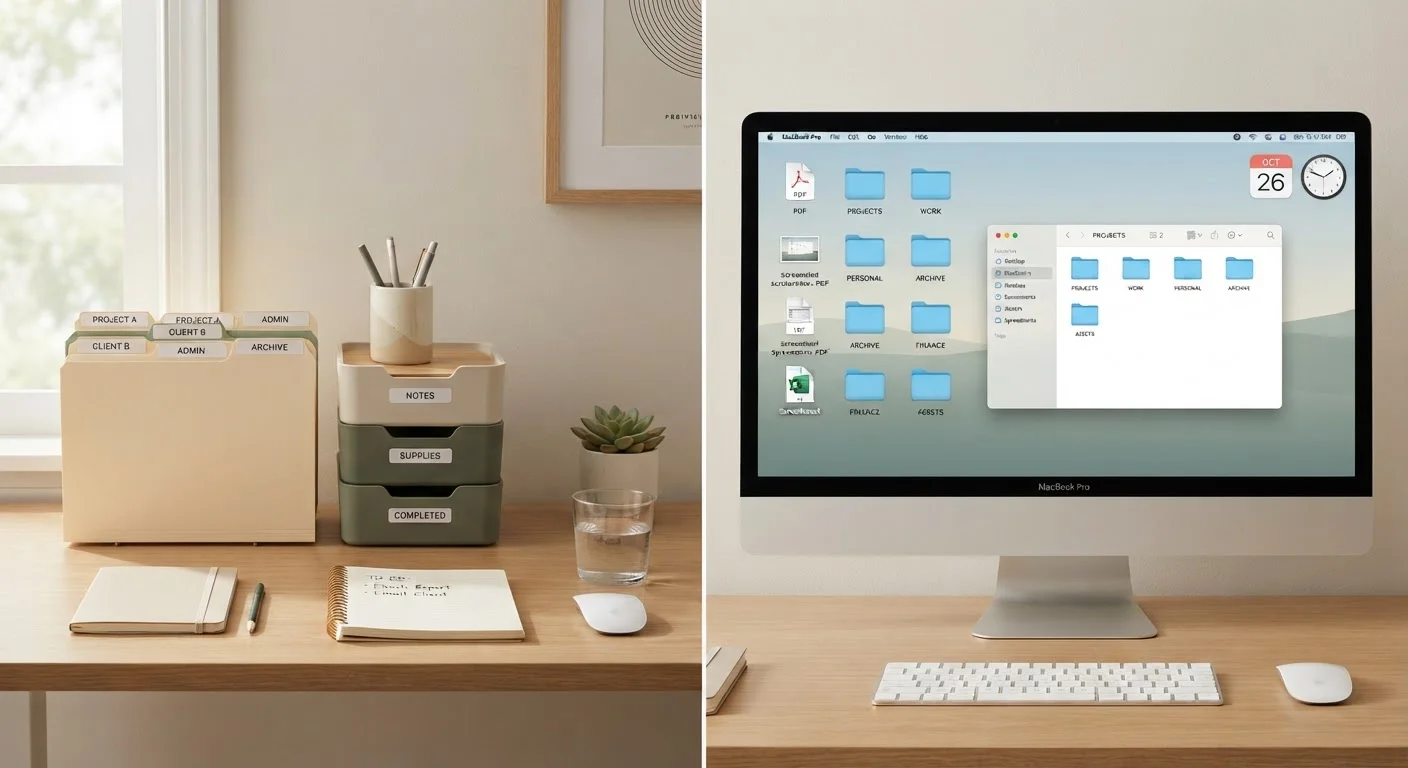
Physical and digital organization are not competing priorities - they are complementary disciplines that reinforce each other. Physical clutter demands spatial thinking and tangible decision-making, while digital clutter demands naming discipline and consistent folder logic. The habits that sustain one tend to strengthen the other, making a unified approach the most effective path to a genuinely calm, functional home and work life.
| Best for | Recommended |
|---|---|
| Those overwhelmed by visible mess at home | Physical Organization (start here) |
| Those who lose files, miss emails, or feel buried in screens | Digital Organization (start here) |
| Those building a long-term low-maintenance system | Unified approach addressing both domains |
Two Types of Clutter, One Underlying Problem
Most people recognize physical clutter the moment they see it - a counter buried in mail, a closet that no longer closes. Digital clutter is subtler: a downloads folder with 3,000 unnamed files, an inbox with unread counts in the thousands, a desktop covered in screenshots. Different surfaces, same root cause: things accumulate faster than decisions are made about them.
Both forms of disorganization share a structural problem. Without a clear system that defines where things live and when they leave, stuff simply piles up by default. Understanding what makes each domain distinct - and where they overlap - is the first step toward addressing both effectively. See also why a tidy room can still feel chaotic for a deeper look at how clutter affects perception even when things appear orderly.
How Physical and Digital Organization Differ
Physical organization is fundamentally spatial. It requires decisions about containers, categories, and the physical flow of a room. Clutter here is visible, tactile, and often emotionally weighted - old gifts, sentimental paperwork, duplicate kitchen gadgets. The limiting factor is space itself, which creates natural pressure to make decisions.
Digital organization, by contrast, has almost no natural limits. Hard drives and cloud storage can hold hundreds of thousands of files, which removes the pressure to decide. Without active curation, digital spaces expand invisibly. A scanned document doesn't pile up on a table - it simply disappears into an unsorted folder and reappears only when you desperately need it.
| Physical Organization | Digital Organization | |
|---|---|---|
| Primary constraint | Limited physical space | Virtually unlimited storage |
| Clutter visibility | Immediately visible | Often hidden until searched |
| Main tool | Containers, labels, furniture | Folder structures, naming conventions |
| Emotional weight | Often high (sentimental items) | Generally lower, but anxiety-inducing |
| Pressure to decide | Natural (space runs out) | Must be self-imposed |
| Maintenance frequency | Daily to weekly tidying | Weekly to monthly review |
| Risk of relapse | High without daily habits | High without automated rules |
Paper clutter sits at the intersection of both worlds - physically present but often best managed through digitization and a clear filing hierarchy. It illustrates how the two domains bleed into each other more often than most people expect.
Where the Solutions Overlap
Despite their differences, both types of organization respond well to the same core principles:
- Categorization: Grouping like items together - whether shirts by type or documents by year - reduces search time and makes gaps visible.
- Naming conventions: Just as labeled bins reduce physical confusion, consistent file-naming (dates, project names, version numbers) prevents digital chaos.
- One-in-one-out discipline: Every new item - physical or digital - should displace or prompt a review of an existing one. Habits like this are what prevent well-organized systems from reverting to disorder within weeks.
- Dedicated homes: Both domains benefit from the principle that every item has exactly one place it belongs. Ambiguity is the enemy of any system.
Start With One Domain, Then Cross-Train
If you're new to systematic organization, it's easier to start with one domain - whichever causes you more daily friction. Once your physical or digital system feels stable, apply the same structural logic to the other. The categories and habits you've built will transfer more readily than you expect, cutting the learning curve significantly.
Zone-based thinking - a proven physical organization strategy - also translates well digitally. Dividing your home into functional zones parallels creating top-level digital folders by life area: Work, Finance, Health, Home.
Building a Maintenance Routine for Both
Organization isn't a project with a finish line - it's an ongoing practice. Both physical and digital systems need scheduled maintenance to stay functional:
- Weekly micro-sessions: A 10-minute physical tidy and a quick inbox or downloads folder review prevent buildup from becoming overwhelming.
- Monthly audits: Go through one physical zone and one digital category - delete duplicates, archive what's no longer active, discard what's genuinely useless.
- Annual deep declutter: Align physical purges with digital ones. Clearing an attic and archiving old project files in the same session reinforces both habits simultaneously.
For homes with multiple occupants, different tolerance levels for clutter - physical or digital - can complicate shared systems. Organizing a home when not everyone agrees explores how to build systems that work across different preferences without conflict.
The goal in both domains is identical: reduce friction. A well-organized physical space and a well-organized digital environment both answer the same question quickly - where is the thing I need right now? Building systems that reliably answer that question, in both worlds, is what organization actually means.
The content on this site is for informational purposes only and is not a substitute for professional advice. Always consult a qualified professional for guidance specific to your situation.