

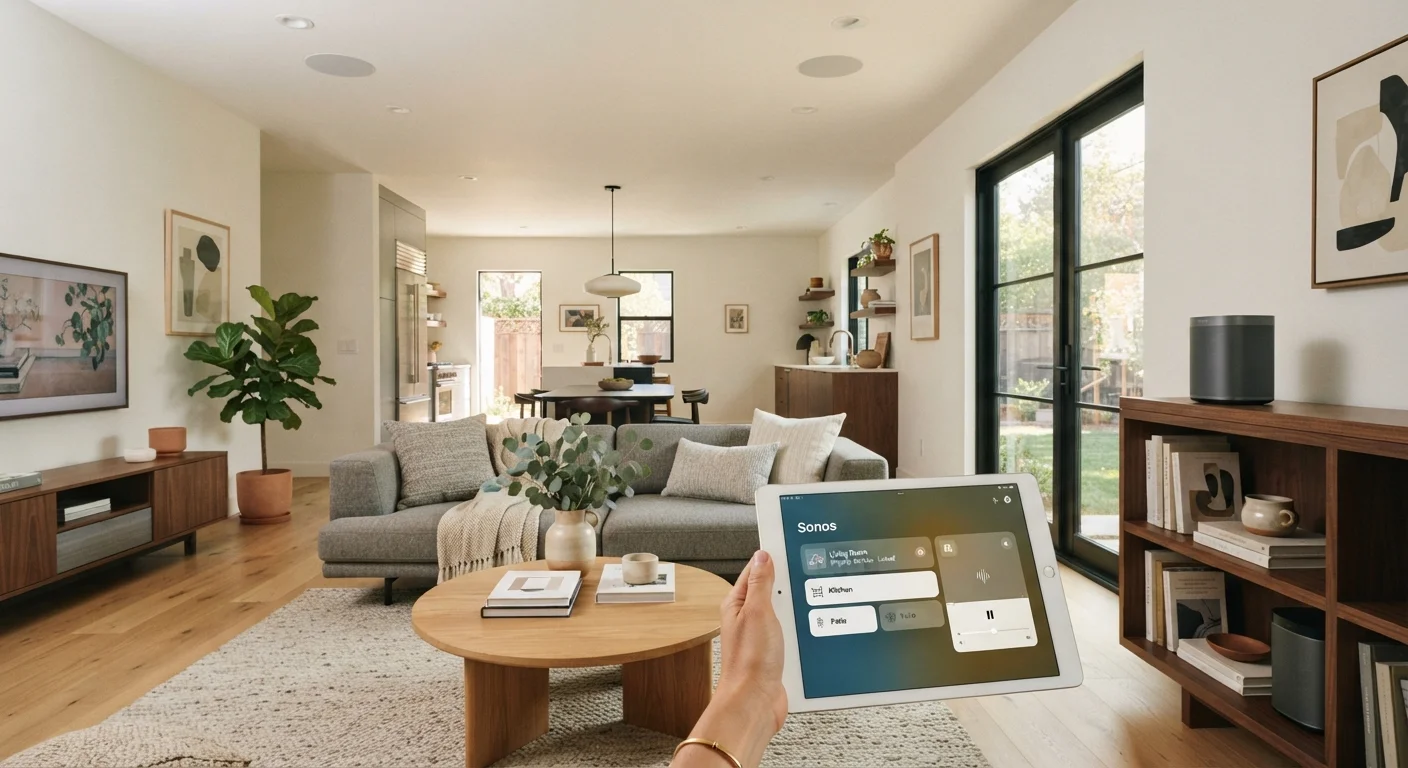
The Core Idea: Zones and Sources
A whole-home audio system is built around two fundamental concepts: sources and zones. A source is anything that produces audio — a streaming service, a turntable, a TV, or a network music player. A zone is any physical space in your home where you want sound to come out.
The system's job is to route the right source to the right zone at the right time. In a basic setup, you might have a single source (your phone's music library) playing the same playlist in the living room and kitchen simultaneously. In a more advanced setup, the kitchen might play a cooking podcast while the living room streams a vinyl record and the patio plays a radio station — all at once, all independently controlled.
This zone-based approach parallels how people organize other parts of their homes for specific functions. Just as zone-based organization helps you assign purpose to physical spaces for tidiness, audio zones assign audio roles to each room based on how it's used.
Wired vs. Wireless: How the Signal Gets There
The biggest structural decision in any whole-home audio system is how audio signals travel from the source to the speaker. The two approaches — wired and wireless — each have meaningful trade-offs.
Wired Systems
Traditional wired systems use speaker wire run through walls and ceilings to connect passive speakers to a central amplifier or receiver. The amplifier handles the heavy lifting: it receives audio input, amplifies it, and sends it to each zone through dedicated wire runs. Wired systems offer consistent, high-quality audio with zero latency and no dependence on Wi-Fi. The downside is installation complexity — running cable through finished walls usually requires a professional and involves planning around insulation, fire blocking, and structural elements.
Wireless Systems
Wireless multi-room systems eliminate the need for in-wall cable by transmitting audio over your home's Wi-Fi network (or sometimes a proprietary wireless protocol). Each speaker or zone player has its own amplifier and connects to your network independently. This makes setup significantly easier: you place speakers, connect them to Wi-Fi via an app, and assign them to zones.
The trade-off is network dependence. A wireless system performs only as well as your Wi-Fi allows. Dead zones, interference, and network congestion can all affect audio quality or cause dropouts. A solid mesh Wi-Fi foundation matters considerably here — see our guide on setting up a mesh Wi-Fi network for practical setup guidance.
~60%
US households with at least one wireless speaker
Consumer Electronics Association data consistently shows wireless speaker adoption as one of the fastest-growing home audio segments in the US.
4–8 zones
Typical zone count in a mid-range wired system
Most residential multi-zone amplifiers designed for average-sized homes support between four and eight independently controlled zones.
< 2ms
Synchronization lag in dedicated multi-room audio protocols
Purpose-built wireless audio platforms are engineered to keep speaker timing within milliseconds, eliminating the echo effect of misaligned playback.
The Central Controller: What Ties It Together
Whether wired or wireless, every multi-room system needs something to manage zone assignments, volume levels, and source routing. In wired systems, this is typically a multi-zone amplifier — a rack-mounted device with dedicated outputs for each zone and inputs for each audio source. You configure zones either through physical controls or, increasingly, a companion app.
In wireless systems, the "controller" is usually software: a mobile app connected to a dedicated hub device, or a cloud-based platform that coordinates all speakers on the network. Some systems use a proprietary hub; others are entirely app-and-speaker-based with no separate hardware.
Either way, the controller is where you group zones, set schedules, and integrate with other smart home tools. Many systems now connect to broader smart home ecosystems, allowing audio zones to be triggered by lighting scenes, motion sensors, or voice commands. For more on how these integrations work across platforms, see our explainer on smart home ecosystems.
“The promise of whole-home audio isn't just convenience — it's the ability to design a listening experience that matches how you actually live in your space, room by room.”
— Custom Electronics Design & Installation Association (CEDIA), Professional trade association for home technology integrators
Smart Speakers, Voice Control, and Privacy Considerations
Many Americans build multi-room audio incrementally, starting with one or two standalone smart speakers before expanding into a more deliberate system. Smart speakers can function as audio zones in supported ecosystems, and voice control adds a hands-free convenience layer — useful when your hands are full in the kitchen or you're across the house.
If you use voice assistants as part of your audio setup, understanding how they handle audio in shared living spaces is worth your time. Our article on voice assistants in multi-person households covers how these devices manage multiple users, preferences, and potential friction points.
Privacy is also a reasonable concern when microphone-equipped devices are distributed throughout your home. For a grounded look at what smart speakers actually do with audio data, see common myths about smart speakers and privacy.
Start With One Zone, Then Expand
You don't need to outfit every room at once. Most wireless multi-room platforms are designed to scale — you can start with a single zone in your most-used room and add speakers over time as your needs and budget allow. This approach also lets you evaluate sound quality and app usability before committing to a whole-home deployment.
Frequently Asked Questions
Wireless systems are generally DIY-friendly and require no in-wall wiring. Wired systems, which involve running speaker cable through walls and ceilings, typically benefit from professional installation to avoid structural and safety complications.
A zone is any defined area — a room, a floor, or an outdoor space — that can be controlled independently for volume and audio source. You can group zones together to play the same audio in sync, or keep them separate.
It depends on the platform. Some ecosystems allow standalone smart speakers to act as zones. Compatibility varies by brand and protocol, so checking whether your devices share a common platform or support a standard like Matter is important before purchasing.
Wireless systems use time-stamping and buffering techniques to align audio playback across multiple speakers. Protocols designed specifically for audio, such as those used by dedicated multi-room platforms, are engineered to minimize audible lag between rooms.
Streaming from services like Spotify or Apple Music requires an internet connection. However, many systems can still play locally stored audio or radio stations over your local network even if the internet is unavailable.
The content on this site is for informational purposes only and is not a substitute for professional advice. Always consult a qualified professional for guidance specific to your situation.