

Why Small-Space Organization Is Different
Organizing a small apartment is not simply a scaled-down version of organizing a larger home. The margin for error is narrower: one misplaced category of items, one piece of oversized furniture, or one absent habit can make a compact space feel genuinely unlivable. The standard advice - "just get more storage bins" - often makes things worse by adding visual bulk without solving the root problem.
Small-space organization requires thinking about capacity before containers. The sequence matters: decide what you own, then decide where it lives, and only then acquire the physical storage to hold it. Jumping straight to buying organizers is a common and expensive misstep.
It also means being honest about how your apartment actually functions day-to-day - where things land when you walk in the door, which surfaces collect clutter by default, and which areas feel most chaotic. That honest assessment is the foundation everything else is built on.
Start With a Honest Declutter
No organizational system can compensate for owning more than your space can comfortably hold. Before rearranging a single shelf, work through every category of belongings and make deliberate keep, donate, discard, or relocate decisions.
A useful framework: handle each category once rather than item by item. Group all clothing, then all kitchen items, then books, and so on. Seeing the full volume of a category in one place makes excess obvious in a way that drawer-by-drawer tidying never does.
The 'One Full Category at a Time' Rule
When decluttering, resist the urge to tidy room by room. Instead, gather every item in a single category - all shoes, all books, all cables - in one place before making decisions. Seeing the full volume at once makes it far easier to identify what's redundant or unused. This approach also prevents the same item from being reconsidered multiple times across different rooms.
For items you're unsure about, consider whether they serve a function you cannot replicate with something you already own. Duplicate tools, aspirational gear for hobbies you no longer pursue, and items kept out of obligation rather than use are prime candidates for removal in a small space.
If you share your apartment, navigating decluttering with a roommate or partner requires its own set of strategies - each person's belongings are ultimately their own decision.
Use Vertical Space Strategically
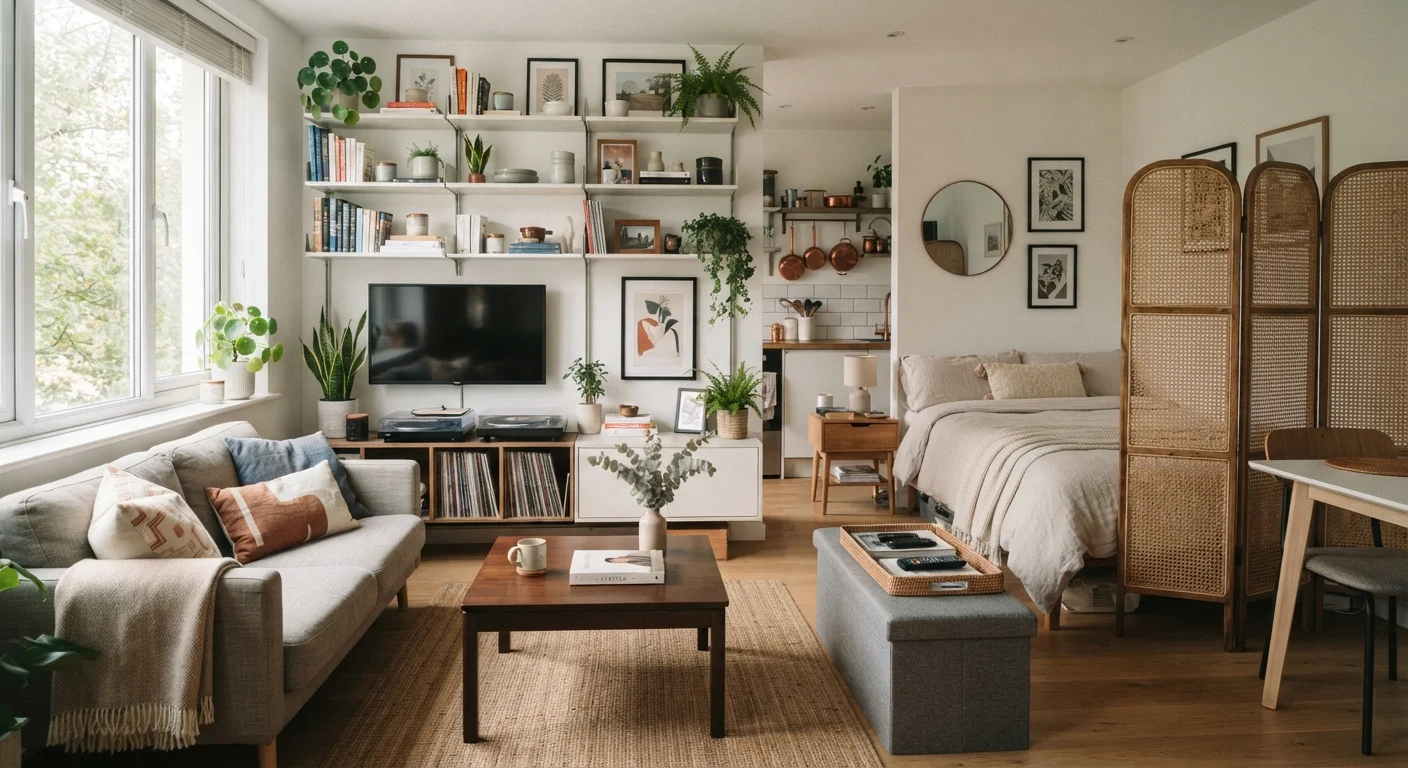
Floor space in a small apartment is finite, but wall space is frequently underused. Shelving mounted above desk height, hooks installed near entryways, and tall bookcases that reach toward the ceiling all extend usable storage into the vertical plane without consuming precious floor area.
~38%
Americans living in apartments
According to U.S. Census Bureau data, roughly 38% of American households live in renter-occupied units, many of which are compact apartments.
500 sq ft
Threshold where vertical storage outperforms horizontal
Organization specialists commonly note that in spaces under 500 square feet, wall-mounted vertical storage delivers more usable capacity per dollar than floor-based horizontal solutions.
Comparing vertical and horizontal storage approaches in detail shows that vertical solutions generally outperform horizontal ones in rooms under 500 square feet - but placement matters. Items used daily should remain accessible at eye level or below. Reserve higher shelves for seasonal or infrequently needed items.
Over-door organizers are another overlooked vertical option. Cabinet interiors, closet doors, and even the back of a bathroom door can hold surprising amounts when fitted with shallow pocketed organizers. These work particularly well for cleaning supplies, shoes, and accessories.
Mount your first shelf at or above 72 inches from the floor to preserve wall real estate below it for furniture. The space between the top of a bookcase and the ceiling is almost always wasted - add a second shelf there for seasonal or archival storage.
Most renters leave the upper 12-18 inches of wall space completely unused, which in an 8-foot-ceiling apartment represents significant storage potential.
Before buying any new storage product, spend one week tracking where clutter actually lands in your apartment. The spots with the most accumulation are where your system has a gap - solve the gap first, then buy the container.
Purchasing storage based on aesthetic appeal rather than observed behavior is the single most common reason small-space organization systems fail within weeks.
Choose Furniture That Earns Its Place
In a small apartment, every piece of furniture occupies a disproportionately large share of available space. The guiding principle is that each item should serve at least two purposes - ideally three.
- Storage ottomans provide seating, a footrest, and concealed storage for blankets, chargers, or off-season accessories.
- Beds with under-frame drawers or lift-up bases turn dead under-bed space into meaningful storage for clothing, linens, or luggage.
- Fold-down wall desks create a work surface when needed and disappear when not, freeing floor space for other uses.
- Nesting tables replace a single fixed coffee table with flexible surface area that stores compactly.
Resist the pull of large sectional sofas, oversized dining tables, or entertainment centers that dominate a room. Proportionate furniture maintains the breathing room that makes a small space feel livable rather than cramped. When in doubt, measure twice: know your room dimensions and the furniture's footprint before committing to any piece.
“The best small space is one where nothing is stored without a reason - and nothing is owned without a home. When those two conditions are met, the apartment almost organizes itself.”
— Sarah Susanka, Architect and author known for the 'Not So Big' design philosophy
Create Functional Zones Without Walls
Open-plan and studio apartments present a specific challenge: every function - sleeping, working, eating, relaxing - shares the same physical envelope. Without intentional zone definition, activities and the clutter associated with them bleed together.
Zone-based thinking assigns each area a primary function and limits what lives there to items that serve that function. A rug can anchor a seating area. A bookcase or open shelving unit can serve as a visual room divider between a sleeping zone and a living area. Consistent placement of category-specific items trains both the eye and the habit: work materials stay near the desk, kitchen items stay in the kitchen zone.
Zone-based organization applied across an entire home follows the same logic at larger scale - the principles transfer directly to studio layouts.
For seasonal items that rotate in and out of active use, a disciplined storage rotation keeps zones from accumulating off-season clutter. Rotating what's accessible throughout the year is one of the most effective ways to keep a small apartment feeling spacious regardless of season.
Habits That Keep a Small Space Organized
In a large home, clutter can accumulate in guest rooms or spare corners without immediately affecting daily life. In a small apartment, disorder is immediately visible and felt. This makes maintenance habits more critical - and more powerful - than in larger spaces.
Two habits have an outsized effect:
- The one-in, one-out rule: When a new item enters the apartment, an equivalent item leaves. This keeps total volume stable and prevents gradual accumulation over months and years.
- Daily reset (5-10 minutes): A brief end-of-day tidy - surfaces cleared, items returned to their zones, dishes handled - prevents small disorder from becoming overwhelming chaos. The smaller the space, the faster this routine goes.
Building these habits is more sustainable than relying on periodic deep-organization sessions. A system that requires a full weekend every few months to reset is a sign that daily habits need adjustment, not that you need more storage.
For anyone working within a tight household budget while building out an organization system, general budgeting fundamentals can help prioritize purchases like storage furniture over time rather than buying everything at once.
This article is for general informational and educational purposes only. Costs, results, and space configurations will vary depending on individual circumstances. Always consult a qualified professional for significant structural or renovation decisions in your home.
The content on this site is for informational purposes only and is not a substitute for professional advice. Always consult a qualified professional for guidance specific to your situation.