

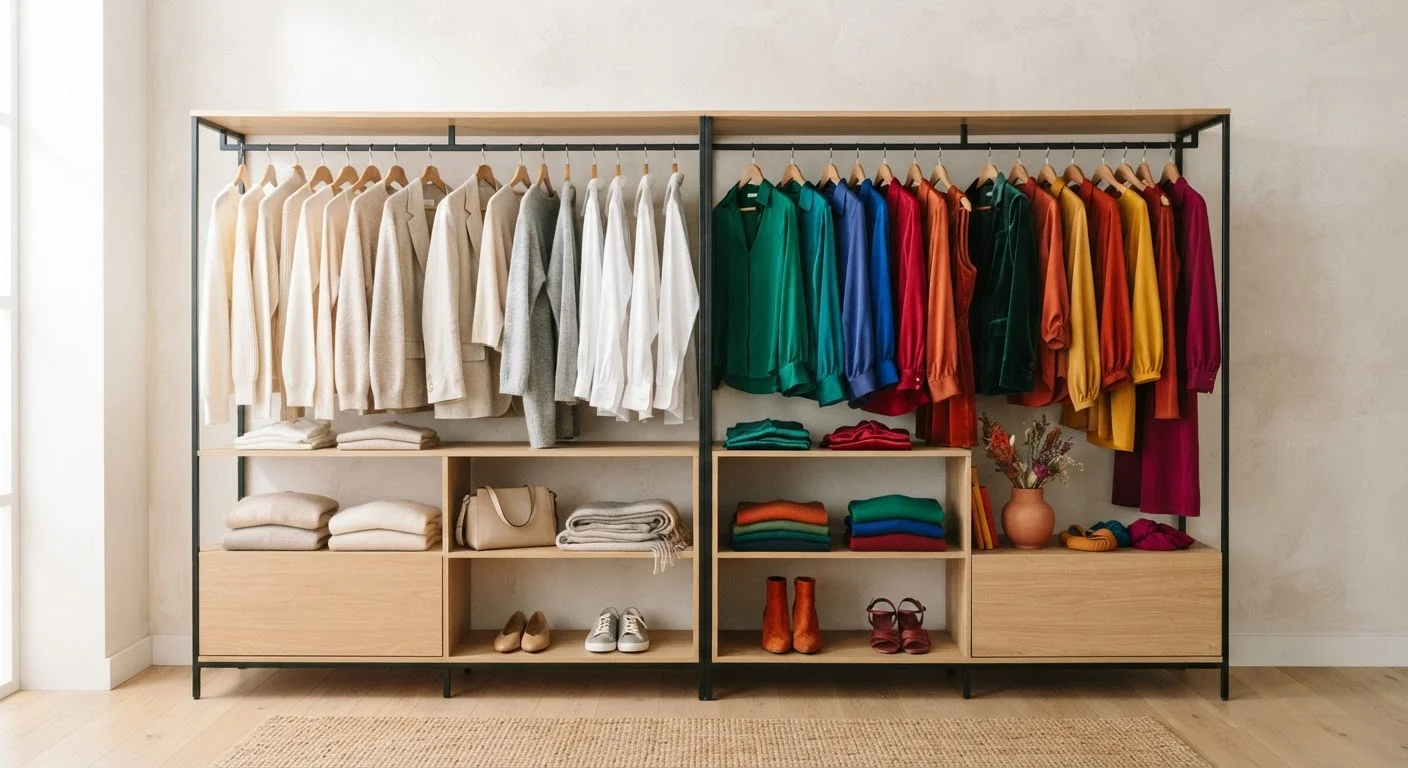
Option A
Neutral Wardrobe
The effortlessly cohesive, mix-and-match foundation.
Best for: Anyone who wants to get dressed quickly, reduce decision fatigue, and build a wardrobe where everything pairs easily.
Option B
Colorful Wardrobe
The expressive, mood-lifting, personality-forward approach.
Best for: People who use clothing as a form of self-expression and feel most themselves when their outfit reflects energy, creativity, or joy.
What Each Approach Actually Means in Practice
A neutral wardrobe is built primarily around colors without strong hue — think white, cream, grey, navy, camel, black, and taupe. These shades work together almost automatically, meaning you can grab items at random and rarely end up with a clash. That's the core appeal: low cognitive load, high compatibility.
A colorful wardrobe leans into saturated or varied hues — cobalt, sage, burnt orange, blush, forest green, mustard — as central elements rather than accents. Color becomes the design language of the closet. Done with intention, it's not chaotic; it's curated around a personal palette that reflects what genuinely lights you up.
It's worth noting that neither exists in a pure form for most people. Even the most committed minimalist in ivory and grey usually owns one burgundy sweater. The real question is which approach forms your foundation — and which supplements it. If you're just starting to build your closet with intention, our guide to building a wardrobe from scratch covers how color logic fits into the bigger picture.
The Real-World Tradeoffs: Versatility vs. Expression
Here's where the comparison gets practical. Neutrals win on raw interoperability — a beige trouser goes with virtually everything in a neutral closet, and that frictionless pairing ability means fewer pieces can do more work. This is particularly relevant if you're dressing for varied contexts (work meetings, casual weekends, evening plans) from a single closet. Color coordination still applies to a colorful wardrobe, but it requires more intention — knowing which of your shades actually work together, and building outfits with that in mind.
Color, on the other hand, offers something neutrals genuinely can't: mood signaling. Research in color psychology consistently suggests that the colors we wear can affect both our own emotional state and how others perceive us — though individual and cultural responses vary considerably. Wearing something that feels energizing or joyful isn't a superficial choice; it's a real psychological lever many people use daily.
| Criterion | Neutral Wardrobe | Colorful Wardrobe |
|---|---|---|
| Outfit combinations | High — pieces mix almost automatically | Moderate — requires intentional pairing |
| Daily decision effort | Low — minimal styling thought needed | Moderate — color coordination matters |
| Self-expression potential | Subtle, through texture and fit | High — color communicates personality directly |
| Mood impact | Calm and understated | Energizing and mood-responsive |
| Seasonal flexibility | Very smooth — no coordination reset needed | Requires more planning across seasons |
| Starting wardrobe cost efficiency | High — every piece pairs with existing items | Varies — depends on palette discipline |
| Trend sensitivity | Low — neutrals resist dating quickly | Higher — color trends shift seasonally |
Neither approach automatically saves you money or wastes it — that depends on how deliberately you shop. For a grounded look at the spending tradeoffs behind different style philosophies, classic vs. trend-driven buying digs into that question directly.
Closet Organization and Seasonal Transitions
Neutral wardrobes tend to store and rotate more cleanly. Because the palette is consistent, you can swap pieces in and out between seasons without worrying that the incoming items clash with what's already hanging there. If you've ever opened your closet in October and felt frustrated that nothing seems to go together, a neutral base often solves that without a single new purchase.
Colorful wardrobes can feel seasonally alive in a way neutrals sometimes don't — a vivid spring green or a warm persimmon can announce a season more powerfully than any beige. But they require slightly more organizational awareness: grouping by color family, understanding which pieces truly coordinate, and being honest when something beloved just doesn't play well with the rest. For practical help rotating your closet without the annual panic, see our piece on transitioning your wardrobe between seasons.
66%
People who say color affects their mood when dressing
A survey by the Color Association of the United States found a majority of respondents reported that the colors they wear influence how they feel throughout the day.
~30%
Clothes in an average closet rarely or never worn
Consumer research from ClosetMaid found roughly 30% of clothing in typical American households goes unworn for extended periods, often due to poor coordination with the rest of the wardrobe.
How to Decide What Actually Fits Your Life
The most useful question isn't "which is better?" — it's "which one matches how I actually get dressed?" If you're someone who makes outfit decisions at 7 a.m. while half-awake, a neutral foundation will genuinely reduce daily friction. If getting dressed is one of the moments in your day where you feel most yourself, a colorful closet gives that moment real substance.
It also helps to be honest about your actual daily life versus the life you imagine dressing for. A wardrobe full of bold statement pieces might feel exciting at the store but stressful if your real schedule is a mix of video calls, school pickup, and errands. Our article on dressing for your actual daily life is built exactly for that kind of honest inventory.
A practical middle path: build your closet's core — bottoms, layering pieces, outerwear — in neutrals, and let color live in your tops, accessories, and one or two seasonal statement pieces. This gives you the versatility of a neutral foundation with enough color to feel expressive. If the capsule wardrobe concept appeals to you, what a capsule wardrobe actually means explains how this logic plays out in a smaller, more intentional collection.
Color Palette Doesn't Mean Unlimited Color
A colorful wardrobe doesn't have to mean every hue under the sun — it means building around a personal palette of colors that genuinely work for your skin tone, preferences, and lifestyle. Many people find that committing to four to six complementary colors gives the expressiveness of a colorful closet with most of the coordination ease of a neutral one. Think of it as curating your own signature palette rather than defaulting to whatever's on the rack.
The content on this site is for informational purposes only and is not a substitute for professional advice. Always consult a qualified professional for guidance specific to your situation.