

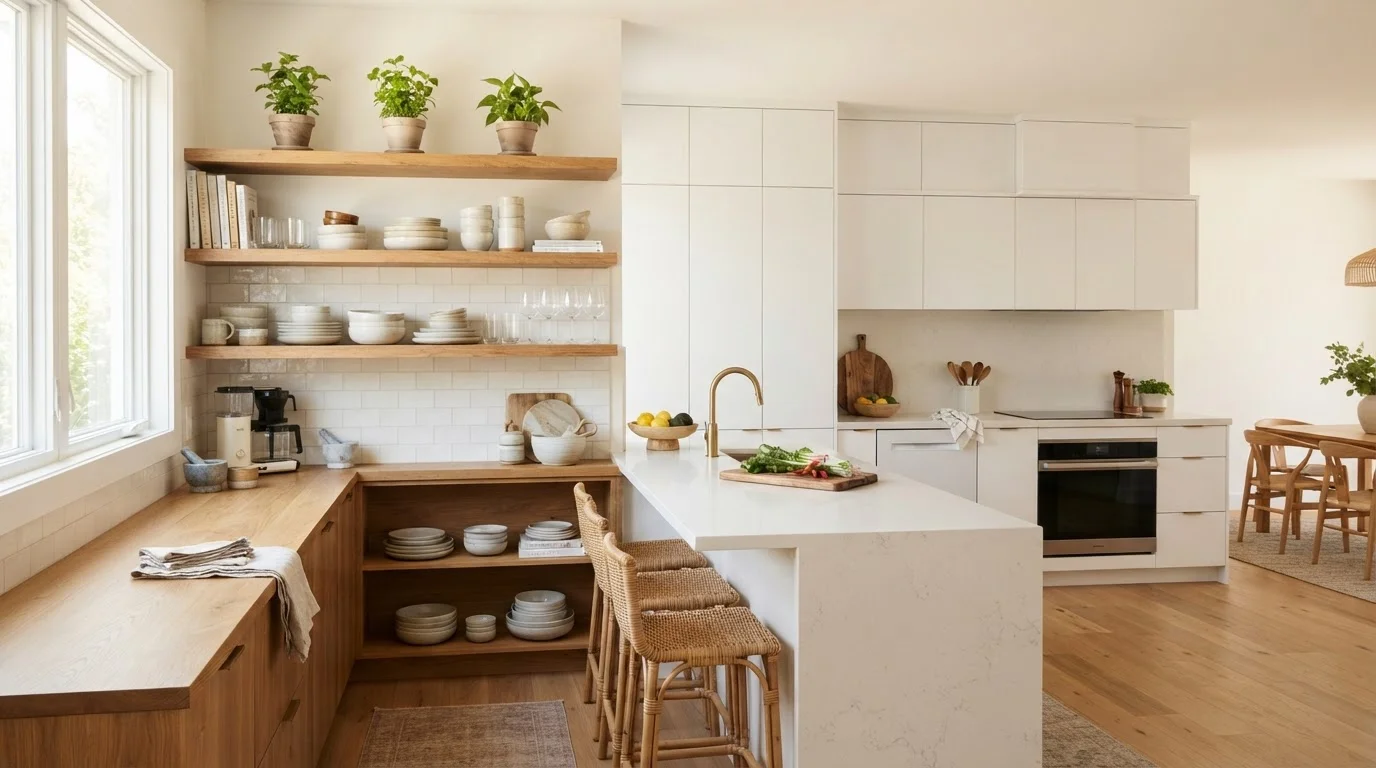
Option A
Open Shelving
The visually airy, display-forward choice.
Best for: Homeowners who keep a tidy kitchen and want an open, accessible layout that doubles as décor.
Option B
Closed Cabinets
The practical, clutter-concealing standard.
Best for: Households that prioritize concealed storage, less frequent cleaning, and a streamlined visual appearance.
What Each Storage Style Actually Offers
The debate between open shelving and closed cabinets is really a question about how you live in your kitchen - not just how you want it to look. Both approaches have real functional trade-offs that become apparent only after daily use.
Open shelving removes upper cabinet doors entirely, leaving your dishes, glasses, and pantry items visible and within easy reach. This creates a sense of openness, particularly valuable in smaller kitchens where closed upper cabinets can feel like walls closing in. For ideas on making limited space work harder, see our small-space organization guide.
Closed cabinets do the opposite: they enclose storage behind doors, concealing everyday disorder and protecting contents from kitchen grease, steam, and dust. They are the dominant choice in American kitchens for practical reasons - they require far less curation and maintenance to look presentable.
| Criterion | Open Shelving | Closed Cabinets |
|---|---|---|
| Visual effect | Airy, open, spacious feel | Tidy, uniform, enclosed look |
| Maintenance frequency | High - regular dusting and wiping | Low - periodic interior deep-clean |
| Dust and grease protection | Minimal - items fully exposed | Strong - contents enclosed behind doors |
| Curation required | Yes - visible items must look cohesive | No - interior organization is hidden |
| Accessibility | Immediate - no doors to open | Standard - requires opening a door |
| Best kitchen size | Works well in smaller kitchens | Works in any kitchen size |
| Flexibility for mixed households | Lower - visible mess is always visible | Higher - clutter hidden behind doors |
The Real Cost of Open Shelves: Maintenance and Curation
Open shelving looks inviting in design magazines, but the version you see there is deliberately staged. In a working kitchen, the maintenance burden is significant and often underestimated.
Items stored on open shelves collect dust and grease film continuously. In an active cooking household, a thorough wipe-down of both the shelves and every item on them may be needed weekly. Dishes at the back of a shelf can accumulate grime between uses. This is a manageable commitment for some homeowners - and genuinely unworkable for others.
Curation is the other hidden demand. Open shelving only looks good when what's displayed is visually cohesive: matching or complementary dishes, consistent colors, items stored at intentional heights. A mismatched collection of random mugs and cereal boxes will make an open-shelf kitchen feel chaotic rather than calm. If your household has multiple people with different organizational standards, reaching agreement on what stays visible can become a source of friction. Our guide on organizing shared spaces explores how to navigate those conversations.
~67%
Of U.S. kitchens use predominantly closed cabinetry
National Association of Home Builders survey data consistently shows closed cabinetry as the dominant kitchen storage choice in American homes.
2-3x
Faster dust accumulation on open shelves vs. closed
Interior design professionals commonly note that open shelves in active kitchens require cleaning roughly two to three times more often than enclosed cabinet interiors.
When Closed Cabinets Are the Smarter Long-Term Choice
Closed cabinets remain the practical standard for good reason. They hide visual clutter behind a door, protect contents from airborne grease and cooking steam, and require no particular curation. You can store mismatched items, half-used packages, and everyday clutter without it affecting how your kitchen looks at a glance.
From a maintenance perspective, the interior of a closed cabinet stays relatively clean between deep-cleans. The exterior doors may need occasional wiping - particularly around handles - but that's far less labor than maintaining open shelves in an active kitchen.
Closed cabinets also provide better long-term storage flexibility. You can reorganize the interior, add shelf liners, or rotate seasonal items without adjusting what's visible. For households that rotate pantry goods or specialty equipment seasonally, this flexibility is meaningful. Our seasonal organization guide covers how to rotate kitchen and household items effectively through the year.
A Hybrid Approach: Getting the Best of Both
Most kitchens don't require an all-or-nothing decision. A hybrid layout - where open shelves occupy one section of the kitchen and closed cabinets handle everyday storage elsewhere - lets you enjoy visual openness without the full maintenance commitment.
Common hybrid configurations include open shelving on a single accent wall or between windows, with closed cabinetry handling lower storage and the bulk of upper storage. Another approach is to use glass-front cabinet doors: they provide the visual depth of open display while still protecting contents from dust and grease.
When planning any structural changes to your kitchen layout - including removing upper cabinets to install shelving - it's worth understanding what's behind those walls. Our article on open-plan renovations and wall removal explains when to involve a licensed professional. Similarly, if you're thinking through vertical versus horizontal storage strategies, those principles apply directly to how you configure shelf height and depth in a hybrid kitchen setup.
Installation and Permit Considerations
Removing existing upper cabinets to install open shelving generally requires wall anchoring into studs and may involve patching or repainting walls. While this is often a DIY-feasible project, the scope depends on your wall material, plumbing, and electrical layout. Always check local building codes before making structural or electrical changes, and consult a licensed contractor when in doubt about what's safe to remove.
The content on this site is for informational purposes only and is not a substitute for professional advice. Always consult a qualified professional for guidance specific to your situation.